
Executive Summary Most importers think of the ocean decision as a binary choice: FCL (full container load) or LCL (less-than-container load). But there is a third option that can beat both in some circumstances—and it sits in plain sight at the destination port. CFS transloading works by consolidating multiple suppliers’ goods into one full container at origin, sailing it as a single FCL, then deconsolidating and transloading at a destination Container Freight Station (CFS) into domestic trucks, rail, or multiple final destinations. The economics depend heavily on lane rates: published forwarder guides place the point where a dedicated container becomes cheaper than LCL anywhere from roughly 12–15 CBM to 23–29 CBM, depending on the lane and the rates assumed. One sourcing agent’s worked example with three suppliers and 18 CBM shows one FCL plus destination CFS transloading costing $2,430 versus $2,700 for three separate LCLs—about $270 cheaper—with the added benefit of pre-palletized freight arriving to FBA specification; under different rate assumptions, the same comparison can reverse. Savings percentages circulating in vendor material (for example, 25–35% lower logistics spend) are not supported here by a verifiable methodology, and this analysis does not rely on them. Transloading is not free, and it is not automatic. It depends on the facility’s customs status, the shipper’s documentation discipline, and a comparison of CFS fees against the LCL premium on the specific lane. This analysis examines the mechanics, an illustrative comparison, and the discipline that separates transloading that saves money from transloading that creates new problems.
CFS Transloading: The Quiet Cost Advantage Hiding in Your Inbound Supply Chain
1 · The Binary That Isn’t
FCL vs. LCL: The Framing Most Importers Use
The conventional import decision is framed as a trade-off:
| Model | What You Buy | What You Pay For |
|---|---|---|
| FCL | An entire container | The whole box, whether you fill it or not |
| LCL | Space in a shared container | Only your cubic meters—plus consolidation and deconsolidation fees |
For a small shipment, LCL is generally cheaper than paying for an entire container. For a large shipment, FCL is generally cheaper per CBM. The intuition is sound as far as it goes—but it leaves out a third structure that can change the math.
The Third Option
CFS transloading combines the two models rather than choosing between them:
- Consolidate at origin — multiple suppliers’ goods are gathered and stuffed into one FCL at a Chinese CFS or factory
- Sail as FCL — the full container moves on a single ocean bill of lading
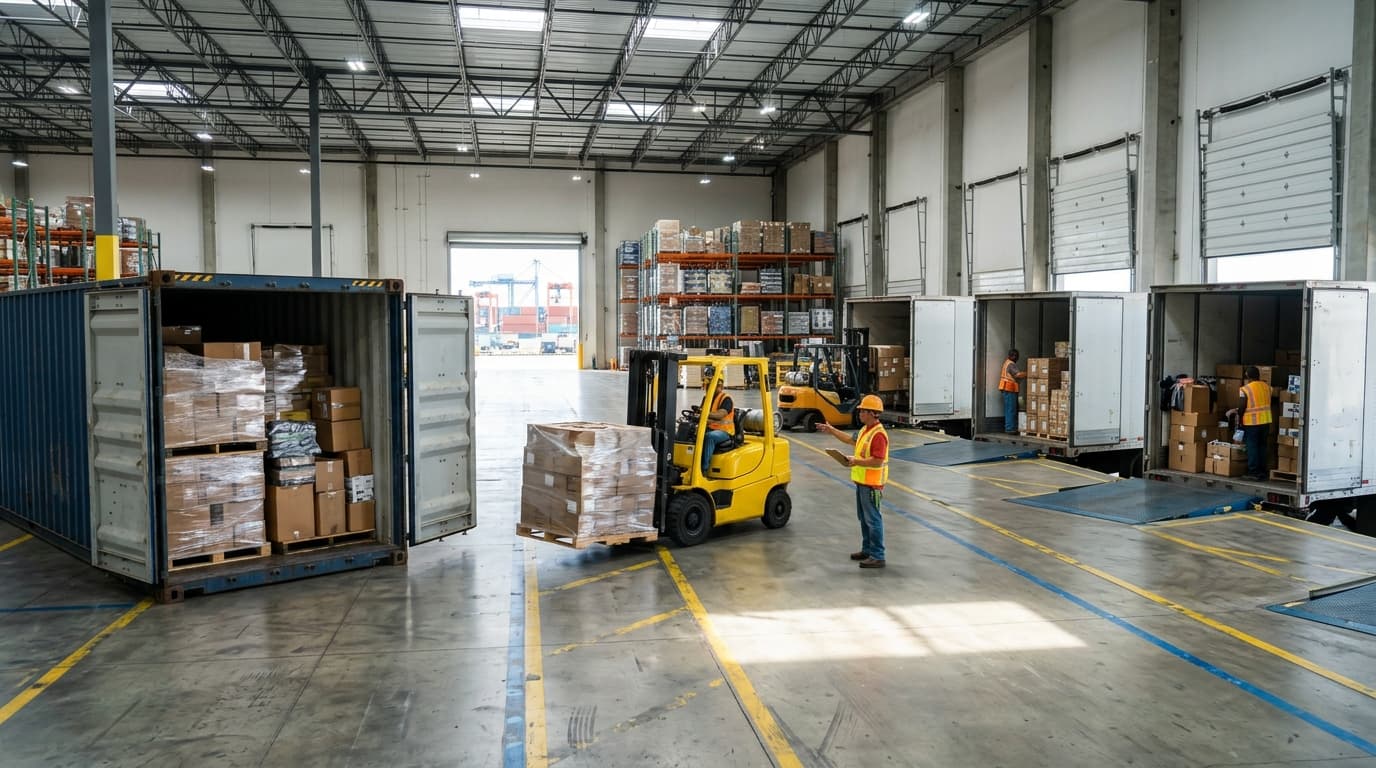
- Deconsolidate at destination — at a destination CFS, the container is opened and sorted by final destination
- Transload — cargo is palletized, re-labeled, and transferred to trucks or rail
- Final mile — goods reach warehouses, 3PLs, or FBA centers as clean, carrier-ready pallets
Source: a sourcing-agent publication (vendor material; indicative only)
The key distinction is definitional: a CFS is the physical node; transloading is the activity. Together they let an importer buy a full container’s economics while shipping to multiple final destinations.
⚠️ Critical Takeaway: The FCL/LCL binary assumes one shipment has one destination. CFS transloading relaxes that assumption—which is why it can be competitive for multi-supplier, multi-destination importers.
2 · The Math: Where the Crossover Sits
The 15 CBM Threshold
There is no single crossover volume. Published 2026 forwarder guides put the LCL-versus-dedicated-container breakeven at roughly 12–15 CBM in some guides and 23–29 CBM in others (the latter for Asia–U.S. lanes at higher container rates). A sourcing-agent guide cites roughly 15 CBM across two or more suppliers as the point where consolidated FCL plus destination transload begins to compete with piecemeal LCL. Below the relevant threshold, LCL is usually cheaper; above it—especially when volume is fragmented across suppliers—consolidated FCL plus destination transload can win. The threshold reflects the fee structure:
| Cost Component | LCL Model | FCL + CFS Transload |
|---|---|---|
| Ocean freight | Per-CBM rate (higher $/CBM) | Per-container rate (lower $/CBM) |
| Origin consolidation | Included in LCL rate | Paid at origin CFS or factory |
| Destination CFS handling | Per-CBM deconsolidation fee | Flat or per-container transload fee |
| Delivery | Per-shipment delivery charges | Consolidated truck/rail dispatch |
| Timing | Often several days slower because of consolidation and deconsolidation handling | Potentially faster—container moves as a unit, then splits at destination |
Sources: published 2026 forwarder and sourcing-agent guides; vendor publications, indicative only
The Worked Example: 3 Suppliers, 1 Destination
A U.S. seller buys from three factories in Yiwu and Guangzhou, totaling 18 CBM, shipping to a Los Angeles 3PL and then to two FBA centers. The comparison:
| Option | Cost | Transit |
|---|---|---|
| Three separate LCLs | $2,700 + 3 deliveries | 38–45 days |
| One FCL + LA CFS transload | $1,950 ocean + $480 CFS = $2,430 | 34–40 days |
Illustrative example from a sourcing-agent publication; container size, date, and rate basis are not specified
On those figures the FCL-plus-transload saves ~$270 and arrives 4–5 days faster. It also delivers the goods pre-palletized to FBA specification, so the 3PL receives clean freight rather than loose cartons requiring rework.
The result is sensitive to the rates assumed. Another 2026 forwarder guide lists Shanghai–Los Angeles at about $120 per CBM for LCL and $3,200 for a 20-foot container, with a breakeven near 27 CBM. At those rates, 18 CBM would cost roughly $2,160 as LCL against $3,200 plus destination handling as FCL, reversing the comparison. The example is best read as a template for modeling, not as a benchmark.
Published Fee Ranges
Published 2026 forwarder guides commonly cite CFS charges of roughly $15–$40 per CBM at each end of an LCL move, with some Asia–U.S. lane figures higher, and describe all-in LCL costs as running roughly 30–50% above the base ocean rate once CFS fees, documentation, and surcharges are included. These are vendor-published ranges, not regulated or benchmarked rates.
Figures such as “25–35% lower logistics spend” or “20–30% lower inland transport costs” appear in vendor marketing, but no underlying data or methodology was identified for them, so they are not relied on here.
⚠️ Critical Takeaway: The crossover is not a fixed number—it depends on the CFS fee schedule, the LCL rate premium on that lane, container rates, and the number of destinations. Any single CBM figure is a starting point for modeling, not a universal rule.
3 · The Four Costs Transloading Actually Reduces
Cost 1: Container Detention and Demurrage
The default inland move—delivering the sealed ocean container directly to the consignee—keeps the container in the supply chain for the entire inland leg. That means:
- The container sits at the consignee’s dock while it is unloaded
- The chassis is tied up
- The empty return trip happens after the consignee is done
Transloading can return the ocean container to the port sooner, because the freight continues in domestic equipment and the empty container goes back after unloading at the transload facility. Free time and charges are set by the carrier’s or terminal’s tariff and vary, so the effect depends on how quickly the container is picked up, unloaded, and returned.
| Risk | Direct Container Move | CFS Transload |
|---|---|---|
| Detention exposure | Until consignee unloads and returns | Ends when the empty is returned after unloading at the transload facility |
| Demurrage exposure | If terminal pickup delayed | May be reduced if pickup is prompt |
| Chassis utilization | Tied up for full inland leg | Released after transload |
Sources: industry publications — vendor sources, directional only
Cost 2: Inland Truck Moves
A 40-foot ocean container carries roughly 67 CBM. A 53-foot domestic trailer carries roughly 110 CBM of palletized freight—but the comparison is not about cubic capacity alone. The relevant question is how many trucks are needed to move the same freight inland.
One freight forwarder describes a case in which the contents of three 40-foot containers fit into two 53-foot dry vans, and reports that ocean freight plus transloading cost less than regular FCL to inland cities because the inland leg was cheaper. A volume ratio of roughly 3:2 is consistent with the capacities above, but road weight limits can bind first for dense freight, and results depend on the lane.
Source: forwarder publication (vendor material; indicative only)
Cost 3: Split-Destination Penalties
The most underappreciated saving is avoiding the penalty for fragmentation. When one shipment serves three warehouses or FBA regions, the default options are:
- Three separate LCL shipments — each paying its own ocean premium and destination charges
- One FCL delivered to one location, then re-shipped — paying inland freight twice for the portion that moves again
CFS transloading splits the container at the destination—after the ocean leg, before the inland leg. Each destination gets its own truck or rail dispatch, and no freight travels inland twice.
Cost 4: Handling and Damage
Transloading at a CFS introduces one more handling event. That is a cost. But it also introduces controlled handling—palletization, stretch-wrapping, labeling, and inspection in a facility designed for it. For FBA-bound freight, the alternative is often loose cartons arriving at a 3PL that must be reworked before Amazon will accept them. The CFS fee may replace that rework cost rather than adding to it.
⚠️ Critical Takeaway: Transloading does not eliminate handling—it relocates it. The savings come from where the handling happens and what equipment carries the freight afterward, not from doing less work.
4 · The Discipline: What Separates Good Transloading from Bad
The Documentation Requirement
CFS transactions are touchpoints where mistakes compound. The most common shipper-side failures are well documented:
| Mistake | Consequence |
|---|---|
| Inaccurate weights and dimensions | Reweighs, recalculated freight, potential fines |
| Poor packaging | Damage during consolidation and deconsolidation |
| Missing or incorrect documentation | Customs holds; clearance delays |
| No pre-alert to the CFS | Poor space planning; increased dwell time |
| Incorrect labeling | Misrouting; delayed final delivery |
Source: industry best-practice publications (vendor material; directional only)
The Pre-Alert Discipline
The single highest-leverage operational habit is the pre-alert. Sending advance notice to the destination CFS with arrival windows, commercial invoices, packing lists, and correct HS codes allows the facility to schedule labor and space efficiently. Without it, the container arrives and waits—which is exactly the outcome transloading is supposed to prevent.
The Customs Status Question
Not all facilities that transload cargo have the same customs status. In U.S. customs regulation, a container station (commonly called a CFS) is a facility approved under 19 CFR 19.40–19.49. Under 19 CFR 19.41, containerized cargo may be moved from the place of unlading to a designated container station, or received there from a bonded carrier after in-bond transportation, before an entry is filed, for the purpose of breaking bulk and redelivery. A transload warehouse that handles cargo only after it has been entered and released operates outside that framework and need not be bonded.
For importers using transloading as part of an inspection or entry-timing strategy, the facility’s customs status determines what can happen to the cargo and when. The same applies to the movement itself: cargo moving from the port to a container station before entry travels in-bond, and the bonded carrier remains liable under its bond until the container station operator receipts for the cargo (19 CFR 19.42). Importers typically confirm with their broker how each move is documented, because the paperwork determines whether the goods are in bond or have been entered and released. (In this context “in-bond movement” is a customs control procedure and is unrelated to the country-of-origin concept of transshipment.)
⚠️ Critical Takeaway: A CFS operating under customs authorization is a different product from a warehouse with a loading dock. The customs status of the facility, and of the cargo when it arrives, is part of the model rather than a detail.
5 · When Transloading Does Not Pay
The Four Conditions Where Direct Container Wins
Transloading is not universally superior. Industry sources identify several recurring exceptions:
| Condition | Why Direct Container Wins |
|---|---|
| Heavy, dense freight | The container is weight-limited, not cube-limited; splitting adds handling without saving inland space |
| Single destination | No split to capture; the transload fee buys nothing |
| Fragile cargo | Every handling event adds damage risk; the fewest touches win |
| Very low volume | Below the lane-specific breakeven (cited anywhere from ~12 to ~29 CBM), the CFS fee may exceed the LCL premium |
Source: industry publications (vendor material; directional only)
The general principle: transloading tends to pay when the freight is light for its size, headed to multiple destinations, or requires domestic-format preparation. It tends not to pay when the freight is heavy, the destination is singular, or the volume is too low to justify the destination fee.
The Modeling Discipline
The CFS fee is not the only variable. A complete comparison typically includes:
- Ocean freight delta (FCL rate vs. LCL rate × CBM)
- Origin consolidation cost
- Destination CFS handling and storage
- Inland transport (per-truck cost × number of trucks vs. per-shipment delivery)
- Detention and demurrage risk (probability × daily rate)
- Rework cost avoided (FBA palletization, labeling)
A comparison limited to the ocean rate can point in the wrong direction on some lanes, in either direction.
⚠️ Critical Takeaway: The question is not “is transloading cheaper?” It is “is this specific shipment, on this lane, with this destination profile, cheaper transloaded?” The answer changes by shipment.
6 · The Strategic Frame: Buying Container Economics Without Buying a Container
The Core Insight
CFS transloading is not new, but several 2026 conditions bear on how it compares with alternatives:
- De minimis is suspended, so even low-value shipments now require an entry, and each separate LCL shipment is a separate entry with its own documentation
- Tariff stacking raises the cost of getting classification and valuation wrong, which may favor models where documentation for a shipment is handled in one place
- Periodic port congestion and detention exposure can make container turnaround time a cost driver, not just a convenience
- FBA and retail routing requirements often call for pallet-level preparation
In that environment, an importer that can consolidate at origin, deconsolidate at destination, and inject prepared pallets into the domestic network has another option to weigh against piecemeal LCL or delivering sealed containers inland.
Where Transloading Sits in Provider Offerings
For logistics providers, the CFS is the point in the supply chain where ocean and domestic execution meet. Some forwarders and 3PLs operate or work closely with CFS and transload facilities, which allows the unit of shipment to change at the port—for example, converting a 40-foot ocean container into the domestic configuration the consignee needs. How that capability is priced varies, and it may not appear as a separate line on a rate quote; its effect shows up in total landed cost and transit time.
⚠️ Critical Takeaway: CFS transloading offers a way to combine container economics with multi-destination flexibility. Whether that is a net saving depends on the lane, the fees, and the shipment profile.
7 · Conclusion: The Option Between the Options
The FCL-versus-LCL framing is not wrong. It is incomplete. For importers with fragmented suppliers, multiple destinations, or FBA-bound freight, the third option—consolidate at origin, transload at destination—can deliver lower total landed cost and shorter transit in some circumstances.
Key Takeaways
| Factor | Detail |
|---|---|
| Crossover Point | Varies by lane: cited from ~12–15 CBM to ~23–29 CBM; ~15 CBM cited for multi-supplier consolidation by one sourcing agent |
| Illustrative Example (18 CBM, 3 suppliers) | $2,430 (FCL + CFS) vs. $2,700 (3 LCLs) on one source’s rates; reverses at other published rates |
| Published CFS Fees | ~$15–$40/CBM per end (forwarder guides; indicative) |
| Savings Claims in Vendor Material | 20–35% figures not supported by an identified methodology; not relied on |
| Container Detention | Container can return sooner; effect depends on pickup, unloading, and tariff terms |
| Customs Framework | Container stations: 19 CFR 19.40–19.49 (19.41: cargo may move there before entry) |
| When It Tends Not to Pay | Heavy/dense freight, single destination, fragile cargo, low volume |
| Operational Habit | Pre-alert the CFS with documents and arrival windows |
The Bottom Line
For importers, the ocean decision is not strictly a binary. Modeling the third option—and building the documentation discipline to execute it—lets an importer compare it against LCL and direct container delivery on the specific lane and shipment profile.
The message is clear: CFS transloading is a model that requires modeling. Whether it beats LCL or direct container delivery depends on the lane, the fees, and the shipment profile.
This analysis reflects CFS transloading economics and operational practices as of October 2026, the container station provisions of 19 CFR 19.40–19.49, and cost comparisons from vendor and forwarder publications, which are indicative and not independently verified. Specific crossover points, CFS fees, and savings figures vary by lane, volume, and facility. Importers should model their own shipment profiles against current rate quotes and confirm customs status and documentation requirements with their broker.