Executive Summary
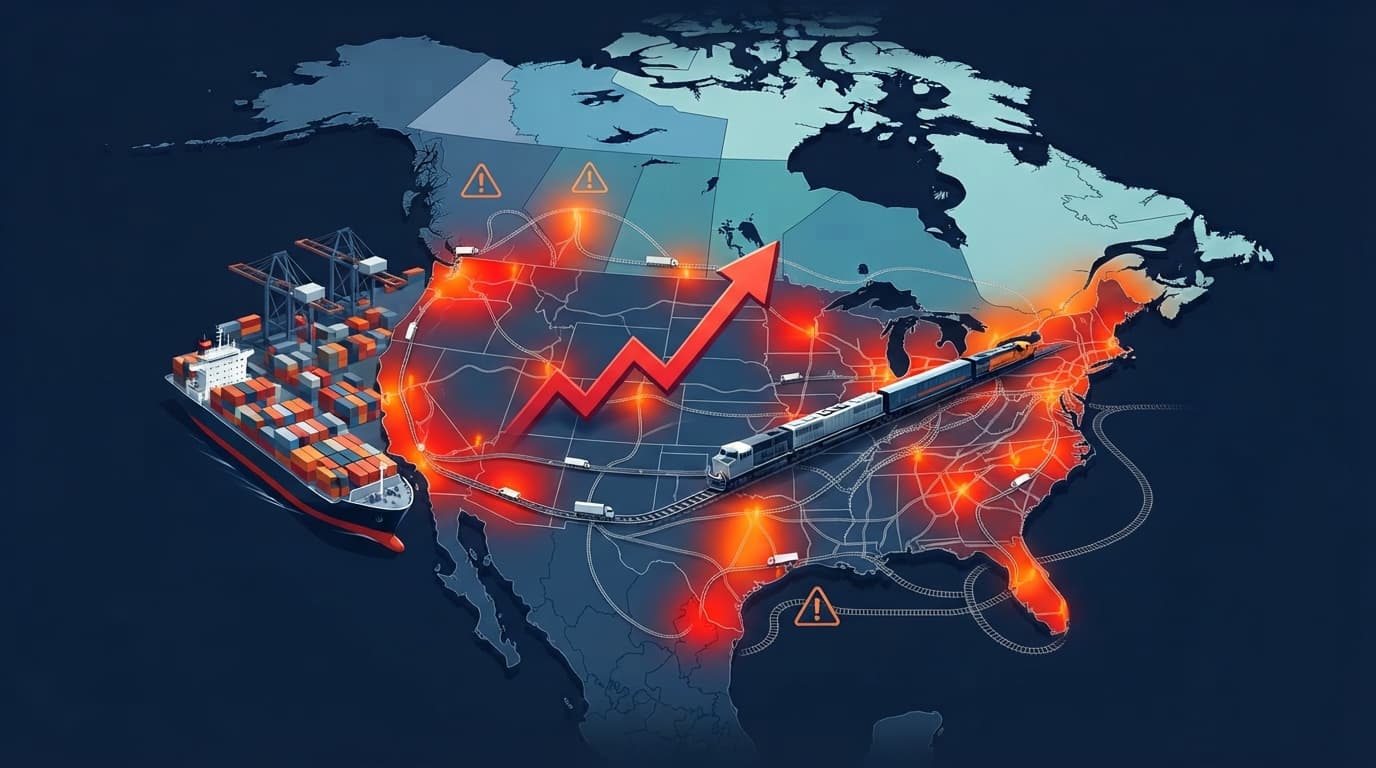
Cross-border truck capacity on both U.S.-Canada and U.S.-Mexico freight lanes remains scarce heading into the latter half of August 2026, even as seasonal volumes ease somewhat from their summer peak. Recent index readings have scored both corridors above the neutral threshold for a second consecutive month, signaling continued elevated costs, limited available capacity, and mounting regulatory challenges across both borders. That said, conditions across the two corridors appear to be diverging in meaningful ways. Mexico routes continue facing tight capacity, border delays, and firm pricing as exports grow, driven by sustained nearshoring investment and structural capacity constraints including a substantial estimated driver shortage. Canada remains comparatively softer amid muted demand and ongoing USMCA uncertainty, though it continues to present more difficult conditions than Mexico when it comes to actually securing available truck capacity. This analysis examines the underlying data, the structural forces shaping each corridor, and strategic considerations for shippers navigating tight cross-border freight markets.
Cross-Border Truck Capacity Remains Tight: Understanding the U.S.-Canada and U.S.-Mexico Lanes
(跨境卡车运力持续紧张:美加与美墨货运通道现状解读)
1 · A Window into Cross-Border Conditions
What the Index Measures
A leading third-party logistics provider launched a monthly cross-border freight index in June 2026 specifically designed to help shippers evaluate freight conditions between the U.S. and Canada and separately between the U.S. and Mexico. The index combines more than a dozen economic, freight, and trade indicators into a single composite score for each corridor. Readings above the neutral 50-point threshold signal tighter-than-normal conditions, higher costs, reduced capacity, and greater regulatory challenges, while readings below 50 generally indicate looser, more favorable conditions for shippers.
Recent Readings: Both Corridors Above Neutral
The most recent index readings scored the U.S.-Canada corridor at 57 and the U.S.-Mexico corridor at 54—both above the 50-point neutral threshold for a second consecutive month. This signals that cross-border freight conditions remain tighter than normal on both corridors, even as seasonal volumes have begun easing somewhat.
Key indicator breakdown:
| Component | Reading | Implication |
|---|---|---|
| Capacity | Elevated | Primary driver of tight conditions; truck availability remains limited |
| Costs | Moderate | Elevated but leveling off; lower fuel prices have provided some relief |
| Demand | Steady | Consistent volumes without significant growth or decline |
| Policy Pressure | Rising | Increased from prior month but below earlier 2026 levels |
Commercial intelligence analysts tracking the index have observed that what stands out most in the current reading is capacity staying tight even as volumes ease from a summer peak—a pattern that suggests structural rather than purely seasonal pressures.
2 · The Mexico Corridor: Nearshoring-Driven Demand Outpaces Capacity
A Structural Divergence
Market reports throughout the summer have pointed to a fairly clear divergence across North America. While Canada-related lanes have generally softened somewhat, Mexico-U.S. corridors continue experiencing tighter capacity, longer border delays, and firmer pricing overall, supported by sustained growth in Mexican export activity.
Mexican export growth has been remarkable. Mexican exports to the United States increased substantially year-over-year in recent months—the fastest pace recorded in several years—with imports also rising notably. Manufacturing exports have led this expansion, with non-automotive segments, particularly electrical and electronic equipment, emerging as the primary growth driver behind this broader trend.
Nearshoring as a Structural Driver
The relocation of manufacturing to Mexico, particularly across the automotive, electronics, and aerospace sectors, continues generating sustained freight flows from major industrial hubs including Nuevo Leon, Baja California, Chihuahua, Jalisco, Queretaro, Leon, and Guanajuato. These investments reflect long-term supply chain decisions rather than short-term economic cycles, suggesting that pressure on cross-border transportation capacity is unlikely to ease quickly.
As one recent industry analysis concluded, rather than reflecting a temporary seasonal spike, current conditions appear to reflect the combined impact of several structural factors—export growth, nearshoring investment, an aging trucking fleet, rising operating costs, and tighter regulatory enforcement—all continuing to reshape the balance between freight demand and available capacity along this corridor.
Capacity Constraints: A Convergence of Structural Factors
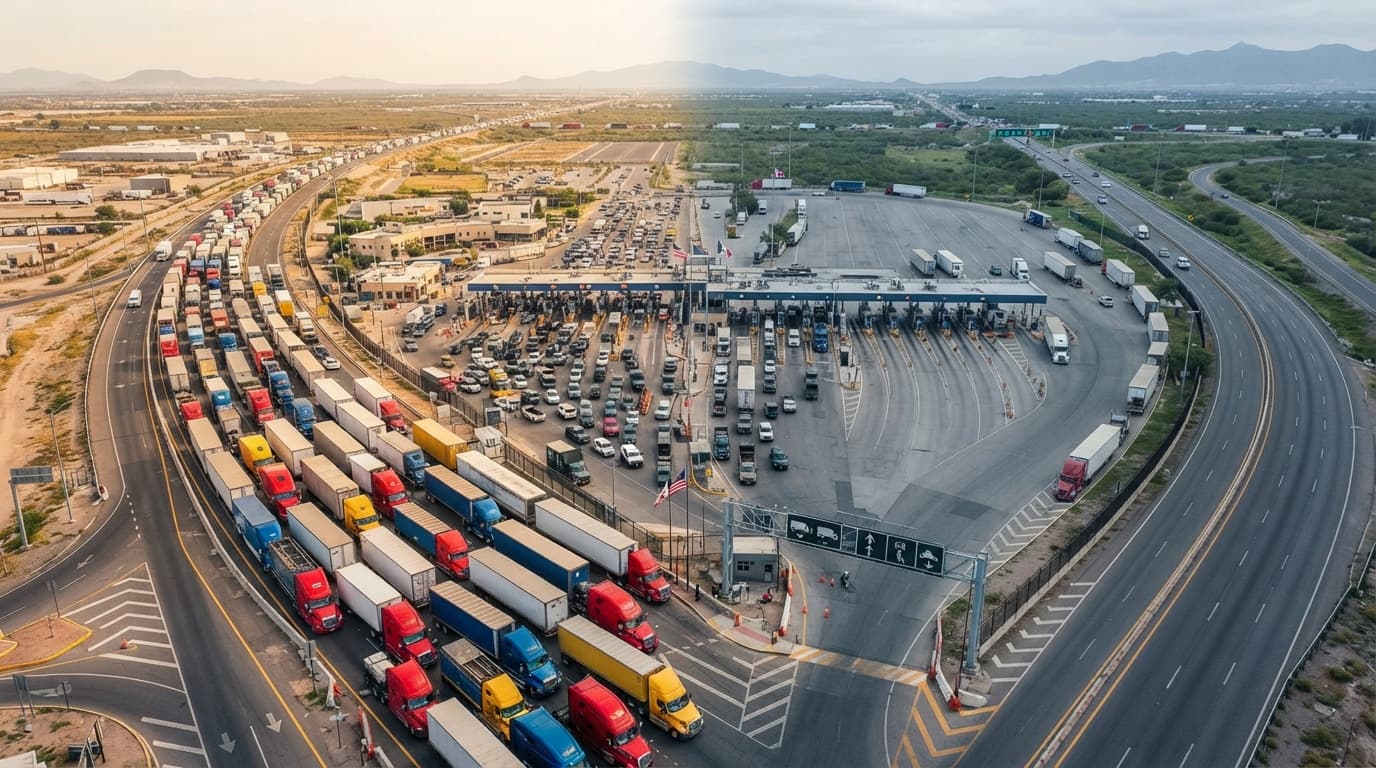
Several distinct factors continue limiting effective trucking capacity along the Mexico-U.S. corridor. The average age of the trucking fleet operating this corridor remains notably high, at roughly two decades. Persistent driver shortages and turnover continue affecting the corridor, with some industry estimates placing the shortage in the tens of thousands of drivers. Purchases of new tractors and trailers have remained historically low. And congestion continues affecting major border crossings including Laredo, Nuevo Laredo, El Paso, and Nogales.
Regulatory Enforcement Tightens Further
A primary development over the summer months has been a pronounced contraction in cross-border driver availability, caused largely by intensified U.S. enforcement of B-1 visa requirements, English language proficiency rules, and restrictions on Mexico-based carriers transporting goods domestically within the United States. While these measures themselves are not new, meaningfully stricter and more consistent application has materially impacted the available driver pool.
Thousands of drivers across key border regions have reportedly been effectively removed from active service in recent weeks. Other drivers appear increasingly reluctant to accept cross-border loads or enter the United States at all, opting instead to avoid inspection or visa-related risk by carrying only intra-Mexico freight. As one freight analysis put it, this behavioral shift has further reduced effective capacity and suggests the disruption may prove structural rather than temporary.
Cost Pressures Compound Capacity Constraints
Carrier economics are compounding the corridor’s supply-side constraints in several ways. Diesel prices have remained elevated throughout the summer. The Mexican peso has remained comparatively strong against the U.S. dollar relative to year-earlier levels—an appreciation that reduces effective revenue for carriers pricing in U.S. dollars once converted back to pesos. And labor costs, which already account for a substantial share of total logistics costs in Mexico, continue rising alongside minimum wage increases.
The net result: carriers appear to be pursuing rate increases primarily to recover rising expenses rather than to expand margins. Layered on top of enforcement-related supply reductions, this combination has produced a market characterized by firmer pricing and limited capacity availability likely to persist through the coming months.
Phantom Capacity Tightening
Some freight technology providers have identified an additional dynamic further tightening this market—sometimes described as “phantom capacity.” The U.S.-Mexico trucking market appears to be tightening in ways that don’t fully register in traditional freight indicators, as equipment imbalances force carriers to reposition trucks and trailers back into Mexico more frequently, effectively tightening available capacity for U.S.-bound shipments even when aggregate fleet numbers might otherwise suggest adequate supply.
3 · The Canada Corridor: Softer Demand but Tighter Capacity
A Different Dynamic
Canada presents a genuinely different picture from Mexico. Cross-border freight conditions between the United States and Canada remain comparatively softer amid muted demand and continued USMCA-related uncertainty. Yet Canada continues experiencing more difficult cross-border conditions than Mexico overall, particularly when it comes to actually arranging available truck capacity.
The composite index data reflects this apparent paradox. Canada corridor readings have risen over recent months even as the underlying demand picture has remained relatively soft, while the gap between the two corridors has narrowed somewhat over time—yet Canada remains the more challenging corridor overall for securing truck capacity.
The USMCA Uncertainty Factor
The ongoing uncertainty surrounding the future of the United States-Mexico-Canada Agreement (USMCA) remains a key factor affecting cross-border freight planning specifically on the Canada corridor. The United States declined to renew the USMCA for an additional 16-year term on July 1, 2026, triggering an annual review process that has introduced meaningful uncertainty for cross-border shippers operating on this corridor.
Recent freight market commentary has noted that uncertainty around the future of the USMCA trade agreement continues influencing cross-border demand and planning decisions. While no major immediate impacts have yet become clearly visible, continued policy changes could meaningfully influence longer-term cross-border planning going forward.
Truck Availability as the Primary Pressure Point
Despite comparatively softer demand, truck availability remains the primary challenge on the Canada corridor specifically. The capacity component of the underlying index has climbed notably, with truck availability continuing to be limited even as other demand-related indicators remain relatively moderate.
Industry analysts have specifically recommended that shippers confirm carrier commitments early, particularly on Canada lanes, and build meaningful flexibility into their pickup scheduling given these ongoing capacity constraints.
Shifting Border Crossing Patterns
In a notable shift in cross-border traffic patterns, the Blue Water Bridge overtook the Ambassador Bridge as the busiest U.S.-Canada commercial crossing during 2025, handling a meaningfully higher volume of truck trips compared to the Ambassador. This shift reflects changing trade flows and evolving routing preferences amid the broader cross-border conditions described above.
4 · The Antidumping Factor: New Duties on Mexican and Canadian Trailers
A Significant New Trade Barrier
In early August 2026, the U.S. Department of Commerce imposed preliminary antidumping duties of up to nearly 80% on van trailers imported from Mexico, ruling that foreign manufacturers had been selling this equipment in the U.S. market below fair market value. These preliminary duties, ranging broadly from roughly 3% up to nearly 80%, build upon previously announced countervailing duties.
Impact on Equipment Availability
These duties are likely to carry significant implications for cross-border trucking capacity more broadly. Mexican trailer imports have historically served as an important source of equipment for carriers operating cross-border routes. Higher duties will likely increase overall equipment costs, potentially reducing fleet expansion and replacement activity, and further constraining available capacity across the corridor.
The domestic trailer industry directly employs several thousand workers and indirectly supports tens of thousands of additional American jobs. Coalitions representing domestic manufacturers have welcomed these preliminary determinations as a meaningful step toward restoring fair competition in the U.S. trailer market.
China-Origin Trailers Routed Through Canada
In a related enforcement action, federal officials have also announced that existing antidumping and countervailing duties on Chinese-made van-type trailers will now apply to Chinese-origin merchandise routed through Canada into the U.S. market. This action closes a potential circumvention pathway and adds yet another layer of complexity to cross-border supply chains spanning both corridors.
5 · The Shipper Challenge: Planning in a Tight Market
Elevated Costs, Limited Flexibility
Transportation costs remain elevated across both cross-border lanes, leaving shippers with considerably less room for savings when freight requires short notice or guaranteed service levels. Lower seasonal freight volumes have not made trucks meaningfully easier to secure overall, and capacity remains the primary day-to-day challenge facing shippers on both corridors.
As commercial intelligence analysts have observed, shippers who lock in strong carrier partners early, and who account for all relevant costs—freight, fuel, duty, and inventory costs—when budgeting, are generally in a much better position to handle whatever the border throws at them next.
The Canada-Mexico Divergence in Practice
For shippers, this divergence between the two corridors creates genuinely different planning requirements depending on which lane they’re operating.
Canada shipments may require closer cost and schedule reviews, as new trade measures continue adding uncertainty to U.S.-Canada freight planning. Truck availability remains the primary challenge, and shippers should generally confirm carrier commitments well in advance.
Mexico shipments face tight capacity, border delays, and firm pricing amid continued export growth. That said, Mexico has remained somewhat more stable than Canada in recent readings, with truck availability less severely constrained even amid the corridor’s other structural challenges.
The Reliability Premium
The pricing gap between contract and spot freight continues narrowing across both corridors. Reliable carriers offering guaranteed capacity command an increasingly justified premium in this environment. Overreliance on the spot market meaningfully increases exposure to rate volatility in these constrained corridors.
6 · Strategic Considerations for Shippers
Based on recent cross-border index data, industry analysts have suggested several considerations for shippers managing freight on U.S.-Canada and U.S.-Mexico lanes.
Near-Term Considerations
Shippers may benefit from reviewing tariff exposure for Canada-related shipments proactively, updating landed-cost estimates and contingencies for potentially affected goods. Confirming truck coverage well in advance remains essential, given that capacity continues serving as the primary challenge across both corridors. Separating freight, fuel, and duty charges when estimating total shipment costs helps provide clearer visibility into where cost pressures are actually originating. And preparing backup carrier or border-crossing options, where feasible, helps protect freight with fixed delivery commitments.
Mode Optimization
For time-sensitive freight, where a late delivery could meaningfully affect production schedules or customer commitments, expedited service options are generally worth evaluating despite the additional cost. For more flexible, longer-haul freight, intermodal alternatives can help reduce reliance on limited truck capacity on lanes where such conversion makes practical sense.
Carrier Selection
Diversifying carrier networks by corridor, rather than depending heavily on spot capacity alone, generally provides greater resilience in tight market conditions. Prioritizing certified carriers through recognized compliance programs helps reduce border-crossing delays and compliance risk, since digital verification platforms allow shippers to identify transportation providers with demonstrated legal, operational, and security compliance. Reviewing transportation agreements to incorporate realistic provisions for border delays, detention, and fuel-related cost adjustments also remains a worthwhile exercise in the current environment.
7 · Looking Ahead: What to Expect
Continued Tightness
With both corridors holding above the 50-point neutral threshold for a second consecutive month, shippers should generally expect continued tight conditions for cross-border freight in the near term. The observation that capacity is staying tight even as volumes ease from a summer peak suggests these constraints are structural in nature rather than purely seasonal.
The USMCA Wildcard
The ongoing USMCA review process adds another meaningful layer of uncertainty to medium-term transportation planning, particularly for the Canada corridor specifically. While no major immediate impacts have yet become clearly visible, continued policy changes could meaningfully influence longer-term cross-border planning decisions.
Regulatory Enforcement as a Lasting Feature
The intensified enforcement of B-1 visa rules, English language proficiency requirements, and cross-border operating restrictions appears likely to remain a lasting feature of the regulatory landscape rather than a temporary condition. The behavioral shift already visible among drivers—choosing to avoid cross-border loads entirely—may prove structural rather than temporary as these enforcement patterns continue.
8 · Conclusion: A Market Defined by Divergence and Constraint
Two Corridors, Two Stories
Recent cross-border index data tells a story of two corridors moving in somewhat different directions while both facing genuine constraints. Mexico’s nearshoring-driven export growth continues generating strong freight demand that outpaces available capacity. Canada faces comparatively softer demand but tighter truck availability alongside mounting USMCA-related uncertainty.
The Structural Reality
The capacity constraints affecting both corridors do not appear to be temporary seasonal phenomena. They reflect genuinely structural factors—aging fleets, persistent driver shortages, intensified regulatory enforcement, and longer-term supply chain reconfiguration. The substantial driver shortage affecting Mexico’s trucking sector, in particular, appears to be a structural issue unlikely to resolve quickly.
The Strategic Takeaway
For shippers, the underlying message appears reasonably clear: cross-border freight planning increasingly requires more lead time, stronger carrier relationships, and greater attention to total landed cost than in past years. The period of comparatively easy cross-border capacity access appears to have passed, at least for now. Success in this environment generally depends on early planning, thoughtful modal diversification, and strategic carrier partnerships built well ahead of actual shipping needs.
As one industry analyst summarized it, shippers who lock in strong partners early, and who account for all relevant costs when budgeting, are generally in a much better position to handle whatever the border throws at them next.
This analysis reflects cross-border truck capacity conditions as of August 2026 based on available industry index data and market reporting. Market conditions evolve continuously and specific circumstances vary by shipper, lane, and commodity. Organizations managing cross-border freight should consult with logistics providers and supply chain professionals for guidance tailored to their specific requirements and circumstances.