Executive Summary FedEx has significantly expanded its Demand Surcharges on U.S.-bound imports effective September 21, 2026, adding previously uncharged regions and sharply increasing rates for Asian origins. China, Hong Kong, and Macau shipments now face $0.91 per pound for priority services—a 160% increase from $0.35—and $0.54 per pound for economy services, up 116% from $0.25. The surcharge schedule has expanded from three origin groups and four rate lines to nine groups and eleven rate lines, bringing new fees to Canada ($0.14/lb), Latin America and the Caribbean ($0.12/lb), Europe ($0.25/lb), and Israel ($0.25/lb). The changes take effect as the peak holiday shipping season begins, the de minimis exemption remains suspended, and carriers face elevated fuel costs. For cross-border e-commerce sellers and logistics providers, the impact is immediate and cumulative.
FedEx Expands Peak Season Surcharges on U.S. Imports: China Shipments Hit $0.91 Per Pound
(FedEx扩大旺季附加费:中国货件每磅高达0.91美元)
1 · The Surcharge Changes: What’s New
Rate Increases for Asian Origins
The most significant changes affect U.S.-bound shipments from China, Hong Kong, and Macau. FedEx is increasing the Demand Surcharge on these origins from the previous rates:
| Origin | Service Type | Previous Rate | New Rate | Change |
|---|---|---|---|---|
| China, Hong Kong, Macau | Priority | $0.35/lb | $0.91/lb | +160% |
| China, Hong Kong, Macau | Economy | $0.25/lb | $0.54/lb | +116% |
| 13-Origin Group* | Priority | $0.20/lb | $0.73/lb | +265% |
| 13-Origin Group* | Economy | $0.20/lb | $0.54/lb | +170% |
| India | All | $0.70/lb | $0.89/lb | +27% |
| Sub-Saharan Africa | All | $0.70/lb | $0.60/lb | -14% |
| MEISA (excl. India/SSA) | All | $0.70/lb | $0.70/lb | Unchanged |
The 13-origin group includes Australia, Cambodia, Fiji, Guam, Indonesia, Japan, South Korea, Malaysia, New Zealand, the Philippines, Singapore, Taiwan, and Thailand.
Source: FedEx rate schedules effective September 21, 2026
New Regions Added to the Surcharge
For the first time, FedEx is applying Demand Surcharges to U.S.-bound imports from several regions that previously carried no surcharge:
| Origin | New Rate |
|---|---|
| Canada | $0.14/lb |
| Latin America & Caribbean | $0.12/lb |
| Europe | $0.25/lb |
| Israel | $0.25/lb |
Export Surcharges Also Rise
FedEx is also increasing surcharges on U.S. exports:
| Destination | Previous Rate | New Rate | Change |
|---|---|---|---|
| Canada, Latin America, Europe, Australia, New Zealand | $0.20/lb | $0.30/lb | +50% |
Minimum Charges
Parcel shipments are subject to a $1 minimum per shipment, while freight shipments carry a $50 minimum per shipment.
⚠️ Critical Takeaway: The surcharge schedule is no longer a simple three-region, four-rate structure. It is now a highly differentiated, origin-specific system that requires shippers to map every lane and service type.
2 · The Practical Impact: What It Costs
The Per-Pound Math
The headline rates tell only part of the story. Because the surcharge is assessed per pound, the impact scales rapidly with shipment weight.
Example: 10 kg Priority Package (China to U.S.)
| Before Sept. 21 | From Sept. 21 | Increase | |
|---|---|---|---|
| Chargeable weight | 22.05 lb | 22.05 lb | — |
| Surcharge per lb | $0.35 | $0.91 | +$0.56 |
| Total surcharge | $7.72 | $20.06 | +$12.35 |
Source: FedEx rate schedules; calculations based on 10 kg chargeable weight
The Volume Effect
The per-shipment increase becomes significant at scale:
| Chargeable Weight | Surcharge Increase (Priority) |
|---|---|
| 1 kg | ~$1.23 |
| 5 kg | ~$6.17 |
| 10 kg | ~$12.35 |
| 20 kg | ~$24.69 |
| 100 shipments × 10 kg | ~$1,235 |
The Lightweight Shipment Nuance
For very light packages, the $1 minimum per shipment provides some cushion. A 1 kg Priority package that previously paid $0.77 (below the minimum) would have been charged $1.00; under the new rate, it would be charged $2.01—still a meaningful increase, but less dramatic than the headline 160% suggests.
A 40-Pound Shipment Example
For a 40-pound Priority shipment from China:
| Before | After | Increase | |
|---|---|---|---|
| Surcharge | $14.00 | $36.40 | +$22.40 |
Source: ShipScience analysis
⚠️ Critical Takeaway: The impact is most severe for heavier shipments and high-frequency shippers. Sellers who rely on Priority services for rapid replenishment—particularly during peak season—face the steepest cost increases.
3 · The Broader Cost Landscape: A Triple Squeeze
Factor 1: De Minimis Suspension
The FedEx surcharge increase comes as the de minimis exemption—which previously allowed shipments valued at $800 or less to enter duty-free—remains suspended. The U.S. Court of International Trade upheld the suspension on August 13, 2026, in Axle of Dearborn, Inc. v. Department of Commerce (Slip Op. 26-94), rejecting a challenge from Detroit-based auto parts distributor Detroit Axle, and the exemption is set to end permanently by statute on July 1, 2027. The ruling is not necessarily the final word—Detroit Axle retains the option to appeal to the Federal Circuit—but the underlying statutory repeal proceeds regardless of how any further appeal is resolved.
For e-commerce sellers, this means:
- Duties now apply to all shipments, regardless of value
- Formal customs processing is required for every parcel
- Brokerage fees add $2 to $5 per package on top of duties
Factor 2: Elevated Fuel Costs
Global express carriers have been raising fuel surcharges throughout 2026 amid geopolitical tensions and rising oil prices. FedEx’s Demand Surcharge is separate from—and stacks on top of—fuel surcharges, which have been climbing.
Factor 3: Peak Season Capacity Constraints
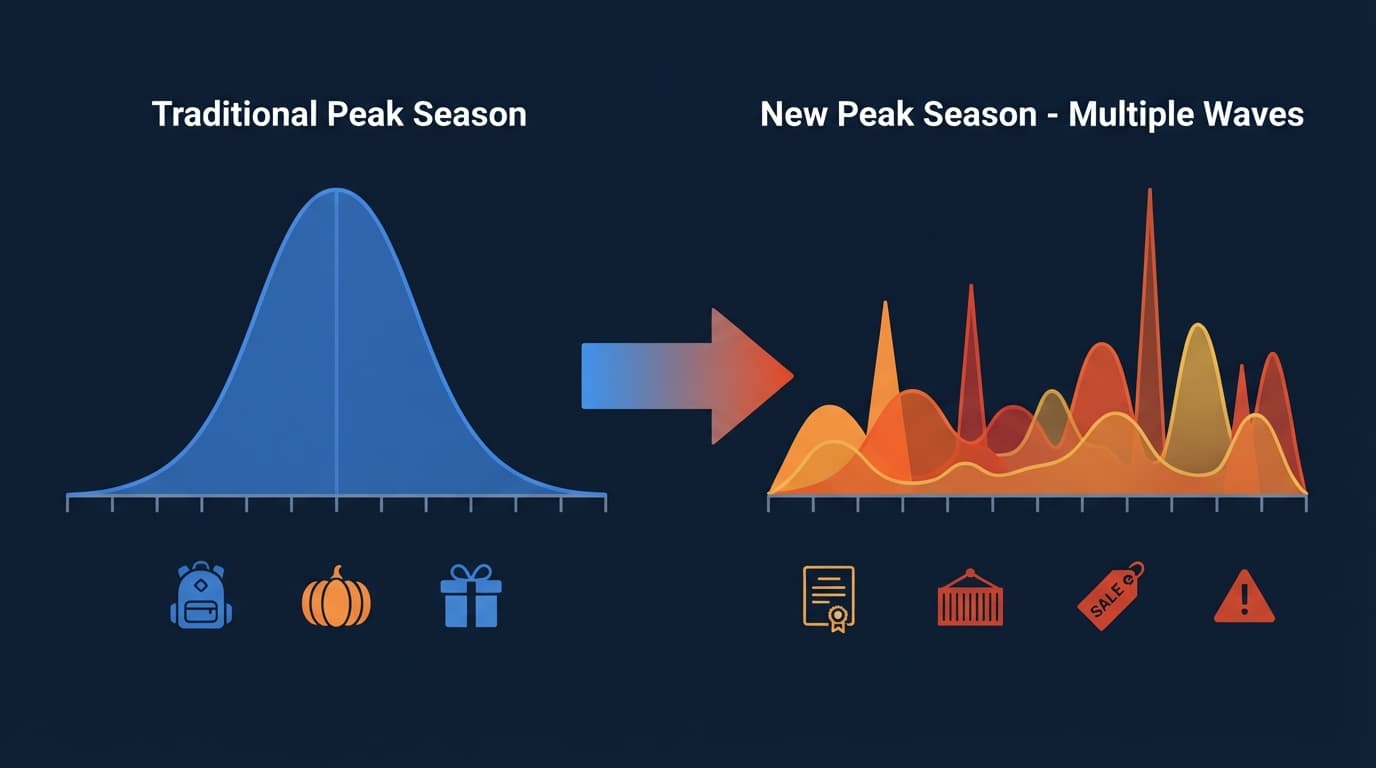
The surcharge increase is timed to coincide with the peak holiday shipping season. FedEx has stated it will implement Demand Surcharges “during times of elevated volumes, high demand for capacity, and increased operating costs across our network”.
⚠️ Critical Takeaway: The FedEx surcharge is not an isolated increase—it is one layer in a triple squeeze that includes duties, fuel surcharges, and peak season premiums.
4 · UPS Responds: Parallel Cost Increases
UPS Import Disbursement Fee
FedEx is not alone in raising costs. UPS has announced changes to its Disbursement Fee for imports into China, effective September 20, 2026:
- 2.5% of applicable duties, taxes, and government charges
- Minimum RMB 42 per shipment
This fee applies when UPS advances duties or taxes on behalf of the importer—a common occurrence in the post-de minimis environment.
UPS Additional Lines of Entry Fee
UPS also adjusted its Additional Lines of Entry Fee effective September 7, 2026, raising the threshold from 3 tariff lines to 5 tariff lines before the fee applies. While this is a relaxation for some shippers, it reflects the increased complexity of customs processing.
Earlier UPS Surge Fees
Earlier in 2026, UPS introduced emergency surge fees on U.S. imports and exports:
- $0.32 per pound on shipments from China and Hong Kong to the U.S.
- $0.23 per pound on shipments between the U.S. and most other countries
- $1.50 per pound on certain high-demand lanes
While those emergency fees have since been adjusted or expired, they demonstrate that both major carriers are actively using surcharges to manage capacity and costs.
5 · What This Means for Cross-Border E-Commerce Sellers
The Margin Squeeze
The cumulative effect of surcharges, duties, and fuel costs is eroding margins for direct-from-China e-commerce sellers. A seller shipping 100 Priority packages per month at 10 kg each now faces:
| Cost Component | Pre-September 2026 | Post-September 2026 |
|---|---|---|
| Base Freight | Variable | Variable |
| Fuel Surcharge | Elevated | Elevated |
| Demand Surcharge | $772 | $2,006 |
| Duties (post-de minimis) | Now applicable | Now applicable |
| Brokerage Fees | $2–$5/parcel | $2–$5/parcel |
The demand surcharge alone represents an additional $1,234 per month for this hypothetical seller—before accounting for duties and fuel.
The Shift Toward Bulk and Local Fulfillment
Industry analysts note that the economics increasingly favor bulk ocean freight, warehousing, and local fulfillment over direct-from-factory air express. Sellers with the resources to adapt—such as Shein and Temu—are already moving in this direction. Smaller sellers face a harder choice: absorb the costs, raise prices, or exit affected markets.
The “Bifurcation” of the Market
The surcharge structure itself creates a bifurcation:
- Priority services (International First, Priority Express, Priority) face the steepest increases ($0.91/lb for China)
- Economy services (International Economy) face lower increases ($0.54/lb for China)
Sellers who can tolerate longer transit times may find Economy services increasingly attractive, even if they must adjust inventory planning accordingly.
6 · What Logistics Providers Must Do Now
1. Update Rate Models Immediately
The new surcharges are effective September 21, 2026. Logistics providers should:
- Update lane-by-lane rate models to reflect new origin-specific surcharges
- Separate Priority and Economy rates for all Asian origins
- Add new origin regions (Canada, Latin America, Europe, Israel) to cost estimates
- Confirm country-level mapping changes with FedEx (several countries have shifted between rate groups)
2. Communicate Cost Impacts to Customers
Proactive communication is essential:
- Issue client alerts explaining the new surcharge structure
- Provide shipment-level cost estimates so customers can adjust pricing
- Highlight the weight threshold at which Priority becomes significantly more expensive than Economy
3. Evaluate Service-Level Optimization
For customers with flexible timelines:
- Model the cost difference between Priority and Economy for each lane
- Identify shipments where Economy service could deliver adequate transit times at lower cost
- Consider consolidating multiple small shipments into fewer larger ones to reduce per-pound surcharge exposure
4. Monitor UPS and Other Carrier Adjustments
FedEx’s changes are part of a broader carrier trend. Logistics providers should:
- Track UPS announcements on surcharges and fees
- Monitor DHL and regional carriers for parallel adjustments
- Compare total landed costs across carriers, not just base rates
5. Build Surcharge Buffers into Pricing
Given the volatility of surcharge schedules—FedEx has adjusted these rates multiple times in 2026—logistics providers should:
- Build a 10–15% buffer into quoted rates for surcharge volatility
- Review surcharge schedules monthly rather than annually
- Establish triggers for renegotiating customer pricing when surcharges change
6. Consider the Strategic Shift
The cumulative cost pressure may warrant a strategic reassessment:
- For high-volume sellers: Evaluate whether bulk ocean freight and U.S. warehousing now offer a lower total landed cost than direct air express
- For medium-volume sellers: Consider hybrid models that combine bulk shipments for core inventory with air express for urgent replenishment
- For all sellers: Model the impact of the July 1, 2027 permanent end of de minimis on long-term cost structures
7 · Conclusion: A New Cost Reality for Cross-Border Shipping
FedEx’s expanded Demand Surcharges represent a structural change in the cost of shipping to the United States. The days of predictable, per-pound pricing for international express services are over.
Key Takeaways
| Factor | Detail |
|---|---|
| Effective Date | September 21, 2026 |
| China Priority Rate | $0.91/lb (up from $0.35 — +160%) |
| China Economy Rate | $0.54/lb (up from $0.25 — +116%) |
| New Origin Groups | Canada, Latin America, Europe, Israel |
| Total Rate Structure | 9 origin groups, 11 rate lines |
| Minimum per Shipment | $1 (parcel) / $50 (freight) |
| 10 kg Package Impact | +$12.35 per shipment |
| Parallel UPS Changes | Disbursement Fee (2.5%, min. RMB 42) effective Sept. 20 |
The Bottom Line
For cross-border e-commerce sellers and logistics providers, the September 21 surcharge increase is not an isolated event—it is the latest layer in a cumulative cost escalation that includes de minimis suspension, fuel surcharges, and peak season capacity constraints. The sellers who adapt fastest—by optimizing service levels, consolidating shipments, and shifting toward bulk and local fulfillment—will be best positioned to protect margins.
The message is clear: The cost of shipping to America is rising on every front. Preparation is no longer optional—it is essential.
This analysis reflects FedEx’s Demand Surcharge schedules effective September 21, 2026, and related carrier announcements as of September 21, 2026. Specific rates, service classifications, and country groupings are subject to FedEx’s published rate schedules and may change with notice. Shippers and logistics providers should verify current rates with FedEx and monitor for further adjustments during peak season.