Executive Summary
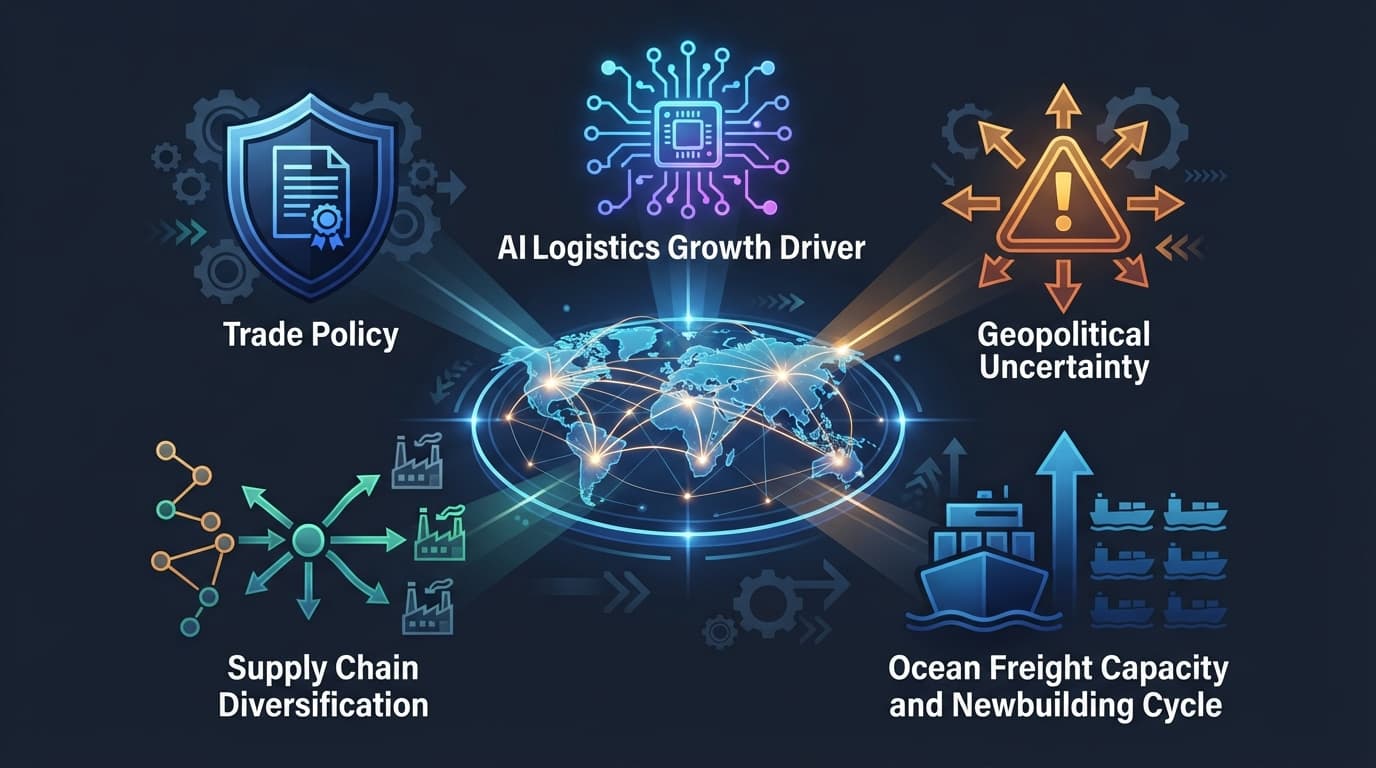
Global supply chains appear to be entering a new phase of structural transformation in 2026, one that extends well beyond the routine ups and downs of an ordinary economic cycle. Dimerco Express Group, marking its 55th anniversary this year, outlined this shift at its Mid-Year 2026 Supply Chain Outlook conference, with Chairman Catherine Chien framing the moment directly: what the industry is witnessing is no longer simply an economic cycle, but a fundamental shift in how global supply chains are organized. Five structural forces underpin this shift: trade policy has become a critical, integrated variable rather than a background compliance concern; geopolitical uncertainty has settled in as an ongoing operating condition rather than a temporary disruption; ocean freight capacity, while broadly balanced through 2026, faces a new competitive cycle as substantial vessel deliveries arrive in 2027 and 2028; global trade flows are diversifying and regionalizing rather than simply moving away from China; and artificial intelligence has emerged as a significant driver of logistics growth in its own right. This analysis examines each force and its strategic implications for supply chain leaders navigating an increasingly transformed global landscape.
Five Structural Shifts Reshaping Global Supply Chains: A 2026 Outlook
(重塑全球供应链的五大结构性变化:2026年展望)
1 · A New Structural Phase for Global Supply Chains
From Economic Cycle to Fundamental Shift
In late July 2026, Dimerco Express Group held its investor conference under the theme “Mid-Year 2026 Supply Chain Outlook: From Market Volatility to Strategic Opportunities,” sharing its latest perspective on the evolving global supply chain landscape.
The company’s broader observation is that global supply chains are entering a new era of structural transformation. Trade policy, geopolitical developments, ocean freight capacity, shifting global trade flows, and AI infrastructure investment are together reshaping how cargo moves and redefining what logistics providers are expected to deliver.
The underlying shift: competitive advantage in logistics increasingly appears to rest not solely on transportation efficiency, but on the ability to help customers navigate policy change, manage supply chain risk, strengthen resilience, and capture opportunities arising from broader supply chain reconfiguration.
The Five Structural Forces
According to this analysis, five structural forces are driving the most significant changes in global supply chains this year:
- Trade policy has become one of the most critical variables affecting global logistics
- Geopolitical uncertainty has settled in as an ongoing operating condition
- Ocean freight capacity faces a new competitive cycle tied to a significant wave of new vessel deliveries
- Global trade flows are shifting toward diversification and regionalization
- Artificial intelligence has emerged as a major driver of the next phase of logistics growth
2 · Force One: Trade Policy as a Critical Variable
From Broad-Based to Targeted Measures
Trade policy has become one of the most consequential variables affecting global logistics planning. Recent U.S. regulatory adjustments—including importer of record requirements, Section 301 tariffs, and measures pursued under the International Emergency Economic Powers Act—reflect a broader shift away from blunt, broad-based tariff policy toward more targeted management differentiated by country, product category, and even individual enterprise compliance profile.
This shift means supply chain planning increasingly requires trade compliance to become an integral part of business strategy, rather than a narrow operational concern addressed only when a shipment reaches the border.
The Compliance Imperative
The move toward more targeted trade policy means importers can no longer treat compliance as a purely back-office function. Companies increasingly need to weave trade compliance directly into core business strategy, with implications reaching into sourcing decisions, supply chain network design, and day-to-day operational planning.
Trade compliance as a value-added service: logistics providers report having helped customers secure tens of millions of dollars in tariff refunds tied to recent IEEPA-related legal developments—illustrating how logistics services are increasingly expected to extend beyond transportation management into higher value-added areas such as supply chain planning, tariff management, and broader risk control.
3 · Force Two: Geopolitical Uncertainty as an Ongoing Condition
A Lasting Feature, Not a Temporary Disruption
The second structural force is the growing recognition that geopolitical uncertainty has settled in as an enduring operating condition rather than a temporary disruption to be waited out. Developments in the Middle East, fluctuations in energy prices, and risks affecting key shipping routes all continue to underscore the importance of building genuine supply chain resilience.
The balancing act: businesses are increasingly weighing cost optimization against risk management and operational flexibility in ways that mark a real departure from the pre-pandemic era, when cost minimization functioned as the dominant objective and risk was largely treated as manageable in the background.
The Resilience Mandate
The current geopolitical environment no longer allows companies to assume stable access to key shipping routes, predictable energy prices, or consistent trade relationships. Supply chain resilience—once discussed mainly in theoretical terms—has become an operational imperative in its own right.
Companies that fail to build resilience into their supply chain design increasingly risk not only operational disruption when conditions shift, but genuine competitive disadvantage relative to more adaptable peers capturing market share during periods of volatility.
4 · Force Three: Ocean Freight Capacity and the 2027-2028 Newbuilding Cycle
A Balanced 2026, but a New Competitive Cycle Ahead
Within ocean freight specifically, supply and demand have remained relatively balanced through 2026. However, a substantial wave of new vessel capacity scheduled for delivery between 2027 and 2028 is widely expected to usher in a new competitive cycle across global shipping.
This newbuilding cycle represents a genuinely structural shift within ocean freight markets. As new vessels enter service, available capacity will expand meaningfully, potentially creating downward pressure on freight rates while reshaping carrier strategy more broadly.
Implications for Shippers
The 2027-2028 newbuilding cycle carries several practical implications for shippers to weigh in advance:
Rate volatility: an influx of new capacity may exert downward pressure on rates generally, but is also likely to introduce greater short-term volatility as carriers work to adjust utilization.
Carrier strategy: carriers facing potential overcapacity may respond through more aggressive blank sailings, alliance restructuring, or broader service network adjustments.
Contracting strategy: shippers may benefit from reassessing how the newbuilding cycle affects their contracting approach—weighing the relative merits of locking in rates versus preserving flexibility as the cycle unfolds.
Network planning: the more competitive environment created by this cycle may open opportunities for route optimization and greater carrier diversification than has been practical in tighter capacity conditions.
5 · Force Four: Shifting Global Trade Flows and Supply Chain Diversification
Beyond a Simple ‘De-China’ Narrative
The fourth structural force concerns the ongoing evolution of global trade flows. China’s export focus appears to be gradually broadening toward ASEAN, India, and other emerging markets, even as exports of high-value goods from Taiwan and Southeast Asia to the United States continue to grow in parallel.
The key insight: rather than a simple “de-China” narrative, supply chains appear to be becoming more genuinely diversified and regionalized. This is not a wholesale abandonment of China as a manufacturing base, but a more strategic reconfiguration of supply chains across a broader set of countries and regions.
The Diversification Pattern
This shift toward diversification and regionalization is evident across several dimensions:
Manufacturing expansion: production capacity continues expanding into newer markets across Asia and beyond, spreading manufacturing risk across a wider geographic base.
China’s continued centrality: despite diversification trends, China continues to play a central role in many supply chain decisions, whether as a manufacturing base, a components supplier, or both.
Changing freight movement patterns: the more significant changes underway may not simply be where products are manufactured, but how freight actually moves, where new investment is flowing, and how businesses are adapting operationally to an increasingly complex global trade environment.
The China Plus One Evolution
This pattern is consistent with what industry observers commonly describe as the continued evolution of “China plus one” strategies—companies actively diversifying their supply chains in response to ongoing trade tensions and rising costs within China specifically. This diversification is generally not about abandoning China altogether, but about building genuine resilience through multiple, complementary sourcing options.
6 · Force Five: AI as a Major Driver of Logistics Growth
From Model Training Toward Commercial Applications
The fifth structural force identifies artificial intelligence as a significant driver of the next phase of growth within global logistics. As AI investment matures from model training toward broader commercial application, demand for AI servers, semiconductors, high-performance computing equipment, and data center infrastructure continues to generate meaningful opportunities for high-value logistics services.
Taiwan’s strategic role: Taiwan continues to play an increasingly important role within the global AI supply chain, with its semiconductor manufacturing base and sophisticated high-tech logistics infrastructure positioning it as a critical node in AI-related supply chains globally.
The Logistics Implications
This AI infrastructure buildout is placing new demands on logistics providers across several dimensions:
High-value, time-critical shipments: AI servers and semiconductor components typically require specialized handling and expedited transportation given their value and sensitivity.
Data center logistics: the construction of new AI data centers requires complex project logistics spanning multiple transportation modes and jurisdictions simultaneously.
Specialized warehousing: AI-related equipment frequently requires bonded warehousing and other specialized handling arrangements not typical of general cargo.
Compliance complexity: AI-related shipments are increasingly subject to export controls and other trade restrictions, adding a compliance layer that general logistics operations may not be equipped to manage.
An Industry Example of AI-Focused Positioning
Some logistics providers have positioned themselves specifically to capture AI-related opportunities of this kind. Dimerco, for instance, reports that roughly half of its current revenue now derives from semiconductor and high-tech logistics, serving several hundred semiconductor customers while maintaining an average on-time delivery rate above 98 percent for time-critical shipments.
Providers pursuing this strategy have generally developed end-to-end supply chain capabilities connecting Asian manufacturing bases with AI data centers worldwide, strengthening capabilities across air freight, ocean freight, bonded warehousing, project logistics, trade compliance, and integrated supply chain services as AI infrastructure investment continues expanding.
7 · Strategic Implications for Supply Chain Leaders
Rethinking the Role of Logistics
These five structural forces collectively point toward a broader redefinition of what logistics providers are expected to deliver. As one industry leader put it, the value of logistics services is evolving from pure transportation management toward encompassing supply chain strategy, trade compliance, and risk management more broadly.
The new competitive advantage: competitive advantage in logistics increasingly appears determined less by transportation efficiency alone, and more by the ability to help customers navigate policy change, manage supply chain risk, strengthen resilience, and capture opportunities created by ongoing supply chain reconfiguration.
Building Resilience Through Diversification
The structural forces outlined above point clearly toward the growing importance of supply chain diversification and regionalization. Organizations may benefit from considering multi-country sourcing that reduces concentration in any single country or region, building logistics capabilities across multiple regions rather than concentrating them in one, designing supply chain networks flexible enough to adapt as trade flows continue shifting, and integrating trade compliance directly into broader business strategy rather than treating it as a separate function.
Preparing for the Ocean Freight Cycle
The approaching 2027-2028 newbuilding cycle calls for more strategic thinking around ocean freight contracting well in advance. Shippers may benefit from evaluating contract duration and whether to lock in current rates or preserve flexibility, pursuing carrier diversification to avoid over-reliance on any single carrier or alliance, evaluating alternative routes and port pairs as capacity conditions evolve, and maintaining modal flexibility to shift between ocean, air, and intermodal options as conditions warrant.
Capitalizing on AI Logistics Opportunities
The broader AI infrastructure buildout creates opportunities for logistics providers and shippers alike. Organizations may benefit from understanding how AI-related investment affects their own cargo volumes and requirements, building capabilities suited to high-value, time-critical shipments, developing capacity for complex data center project logistics, and strengthening compliance capabilities relevant to export controls and trade restrictions affecting AI-related shipments specifically.
8 · A Longer View: Adaptation Across Decades
A Legacy of Adaptation
The identification of these five structural forces reflects decades of adaptation to shifting supply chain dynamics. Dimerco, marking 55 years since its 1971 founding in Taiwan as an air freight forwarder, has grown alongside Asia’s manufacturing base and the broader evolution of global supply chains, building substantial experience across both Taiwan and the United States along the way.
A global network: the company now serves customers through more than 150 company-owned offices, roughly 80 contract logistics operations, and over 200 strategic partner agents spanning China, India, Asia Pacific, North America, and Europe—with roughly half of total revenue now tied to semiconductor and high-tech logistics specifically.
Entering a New Era
As Dimerco’s Chairman Catherine Chien reflected on the anniversary: 55 years ago, the company grew alongside the rise of Asia’s manufacturing sector; today, it finds itself at the intersection of AI, global supply chain transformation, and a genuinely new trade environment.
A broader mission worth noting: the value of logistics, in this view, extends well beyond simply moving goods—it increasingly involves helping customers connect with global markets, reduce risk, and build competitive advantage amid ongoing change.
9 · Conclusion: Navigating a New Structural Era
A Genuine Transformation
Taken together, these five structural forces provide a useful framework for understanding the current global supply chain environment. Trade policy has become a critical variable requiring genuine strategic integration. Geopolitical uncertainty has settled in as an ongoing operating condition. Ocean freight faces a new competitive cycle on the horizon. Global trade flows are diversifying and regionalizing rather than simply retreating from any single country. And artificial intelligence has emerged as a substantial driver of logistics growth in its own right.
The Strategic Takeaway
What supply chains appear to be experiencing is not simply an ordinary economic cycle, but a more fundamental shift in how global supply chains are structured and operated. The organizations most likely to succeed in this environment are those that recognize the structural—rather than temporary—nature of these changes, and adapt their strategies accordingly rather than waiting for conditions to revert to a prior baseline.
Looking Ahead
These structural forces are likely to continue shaping global supply chains for years to come rather than resolving quickly. Organizations that build resilience through genuine diversification, integrate trade compliance directly into business strategy, prepare thoughtfully for the coming ocean freight cycle, and position themselves to capitalize on AI-related logistics opportunities will generally be better positioned to navigate this new structural era successfully.
This analysis reflects Dimerco Express Group’s Mid-Year 2026 Supply Chain Outlook and related industry commentary as of mid-2026. Market conditions and structural forces continue to evolve. Organizations navigating global supply chains should consult with logistics providers and supply chain professionals for guidance tailored to their specific circumstances.