Executive Summary
A closely watched industry freight index has issued a stark warning heading into mid-2026: U.S. port and rail drayage markets are heading toward tighter capacity, rising congestion, and higher prices as carriers and shippers alike prepare for the 2026 peak shipping season. Recent monthly index data indicates that all regions are now at elevated concern as capacity exits the market and fuel costs rise, creating conditions ripe for downstream congestion across ocean and rail container networks. The core message from industry analysts has been direct: it is not a question of whether inland trucking container haulage rates increase, but when. The U.S. over-the-road transportation ecosystem appears to be operating at tension levels not seen since the pandemic era, with national truckload rate indices reaching all-time highs and broader capacity indices signaling continued contraction in available supply. This analysis examines the warning signs, the converging factors driving market tightening, and strategic considerations for shippers navigating the 2026 peak season.
Freight Market Tightening: Understanding the Signals Ahead of the 2026 Peak Season
(货运市场收紧:解读2026年旺季前的信号)
1 · The Warning: All Regions at Elevated Concern
A Clear and Urgent Signal
In mid-2026, a widely followed monthly freight index tracking U.S. port and rail ramp conditions delivered an unambiguous message: all regions are now at elevated concern as capacity exits the market and rising fuel costs position ocean and rail container drayage markets for downstream congestion and price increases heading into the 2026 peak shipping season.
Industry supply chain analysts have framed the warning directly, noting that ocean and rail container drayage markets may not be feeling the full market squeeze quite yet, but shippers should be prepared for tightening as soon as the peak season begins in earnest.
Tension Levels Not Seen in Years
The U.S. over-the-road transportation ecosystem currently appears to be operating at tension levels not observed since the pandemic era. After enduring one of the longest freight recessions in recent industry history—a stretch that depressed rates and steadily reduced motor carrier counts for nearly three years—trucking rates have broken through pandemic-era pricing records.
Industry voices have emphasized the severity of the current inflection point, noting that even a relatively muted increase in demand could come close to breaking what is already a fairly tense thread running through the broader U.S. transportation market.
2 · The Numbers: Record Rates and Contracting Capacity
National Truckload Rates at an All-Time High
A leading national truckload rate index reached an all-time high early in the summer, and rates are generally expected to remain above historical averages into the third quarter. This record-breaking pricing reflects the convergence of several factors simultaneously tightening the market.
Transportation Capacity in Contraction
A closely watched logistics managers’ survey placed transportation capacity well below the neutral 50% threshold in June, signaling continued contraction in available supply—a clear indicator that capacity is leaving the market faster than it is being replaced by new entrants.
Fuel Costs Surging
Fuel prices have been running roughly 50% higher than the same period a year earlier. This dramatic increase in operating costs has contributed meaningfully to higher all-in freight rates and has placed additional pressure on carriers already operating on thin margins.
The Capacity Exit Continues
Increased regulatory enforcement continues to shrink the available capacity pool, adding further supply-side pricing pressure. The combination of carrier failures, regulatory actions targeting non-domiciled drivers, and surging fuel costs is systematically removing capacity from the market at a pace that shows few signs of slowing.
3 · The Converging Factors Behind the Tightening
Recent freight index warnings point to several converging factors creating current market conditions, each reinforcing the others.
Capacity Exits
After roughly three years of a freight recession that depressed rates and steadily reduced motor carrier counts, the capacity that left the market does not appear to be returning in meaningful numbers. Industry logistics executives have described the situation candidly, noting that pain is building on the transportation side and that signs have been accumulating for months—though shippers do not typically internalize the shift until they begin feeling the pain directly in their own budgets.
Driver exits, carrier closures, increased regulatory scrutiny of non-domiciled operators, and surging fuel costs are all stacking on top of one another.
Rising Fuel Costs
Fuel prices running roughly 50% above year-earlier levels are contributing directly to reduced capacity and upward pricing pressure. For carriers already operating on thin margins, the fuel cost increase alone has been enough to push many smaller operators out of the market entirely.
Stricter Regulatory Enforcement
Increased regulatory enforcement continues to shrink the overall capacity pool. Rules narrowing eligibility for non-domiciled commercial driver’s licenses, alongside other enforcement actions, are removing drivers from the labor pool and further constraining available capacity industry-wide.
Rising Import Demand
Underlying demand indicators suggest continued strength rather than weakness. Recent trade data has shown U.S. containerized imports climbing meaningfully month-over-month, with China-origin imports in particular rising sharply on both a monthly and year-over-year basis.
Maritime Chokepoint Disruptions
Ongoing tension surrounding the Strait of Hormuz—a critical chokepoint for global oil flows—has disrupted energy markets and contributed to broader fuel price volatility affecting transportation costs across the board.
4 · The Intermodal Dimension: A Double-Edged Sword
The Shift Toward Rail
In an effort to manage rising transportation costs, shippers with greater flexibility in their supply chains have increasingly been shifting freight from truckload toward rail. Intermodal volumes have been running notably higher year-over-year as shippers seek relief from elevated fuel costs and tightening truckload capacity.
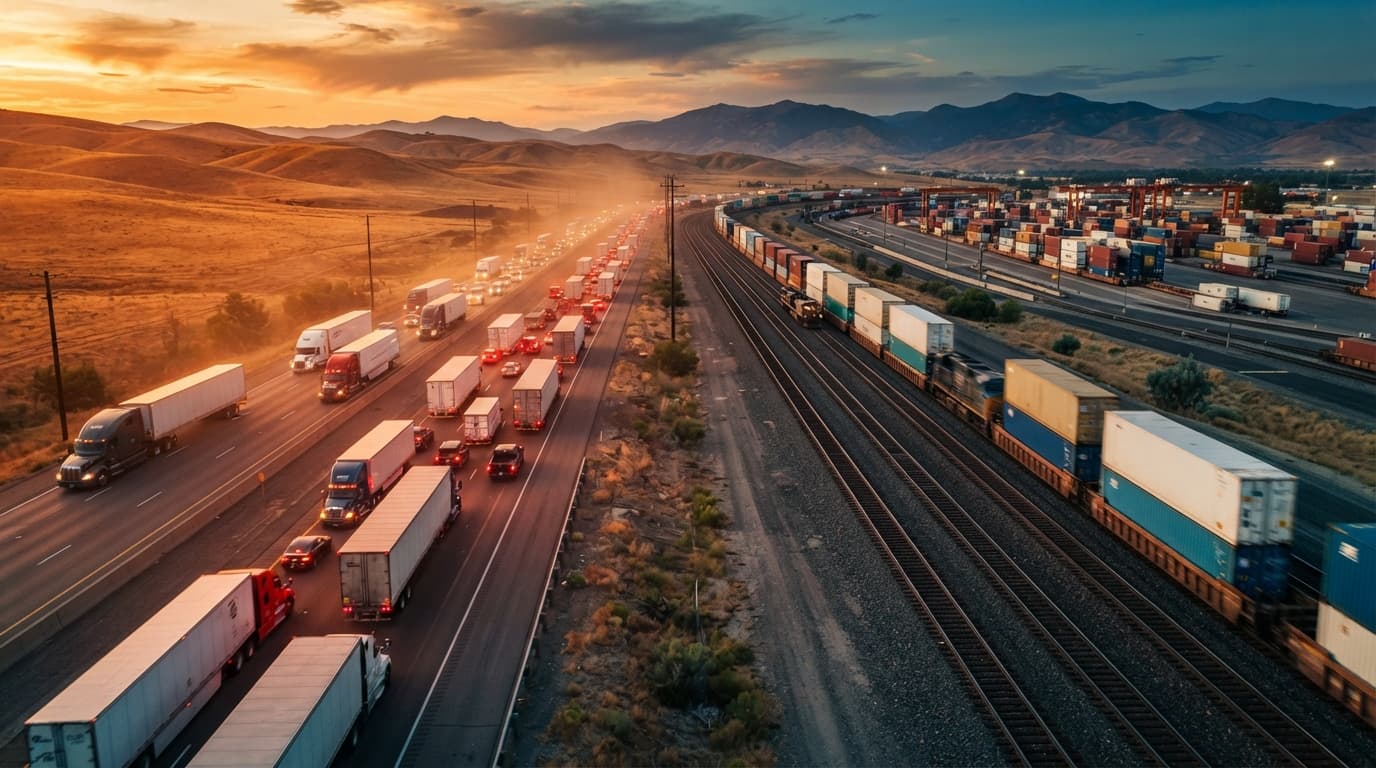
Strain on Inland Rail Ramps
However, this shift is also creating additional strain on inland rail ramps. Industry logistics leaders have cautioned that this transition tends to cause ramp congestion and reduce driver turn time, putting a growing number of containers at risk of incurring storage charges. Increased demand for rail-related drayage capacity has already become apparent in certain regions as a result.
A Capacity Challenge That Spans Modes
The migration of freight from truckload toward rail is adding pressure to inland rail networks that may not have sufficient capacity to absorb the additional volume smoothly. This creates something of a cascading effect: truckload capacity tightens, pushing more freight toward rail; rail capacity then tightens in turn, creating congestion; and that congestion reduces overall efficiency, ultimately increasing costs across the supply chain rather than simply shifting them.
5 · The Inventory Context: A Harsh New Math for Shippers
The Great Inventory Cleanup
Understanding the current situation requires looking back several years. The post-pandemic inventory overhang appears to finally be clearing, though not without real consequences along the way. Industry logistics leaders have described brands wrestling with a genuinely harsh new math problem: products that once cost a dollar to bring in now run considerably more, turning excess inventory into a meaningful cash-flow drain rather than a simple storage inconvenience.
The Cash Flow Pressure
Every customer appears to be pushing for better inventory turns as the cost of holding inventory increases, whether driven by tariffs, transportation rates, or both. Customers increasingly need to manage inventory turns much more closely from a cash flow standpoint, and be considerably more precise about what they actually purchase.
The Retailer Dilemma
The underlying math has become unforgiving. During the pandemic, companies could not manufacture fast enough, and buyers purchased massive volumes of product that arrived in waves and kept selling—until demand eventually cooled. By 2022 and 2023, inventories had ballooned, warehouse space had overflowed, and many brands found themselves sitting on mountains of merchandise they could not move without absorbing real losses.
Retailers generally do not want to heavily discount items—sometimes by 50% to 75% or more—simply to move excess inventory, since that inventory sits on the balance sheet as something close to a cash equivalent. As a result, many companies have chosen to sit on excess stock for extended periods rather than liquidate it aggressively.
6 · The Shipper Challenge: Budgeting for a New Reality
Flat Budgets Face a Capacity Reckoning
For shippers who spent roughly three years enjoying historically low transportation rates, that favorable environment appears to be ending. Freight demand remains something of a wildcard, but any sudden spike in demand is unlikely to draw the same rapid carrier response it might have in years past, given how much capacity has already exited the market.
For large retailers and brands still budgeting for a flat year in transportation spend, this shift could represent a genuine reckoning.
The Warning to Shippers
Industry analysts have been direct in their guidance: ocean and rail container drayage markets may not be feeling the full market squeeze yet, but shippers should be prepared for meaningful tightening as soon as the peak season begins in earnest.
The underlying message is fairly clear: shippers who assume current market conditions will remain broadly favorable through peak season are taking on considerable risk.
7 · Strategic Considerations for Shippers
Early Planning and Capacity Securing
With capacity tightening across virtually all regions and transportation modes, early planning has become increasingly valuable. Shippers generally benefit from securing capacity ahead of the peak season rush, extending planning horizons to account for reduced carrier availability, and considering longer-term agreements that help lock in rates before further increases materialize.
Diversification Across Modes and Carriers
Given current warning signs, over-reliance on any single mode or carrier appears increasingly risky. Shippers may benefit from maintaining relationships with multiple carriers to avoid over-dependence on a single provider, evaluating modal alternatives such as intermodal where the underlying economics support the shift, and monitoring rail ramp congestion closely to plan realistically for potential delays and storage charges.
Fuel Cost Management
With fuel prices running roughly 50% higher than a year earlier, careful fuel cost management has become an important priority. This generally includes auditing fuel surcharges to ensure they are calculated correctly against contract terms, optimizing routing with fuel efficiency in mind, and evaluating intermodal’s structural fuel-related advantages where lanes and volumes make the comparison relevant.
Budget Realism
The era of comfortably flat transportation budgets appears to be drawing to a close for many shippers. Organizations generally benefit from adjusting budgets upward to reflect higher rates and surcharges realistically, building in contingency for continued volatility, and developing scenario plans that account for multiple possible rate and capacity outcomes rather than a single assumed trajectory.
8 · How Logistics Providers Are Responding: Building Capacity
Fleet Expansion
While shippers face tightening capacity broadly, some logistics providers are responding by expanding their own equipment fleets substantially. Industry reporting has described providers doubling drop-trailer fleets year-over-year and projecting continued expansion by year-end, with additional growth potential following recent industry consolidation and acquisitions.
A Flexible Trailer Ecosystem Strategy
This approach extends beyond simply owning more equipment. Beyond company-owned trailers, some providers maintain access to hundreds of thousands of additional trailers through partner carrier networks—a flexibility that customers increasingly expect and, in some cases, require as a baseline capability.
As one industry equipment executive framed it, this kind of drop-trailer strategy is not solely about a single company owning trailers; it is about building a universal, flexible trailer ecosystem that adapts to how each individual customer operates, without sacrificing execution quality or broader network efficiency.
Equipment as a Baseline Requirement
Industry logistics leaders have increasingly described asset access, including drop-trailer capabilities, as something close to table stakes in current customer conversations. In a tightening market, having reliable access to equipment is no longer a meaningful differentiator on its own—it has become closer to a minimum requirement for serious consideration.
9 · The Broader Context: Energy, Inflation, and Consumer Behavior
Energy-Driven Inflation
Recent supply chain reporting has noted that energy-driven inflation continues to challenge all aspects of the supply chain, reshaping consumer spending patterns while pushing the cost of holding inventory higher as peak season approaches.
U.S. inflation has climbed to its highest year-over-year reading in more than two years as of recent data, while consumer confidence indices have fallen for the first time in several months, as conflict in the Middle East and sustained high prices test consumer resilience more broadly.
Shifting Consumer Spending
Consumers appear to be redirecting spending toward essentials, visible in retail gasoline station sales climbing at a notably faster year-over-year pace. The discretionary spending categories that typically generate meaningful freight volume are increasingly competing with fuel and food costs for a limited household budget share.
Record Transportation Prices
A widely tracked transportation prices index reached its highest reading on record in May, according to recent logistics manager survey data. Rates for dry van and refrigerated capacity have remained significantly above five-year historical averages, while capacity signals such as equipment posts and load-to-truck ratios remain tight even after adjusting for typical seasonal patterns.
10 · Conclusion: A Market at a Tipping Point
The Warning Is Clear
Recent freight index warnings deliver a fairly clear and urgent message: U.S. port and rail drayage markets are heading toward tighter capacity, rising congestion, and higher prices. All regions are now flagged at elevated concern. The U.S. over-the-road transportation ecosystem appears to be operating at tension levels not seen since the pandemic era.
The Numbers Tell the Story
National truckload rate indices have reached all-time highs. Broader transportation capacity indices sit well below neutral thresholds. Fuel prices are running roughly 50% higher than a year earlier. Intermodal volumes are up notably year-over-year, adding real strain to inland rail ramps. And containerized imports have continued climbing on both a monthly and annual basis.
The Strategic Takeaway
The underlying message from industry analysts has been consistent: it is generally not a question of whether inland trucking container haulage rates increase, but when. For shippers, this suggests the era of abundant capacity and consistently favorable rates may be drawing to a close, at least for the near term. The 2026 peak season appears likely to be characterized by tighter capacity, higher costs, and increased operational complexity relative to recent years.
The Path Forward
Navigating this environment successfully generally calls for early planning and capacity securing well ahead of peak demand, meaningful diversification across modes and carriers, realistic budgeting that accounts for genuinely higher costs, careful fuel cost management and optimization, and continued investment in strong relationships with logistics partners.
The current tightening does not appear to be a purely temporary disruption—it increasingly looks like a new operating reality. Shippers that recognize this shift early and adapt their strategies accordingly will generally be better positioned to navigate the 2026 peak season, and the market conditions likely to follow it.
This analysis reflects freight market conditions and industry index data as of mid-2026. Market conditions evolve continuously and specific circumstances vary by shipper, lane, and commodity. Organizations managing transportation should consult with logistics providers and supply chain professionals for guidance tailored to their specific requirements and circumstances.