Executive Summary
Two major eastern Pacific hurricanes passed off the coast of Colima and Jalisco within a week of each other in October 2026, and neither made landfall. Hurricane Simon, a high-end Category 4 at peak, passed roughly 100 miles (160 km) offshore on October 11. Mexican authorities closed Lázaro Cárdenas from October 8 and shut Manzanillo—Mexico’s busiest container port—as a precaution; Manzanillo’s terminals suspended operations on October 9–10 and the port reopened to vessels at 9:00 a.m. on October 12. About four and a half days later, Hurricane Trudy, which peaked as a Category 3, prompted a second closure: Manzanillo was closed to vessels over 500 gross tons from 9:00 p.m. on October 16 and reopened at 6:00 a.m. on October 19, with Mexico’s customs office in Manzanillo operating 24 hours a day from October 19 to 23 to help clear accumulated cargo. Coastal damage from both storms was described as limited, although Simon’s rains caused flooding and landslides and one death was reported in Guerrero; a separate storm, Rachel, caused deadly flooding in Baja California. This analysis summarizes what happened, what the data show, and what the repeated closures suggest about concentration in Mexico’s Pacific gateways. Conditions are as of October 20, 2026.
Hurricanes Simon and Trudy and Mexico’s Pacific Ports: Two Closures in Ten Days and a Lesson in Concentration Risk
(飓风"西蒙"与"特鲁迪"和墨西哥太平洋港口:十天内两度关闭与集中度风险的启示)
1 · The First Storm: Simon — Strong, Slow, and Offshore
Simon’s Track
Hurricane Simon (Simón in Spanish) was a tropical storm south of Mexico’s Pacific coast by October 7–8 and intensified rapidly, peaking as a high-end Category 4 hurricane—reported at about 155 mph (250 km/h)—around October 10. It then moved slowly north-northwest roughly parallel to the coast. On October 11 it passed about 100 miles (160 km) west of Colima and Jalisco with winds of roughly 130–150 mph, then weakened to Category 2 on October 12 and Category 1 by October 13. The U.S. National Hurricane Center’s forecasts and Yale Climate Connections’ summary indicate that Simon never made landfall.
Precautionary Measures
Because the track passed so close to the coast, Mexican authorities took extensive precautions: ports were closed, flights were suspended at Manzanillo and Puerto Vallarta airports, and some Jalisco schools suspended in-person classes. According to Mexico’s security ministry, more than 22,000 federal, state, and municipal personnel were involved in preventive and response operations, and hundreds of people were evacuated or sheltered. President Claudia Sheinbaum said damage from Simon was minor.
Impacts
Heavy rain, flooding, and landslides were reported in several Pacific states. One death from Simon was reported in Guerrero. A separate system, Tropical Storm Rachel, struck Baja California, where flooding in the Ensenada area killed at least eight people according to officials on October 14. Rachel and Simon were distinct storms affecting different parts of the country at the same time.
⚠️ Key Point: Simon was a powerful storm that stayed offshore. The port closures were precautionary and, in Manzanillo’s case, brief; they are better understood as a stress test of scheduling and inland flows than as evidence of storm damage to the ports themselves.
2 · The Ports During Simon
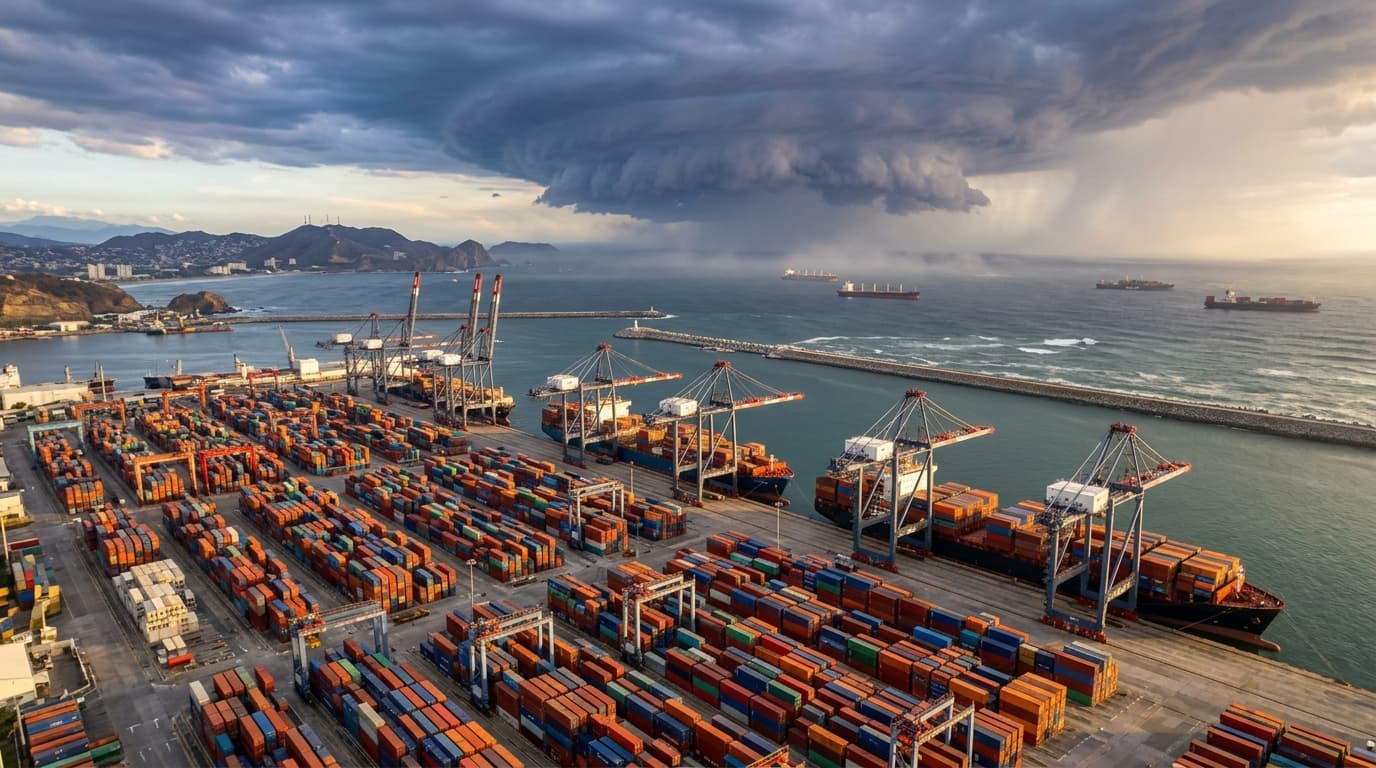
Manzanillo: Mexico’s Busiest Container Port
Manzanillo is Mexico’s principal container port. In January–August 2026 it handled 2,824,839 TEU, an increase of 11.0% over the same period of 2025.
Terminal operators announced these measures:
| Terminal / Operator | Measure |
|---|---|
| Contecon Manzanillo | Vessel attention ended Friday, October 9, at 15:59; operations suspended Saturday, October 10; resumption planned Monday, October 12 |
| SSA Marine México (TEC I and OCUPA) | Operations suspended from 18:00 on October 9; affected appointments rescheduled to October 12 |
| Hutchison Ports TIMSA | Closed Saturday, October 10; appointments rescheduled |
| Granelera Manzanillo | Rail equipment loading suspended from 00:00 on October 10; resumption planned for 08:00 on October 12 |
Sources: terminal notices as reported by T21, DataPortuaria, and a Manzanillo agency notice; C.H. Robinson advisory (October 9)
Reopening
On Monday, October 12, the Manzanillo regional harbor master declared the port open from 9:00 a.m. to vessels over 500 gross tons in ocean and coastal navigation and to smaller vessels. Mexico’s customs agency (ANAM) operated at the port 24 hours that day, and the SSA, TIMSA, and OCUPA terminals resumed available appointments. Contecon announced that it would resume with revised appointment times to help manage the backlog.
Lázaro Cárdenas and Other Ports
The port of Lázaro Cárdenas was closed to all vessels from October 8. On October 11, the Mexican Navy closed nine ports in total, including Manzanillo, Lázaro Cárdenas, Puerto Vallarta, San Blas, and five ports on the Baja California peninsula.
3 · The Second Storm: Trudy
Trudy’s Track
Tropical Storm Trudy formed on October 13, became a hurricane on October 15, and intensified rapidly to a Category 3 with 120 mph (195 km/h) winds on October 16. The National Hurricane Center had forecast a peak at Category 4 and a path similar to Simon’s, passing within about 100 miles of Colima and Jalisco. Trudy followed that general path but did not reach Category 4; its peak remained Category 3.
Trudy passed off the coast of Colima and Jalisco on Sunday, October 18, as a Category 2 and then Category 1 hurricane—at one point about 115 miles (185 km) west-southwest of Manzanillo—and, like Simon, did not make landfall. All hurricane watches and warnings for the Mexican coast had expired by Sunday night, and the NHC classified Trudy as a remnant low on the evening of October 19, about 160 miles west-southwest of Cabo Corrientes.
Impacts
The NHC forecast 4–8 inches of rain, with isolated totals near 12 inches, along the coasts of Michoacán, Colima, and Jalisco. Colima’s civil protection authorities reported flooding, fallen trees, and stranded vehicles in Colima, Villa de Álvarez, and Manzanillo, and state authorities warned that ground already saturated by successive storms increased the risk of damage. We did not find reports of deaths attributed to Trudy in the sources reviewed.
The Second Closure at Manzanillo
| Date / Time | Measure |
|---|---|
| October 16, 21:00 | Manzanillo harbor master closed the port to vessels over 500 gross tons in ocean and coastal navigation (Oficio 5631/2026); operations at external yards and CFS/LCL facilities were also suspended |
| October 17 | Contecon suspended import deliveries from 08:00 and offered no additional Saturday appointments; Hutchison Ports TIMSA rescheduled Saturday appointments to Monday, October 19; port operations suspended from 14:00 |
| October 19, 06:00 | Port reopened to large vessels as conditions improved |
| October 19 | Contecon import and export appointments available after 12:00; container inspections (“previos”) not available until October 20 |
| October 19–23 | Manzanillo customs office operating 24 hours a day to clear accumulated cargo; regular hours resume October 24 |
Sources: Manzanillo harbor master notices as reported by Gomsa, Posta, and AFmedios; Infobae
The Mexican Navy also closed Lázaro Cárdenas and Puerto Vallarta to large vessels during Trudy, along with several smaller ports in Jalisco, Nayarit, and Guerrero. We did not find a confirmed reopening date for Lázaro Cárdenas in the sources reviewed.
⚠️ Key Point: Manzanillo had been open for only about four and a half days between the two closures. The backlog from Simon was therefore still being worked through when Trudy’s closure began.
4 · What Disruption of This Kind Looks Like Operationally
The Closure Is Only Part of the Delay
Even a closure of a few days creates a backlog. C.H. Robinson’s October 9 advisory noted that after terminals reopen, shippers should expect long truck queues at the port, slower customs processing, and limited carrier capacity, and that rail shipments moving inland from Manzanillo may be delayed. After Simon, a Manzanillo agency advised customers to allow extra time because appointments were concentrated on Monday, October 12; ahead of the second reopening, an agency notice similarly advised customers to expect a heavier concentration of operations and possible delays from Monday, October 19.
Two closures in quick succession compound this effect: appointments rescheduled after the first closure overlap with those displaced by the second. Ports operating with high throughput have less room to absorb a backlog, and Manzanillo’s double-digit year-over-year growth is one indicator of how busy the port was before either storm. The decision to extend customs hours through October 23 reflects the volume of cargo waiting to be cleared.
Inland and Cross-Border Flows
We did not find confirmed reports of major damage to Manzanillo’s port facilities or its main inland corridors from either storm; after Simon, Manzanillo’s airport reported no major damage after inspection and reopened on October 12. In Baja California, Rachel’s flooding closed the port of Ensenada on October 10 and caused severe local damage, although one road source reported on October 13 that federal Highway 1 was passable. Shippers using the Tijuana–Ensenada–Mexicali corridor to reach the U.S. border may wish to confirm current conditions with their carriers; we have not verified specific delay or cost figures for this corridor.
5 · What the Episode Suggests About Concentration Risk
Pacific Gateway Concentration
Manzanillo and Lázaro Cárdenas are both on Mexico’s Pacific coast within a relatively short distance of one another, and both closures this month affected both ports at once. Lázaro Cárdenas handled about 1.8 million TEU in January–August 2026, roughly 28% of Mexico’s national container movement, according to port data reported by MundoMaritimo. Together with Manzanillo’s 2.82 million TEU, a large share of the country’s container traffic passes through a stretch of coast that can be affected by the same weather system.
The pattern also extends beyond October. Lázaro Cárdenas was closed to large vessels from September 22 because of Hurricane Polo and reopened on September 25, which means the port was closed three times in roughly four weeks. When two gateways face the same weather systems repeatedly, the alternative routings for Asian cargo bound for Mexico’s interior are more limited than the map might suggest.
Context: Nearshoring and Throughput Growth
As we examined in our analysis of the Mexico nearshoring opportunity, trade and investment flows between Mexico and the United States have been growing strongly, and Manzanillo’s double-digit 2026 throughput growth shows how much Asian-origin cargo also moves through Mexican Pacific ports. Growth of this kind raises the importance of resilience: terminal and inland capacity, appointment systems, and alternative routings.
A Parallel With Other Disruptions
The pattern is familiar from our recent coverage of port congestion elsewhere. As C.H. Robinson and Drewry have noted for global container shipping, even short disruptions at highly utilized terminals can take days or weeks to work through, because spare capacity is limited.
6 · Implementation Considerations for Logistics Providers
Visibility and Communication
- Confirm cargo status for shipments at or bound for Manzanillo and Lázaro Cárdenas, including vessels waiting to berth and containers awaiting pickup
- Share updates early, including changes to terminal appointment times, expected truck queues, and potential storage or demurrage charges
Routing and Scheduling
- Build extra time into Mexico transit schedules while the backlog from two consecutive closures clears
- Consider the options available for cargo that cannot move through Manzanillo or Lázaro Cárdenas, such as other Mexican ports or routing through U.S. gateways, recognizing the cost, transit time, and customs implications of each
- Check rail availability from Manzanillo, since rail loading was suspended during the Simon closure
Monitoring
- Follow official sources: NHC advisories, the Mexican Navy and harbor master notices, terminal operator communications, and carrier advisories
- Review contract terms for force majeure, demurrage and detention, and delay provisions, and document delays caused by official closures, including the dates of each separate closure
Longer-Term Planning
- Map gateway dependencies for Mexico-bound cargo and consider whether secondary options are qualified and ready to use
- Use visibility tools to track cargo through Mexican ports and inland corridors
If your organization would like to discuss routing options or contingency planning for Mexico-bound or U.S.-bound cargo, our team is available to help.
7 · Conclusion: Brief Disruptions With a Broader Message
Key Takeaways
| Factor | Detail |
|---|---|
| Simon | High-end Category 4 at peak; passed ~100 miles off Colima and Jalisco on Oct. 11; no landfall |
| Trudy | Category 3 at peak (forecast Category 4 not reached); passed off Colima and Jalisco on Oct. 18; no landfall; remnant low on Oct. 19 |
| Manzanillo — 1st closure | Terminals suspended Oct. 9–10; port reopened to vessels 9:00 a.m. Oct. 12 |
| Manzanillo — 2nd closure | Closed to large vessels from 9:00 p.m. Oct. 16; reopened 6:00 a.m. Oct. 19; customs operating 24 hours Oct. 19–23 |
| Manzanillo volume | 2,824,839 TEU in Jan.–Aug. 2026 (+11.0%) |
| Lázaro Cárdenas | ~1.8 million TEU in Jan.–Aug. 2026; closed for Polo (Sept. 22–25), Simon (from Oct. 8), and Trudy; latest reopening not confirmed in sources reviewed |
| Other storm | Rachel: flooding in Baja California; at least eight deaths reported by Oct. 14 |
The Takeaway
Neither Simon nor Trudy caused a prolonged shutdown; each led to a precautionary closure of a few days. Taken together, however, they closed Mexico’s busiest container port twice in ten days, and the second closure began before the backlog from the first had cleared. What the episode highlighted is how much Asian-origin cargo for Mexico depends on a small number of Pacific gateways that can be affected by the same weather systems at once, and how much rescheduling follows even short closures. For logistics providers, the practical points are clear communication, flexible scheduling, and a defined understanding of the alternatives.
This analysis reflects information available as of October 20, 2026, including C.H. Robinson’s October 9 advisory; T21 and DataPortuaria reporting on Manzanillo terminal measures; notices from the Manzanillo harbor master (including Oficio 5631/2026), ANAM, and terminal operators as reported by Gomsa, Posta, AFmedios, and Infobae; Lázaro Cárdenas port data reported by MundoMaritimo; National Hurricane Center advisories and NHC-based reporting by CBS News, the Associated Press, and Yale Climate Connections; and Mexican press reports. Storm tracks, port conditions, and recovery timelines change quickly; readers should consult current official advisories and terminal and carrier notices.