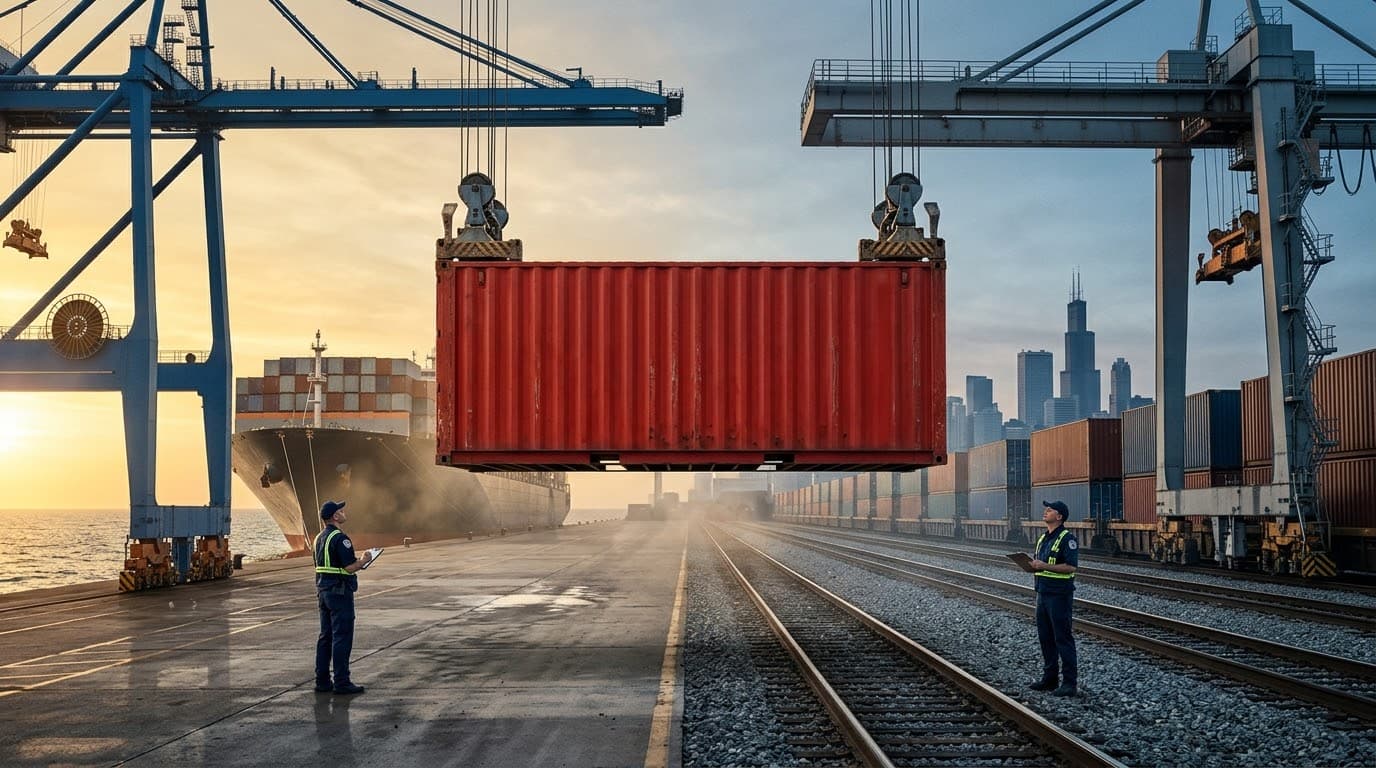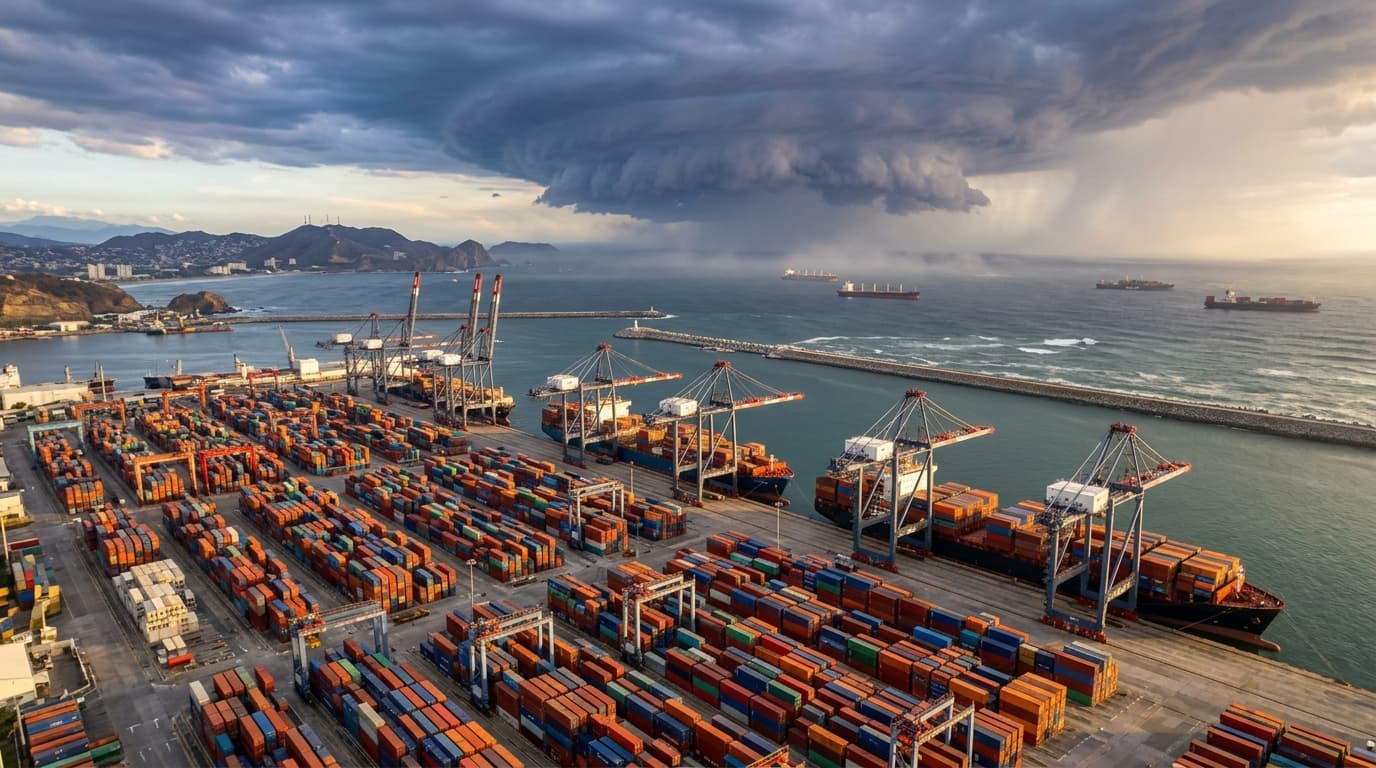
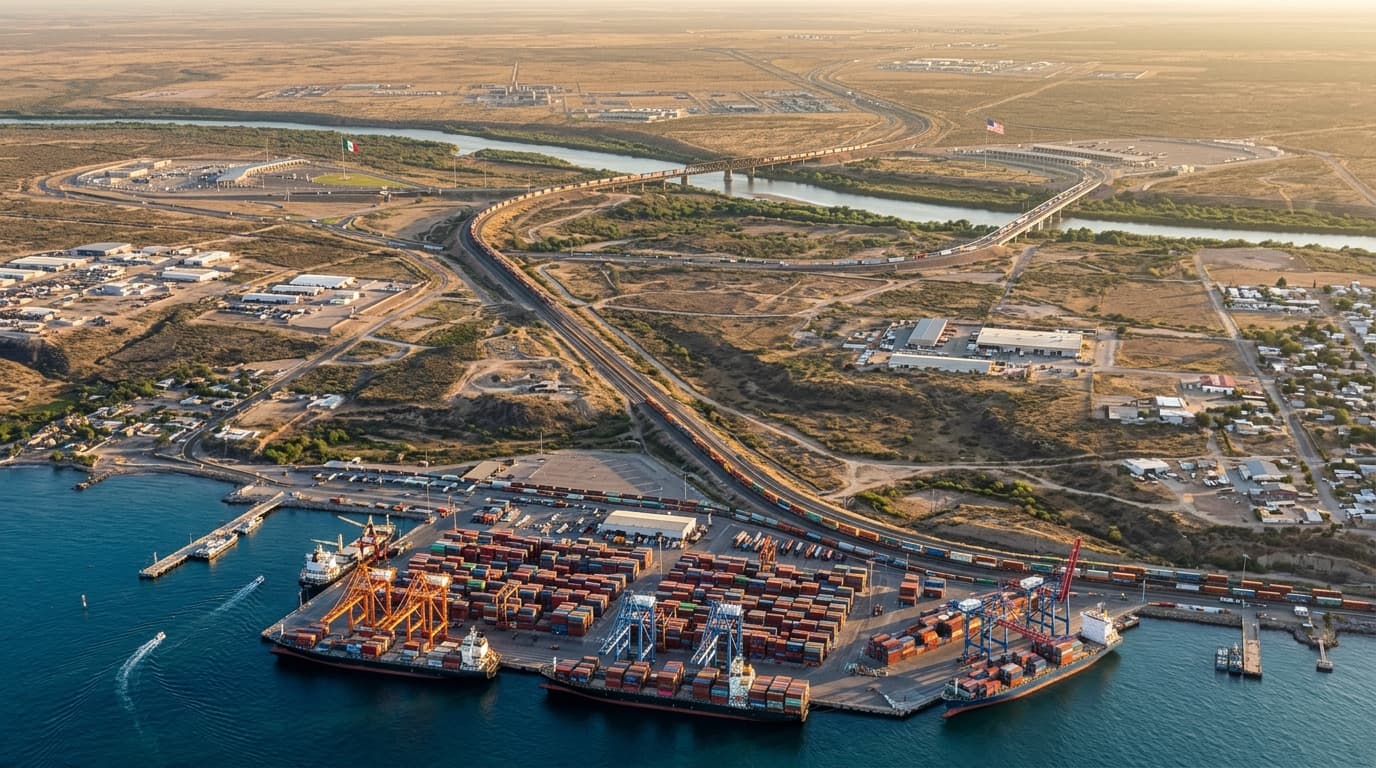
Executive Summary Mexico’s two largest Pacific container ports, Manzanillo and Lázaro Cárdenas, are best known as gateways for Mexico’s own imports, but both also serve as routes for Asia-origin cargo bound for the United States. Manzanillo, Mexico’s busiest container port, handled about 3.89 million TEU in 2025 according to its port authority; Lázaro Cárdenas handled about 2.6 million TEU, according to Mexican port statistics, and is connected by CPKC rail through Laredo to the U.S. Midwest, including a dedicated intermodal service to the Chicago area. Cargo routed this way moves through Mexico under Mexico’s international transit regime, without being imported into Mexico, and enters the United States at the land border or, under U.S. in-bond rules, at an inland port. Because the cargo arrives in the United States by rail or truck rather than by vessel, the Importer Security Filing and the Harbor Maintenance Fee do not apply to it, but U.S. advance manifest rules for rail and truck do, and country of origin does not change by passing through Mexico. The route adds a second customs system, governed since January 2026 by a substantially reformed Ley Aduanera, and concentrates exposure on a few ports, as the two hurricane-related closures in October 2026 showed. This analysis explains how the route works and how it compares with U.S. West Coast routings.
Manzanillo and Lázaro Cárdenas as U.S. Gateways: Routing Asia Cargo Through Mexico’s Pacific Ports
(曼萨尼约与拉萨罗·卡德纳斯作为美国门户:经墨西哥太平洋港口运送亚洲货物)
1 · Why Consider Mexico’s Pacific Ports
The Basic Idea
For cargo from Asia bound for the central United States, the usual routings run through U.S. West Coast ports and then by rail or truck inland, or all-water to the East and Gulf Coasts, as compared in our analysis of West Coast and Chicago gateways. Mexico’s Pacific ports offer another option: discharge in Mexico, move north by rail or truck under customs control, and cross into the United States at the land border.
What Shippers Look For
| Motivation | How the Mexico Route Can Help |
|---|---|
| Diversification | Adds a gateway outside U.S. West Coast port and labor conditions |
| Inland reach | Direct rail corridors to Texas, the Midwest, and the U.S. South |
| Mexico distribution | One routing can serve both Mexican and U.S. customers |
| Capacity alternatives | Another option when U.S. West Coast capacity is tight |
What It Adds
The route also adds complexity: a second customs system, Mexican transit controls and guarantees, a border crossing, and dependence on a small number of ports and rail lines.
⚠️ Critical Takeaway: The Mexico route is not a shortcut around U.S. customs. It is a different physical path to the same U.S. entry, with an additional customs regime in between.
2 · The Two Ports
| Feature | Manzanillo (Colima) | Lázaro Cárdenas (Michoacán) |
|---|---|---|
| 2025 container volume | About 3.89 million TEU (Mexico’s largest) | About 2.6 million TEU |
| Role | Mexico’s main gateway for Asian trade; strong Mexico City and Bajío distribution | Deep-water port with growing container volumes and a strong rail orientation |
| Main rail connection | Ferromex network, connecting with U.S. railroads at several border crossings | CPKC network to Laredo and onward single-line to Texas and the U.S. Midwest |
| Typical U.S. border crossing (rail) | Several, depending on the routing | Laredo, Texas |
Sources: ASIPONA Manzanillo (port authority) for Manzanillo; Mexican port statistics as reported for Lázaro Cárdenas. Figures rounded.
Lázaro Cárdenas and the Laredo Corridor
CPKC, formed in 2023 by the combination of Canadian Pacific and Kansas City Southern, operates the rail line from Lázaro Cárdenas through central Mexico to the Laredo border crossing, the busiest rail crossing between the two countries, and onward on its own network into the United States. CPKC describes its Lázaro Cárdenas–Chicago service as the first dedicated international intermodal train between the port and the U.S. Midwest. A second rail span at Laredo, completed in 2025, increased capacity at the crossing.
Manzanillo
Manzanillo carries the largest share of Mexico’s container trade and is closely linked to central Mexico’s industrial regions. For U.S.-bound cargo, it relies on rail and truck connections to several border crossings rather than one single-line corridor.
3 · How the Cargo Moves Through Mexico
International Transit
Under Mexico’s Ley Aduanera, the régimen de tránsito is the movement of goods under fiscal control from one Mexican customs office to another (Article 124). International transit (Article 130) covers foreign goods that arrive in Mexico destined for another country and move from the customs office of entry to the customs office of exit. In this regime, the goods are not imported into Mexico, so Mexican import duties are not paid as long as the transit is properly completed.
How Transit Is Controlled
International transit across Mexican territory is permitted only in the cases and under the conditions set by Mexico’s tax authority in its general foreign trade rules (Reglas Generales de Comercio Exterior, RGCE). Those rules designate which customs offices may begin and end a transit, set authorized routes for specific corridors, including routes from designated Pacific ports to the U.S. border, and list goods for which international transit is not allowed. A Mexican customs broker or authorized party typically manages the transit filing.
The 2026 Reform
Mexico enacted a substantial reform of the Ley Aduanera, published on November 19, 2025 and in force from January 1, 2026, followed by amended implementing regulations on February 23, 2026. Among other changes, the reform strengthens documentation requirements and the responsibility of parties involved in customs operations, including transit. Where transit is not properly completed, liability is generally measured by the duties and taxes that would have applied on definitive importation into Mexico. Because Mexico raised tariffs in 2026 on many goods from countries without a trade agreement with Mexico, including many Asian origins, the amounts at stake if a transit is not properly closed can be significant.
⚠️ Critical Takeaway: Goods in international transit are not imported into Mexico, but the transit must be filed, routed, and closed correctly. Mexico’s 2026 reforms increased the documentation and liability attached to that process.
4 · Entering the United States
Where Entry Happens
When the cargo reaches the border, it enters the United States in one of two ways:
| Option | How It Works |
|---|---|
| Entry at the border | The importer’s broker files entry at the land port of entry, such as Laredo; after release, the cargo moves as domestic freight |
| In-bond to an inland port | The cargo moves under U.S. in-bond rules to an inland port, such as Chicago or Kansas City, where entry is filed |
U.S. in-bond rules require delivery to the destination port within 30 days and an arrival report within two business days of arrival, as described in our routing comparison.
Which U.S. Requirements Apply
| Requirement | Mexico Pacific Routing | U.S. West Coast Routing |
|---|---|---|
| Importer Security Filing (ISF) | Not applicable to cargo arriving in the U.S. by rail or truck; the ISF applies to cargo arriving at a U.S. port by vessel | Required |
| Advance cargo information | Rail or truck advance electronic manifest before arrival at the border | Vessel manifest and ISF |
| Harbor Maintenance Fee | Not triggered, because the cargo is not unloaded from a vessel at a U.S. port | Applies (0.125% of cargo value) |
| Merchandise Processing Fee | Applies to formal entries | Applies to formal entries |
| Duties | Based on the goods’ classification and country of origin | Same |
| Foreign IOR rule (from January 5, 2027) | Applies to the U.S. entry | Same |
Our ISF guide explains when the ISF applies, and our analysis of the foreign IOR rule for exporters covers the new conditions for importers of record.
Country of Origin Does Not Change
Passing through Mexico, including handling or storage in transit, does not make goods Mexican. Unless the goods are substantially transformed in Mexico, they keep their Asian origin for U.S. duty purposes, including Section 301 duties on products of China and AD/CVD orders. Routing through Mexico while declaring Mexican origin for goods that were not substantially transformed there is a misdeclaration of origin. Our guide to country of origin rules explains the test.
⚠️ Critical Takeaway: The Mexico route changes which U.S. filings and fees apply at arrival, not how the goods are classified or what origin they carry.
5 · Comparing the Routes
| Factor | Mexico Pacific Port + Rail | U.S. West Coast + Rail (IPI) |
|---|---|---|
| Ocean leg from North Asia | Generally somewhat longer than to Southern California | Shortest transpacific routing to North America |
| Inland leg to the Midwest | Rail through Mexico and across the border | Rail across the western U.S. |
| Customs systems | Mexico (transit) and United States (entry) | United States only |
| Border crossing | Yes | No |
| U.S. advance data | Rail or truck manifest | ISF and vessel manifest |
| Harbor Maintenance Fee | Not triggered | Applies |
| Section 301 port fees (currently suspended) | Attach to vessel calls at U.S. ports | Attach to vessel calls at U.S. ports |
| Exposure | Concentrated in a few Mexican ports and rail lines | U.S. West Coast ports and rail interchanges |
Total transit time and cost vary by carrier, service, rail schedule, border dwell, and congestion. The comparison is best made shipment by shipment, using actual schedules and quotes.
6 · Risks Shippers Commonly Weigh
Weather and Concentration
Mexico’s Pacific coast lies in the path of eastern Pacific hurricanes. In October 2026, Hurricanes Simon and Trudy led to two closures of Manzanillo within ten days, and Lázaro Cárdenas was also closed, as discussed in our analysis of the October closures. Because a large share of Mexico’s container trade passes through these two ports, a closure affects many shipments at once.
Congestion
Manzanillo’s volumes have grown faster than surrounding road and rail infrastructure at times, and periods of congestion have raised costs and transit times. Terminal and access capacity are therefore part of the routing decision.
Two Customs Systems
The route requires coordination between a Mexican customs broker handling the transit and a U.S. customs broker handling entry. Inconsistent documents between the two can delay cargo on either side, and under Mexico’s 2026 reform, documentation gaps carry greater consequences.
Cargo Security
Cargo security in transit through Mexico is a long-standing consideration for shippers, and is one reason many U.S.-bound flows use rail or secured truck services. Security procedures are commonly reviewed with carriers and service providers.
Policy Change
Trade relations between the United States and Mexico, Mexico’s own tariff and customs policy, and U.S. enforcement priorities, including scrutiny of origin claims for goods routed through third countries, all shape the route’s risk profile. Our analyses of Mexico’s customs enforcement and the U.S.–Mexico cross-border framework discuss these factors.
⚠️ Critical Takeaway: The Mexico route diversifies away from U.S. West Coast exposure, but it concentrates exposure in a few Mexican ports, a border crossing, and a second customs system.
7 · Practical Considerations
The following points are commonly reviewed by importers and logistics providers considering Mexico’s Pacific gateways. They are offered for information, not as a checklist.
Defining the Purpose
Whether the goal is diversification, inland reach, serving both Mexican and U.S. customers, or capacity, it shapes which port and corridor fit.
Mapping the Full Chain
Ocean carrier, Mexican terminal, Mexican customs broker, rail or truck carrier, border crossing, U.S. customs broker, and final delivery each need to be identified, along with who is responsible for each handoff.
Aligning Documents Across Borders
Commercial invoices, packing lists, origin information, and classification used for Mexican transit and U.S. entry are commonly reviewed for consistency before shipment.
Planning for Disruption
Alternative routings during hurricane season or congestion, and the cost of switching between them, are part of the evaluation.
Comparing Total Landed Cost
A side-by-side model of ocean freight, Mexican handling and transit, rail, border fees, U.S. entry costs, and inventory carrying cost shows how the route compares with U.S. West Coast options for a specific shipment profile.
8 · Conclusion: A Second Pacific Front Door
Manzanillo and Lázaro Cárdenas give Asia-origin cargo a way into the United States that bypasses U.S. West Coast ports, with rail corridors reaching Texas and the Midwest. The route changes which U.S. filings and fees apply on arrival, removing the ISF and Harbor Maintenance Fee in favor of land-border manifest requirements, but it does not change classification, origin, or the duties that follow from them. It adds Mexico’s international transit regime, strengthened by the 2026 customs reform, and concentrates exposure on a few ports, as the October 2026 hurricanes showed.
Key Takeaways
| Factor | Detail |
|---|---|
| Ports | Manzanillo (about 3.89 million TEU in 2025); Lázaro Cárdenas (about 2.6 million TEU) |
| Key Rail Corridor | Lázaro Cárdenas–Laredo–U.S. Midwest (CPKC), including dedicated service to the Chicago area |
| Mexican Regime | International transit (Ley Aduanera Arts. 124, 130); goods not imported into Mexico if transit is properly completed |
| 2026 Reform | Ley Aduanera reform in force January 1, 2026; regulations amended February 23, 2026 |
| U.S. Entry | At the land border or in-bond to an inland port |
| ISF | Not applicable to cargo arriving in the U.S. by rail or truck |
| Harbor Maintenance Fee | Not triggered |
| Country of Origin | Unchanged by transit through Mexico unless substantially transformed |
| Main Risks | Hurricanes, port concentration, congestion, two customs systems, cargo security, policy change |
The Bottom Line
For importers moving Asian goods to the central United States, Mexico’s Pacific ports are a genuine alternative gateway, with their own advantages and their own risks. Understanding how international transit, the border crossing, and U.S. entry fit together, and comparing total landed cost and resilience rather than ocean rates alone, shows where the route fits. Businesses that would like to evaluate Mexico routings alongside U.S. West Coast options may find it useful to work with a logistics partner with operations on both the West Coast and in the Chicago area, and experience coordinating cross-border customs.
The message is clear: Manzanillo and Lázaro Cárdenas can carry Asia cargo to U.S. markets under Mexico’s international transit regime, but the route adds a second customs system and does not change the goods’ origin or U.S. duties.
This analysis reflects Mexico’s Ley Aduanera, including Articles 124 and 130, as reformed by the decree published in the Diario Oficial de la Federación on November 19, 2025 and the amendments to its regulations published on February 23, 2026; port statistics from ASIPONA Manzanillo and Mexican authorities as reported; U.S. regulations on the Importer Security Filing (19 CFR Part 149), the Harbor Maintenance Fee (19 CFR 24.24), and in-bond movements (19 CFR Part 18); and CBP’s interim final rule “Heightened Requirements for Foreign Importers of Record” (91 FR 69977). Rail service descriptions reflect public information from the railroads. Information is current as of November 2026. Mexican transit procedures depend on the RGCE in force and the specific goods and route. Organizations should consult with licensed customs brokers in both Mexico and the United States, carriers, and trade counsel for guidance tailored to their specific shipments.