Executive Summary
The traditional concept of a predictable peak shipping season appears to be losing much of its meaning in 2026, as global trade flows shift toward more volatile and irregular demand patterns throughout the year. A recent industry reader survey of 100 freight transportation and supply chain professionals found that just over half expect peak season to be more active than the previous year—nearly double the share who said the same twelve months earlier. Yet the very definition of “peak season” appears to be shifting alongside these expectations. Industry commentary increasingly suggests that the idea of a single, predictable seasonal surge is becoming outdated, with demand instead fluctuating across multiple overlapping waves throughout the year. Tariff-driven front-loading ahead of a scheduled July tariff expiration pulled substantial cargo volume forward, contributing to record monthly throughput at major West Coast gateways. This analysis examines the survey data, the structural shift toward year-round demand volatility, and the strategic considerations for supply chain leaders navigating a peak season that increasingly behaves less like a discrete season and more like a continuous condition.
2026 Peak Season Outlook: Understanding a Season That No Longer Behaves Like One
(2026年旺季展望:理解一个不再像季节的季节)
1 · The Survey Says: A More Active Peak Season Expected
The Numbers Tell a Story of Cautious Optimism
A recent industry reader survey of 100 freight transportation, logistics, and supply chain professionals offers a useful snapshot of expectations heading into the 2026 peak season.
Just over half of respondents expect peak season to be more active than the prior year—nearly double the share who said the same the year before. Roughly three in ten expect activity to remain about the same, while fewer than one in five expect a slower season, down sharply from a much higher share reported previously.
The Drivers Behind Elevated Expectations
Respondents anticipating a stronger peak season pointed to several converging factors, including pressure to meet customer delivery commitments and service level agreements, tight over-the-road capacity tied to the broader truckload market recovery, expectations of continued freight rate increases, the traditional pull of back-to-school and holiday inventory building, and ongoing geopolitical uncertainty encouraging more proactive shipping behavior.
The Counterarguments
Those anticipating slower activity cited a different set of pressures, including tariff-driven cost increases potentially dampening overall demand, elevated fuel costs affecting transportation economics, and softer consumer spending amid ongoing inflationary pressure.
A Subtle but Telling Shift in Operational Impact
Perhaps the most revealing finding involves how peak season affects day-to-day operations. Roughly eight in ten respondents said peak season affects their daily operations, down from a considerably higher share the previous year. Among those affected, a meaningful portion described the impact as very significant, while the remainder characterized it as somewhat significant.
This decline suggests something important: peak season volatility appears to be becoming a normalized, ongoing condition rather than a discrete annual event. Supply chains, in effect, seem to be adapting to a more continuous state of disruption rather than treating peak season as a distinct, bounded period requiring separate planning.
2 · Rethinking Peak Season: A Shift Toward Multiple Demand Waves
A Structural Shift, Not a Temporary Disruption
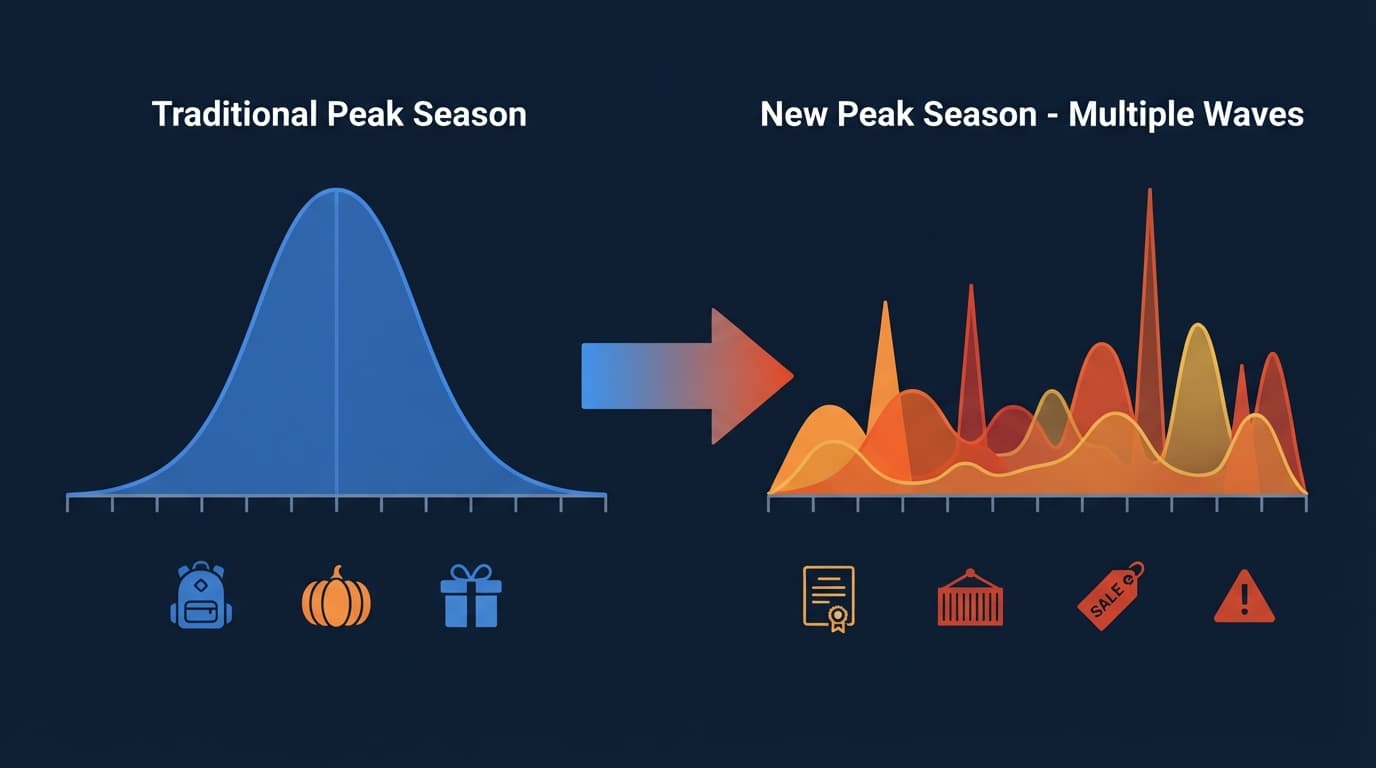
Perhaps the most significant insight for 2026 comes not from survey data alone but from a broader industry rethinking of what “peak season” actually means. Global logistics providers have increasingly suggested that the traditional concept of a predictable peak shipping season is becoming less relevant to how trade actually flows today.
Industry commentary from logistics executives has framed this directly: rather than one predictable surge, demand appears to be fluctuating across multiple waves throughout the year. Volumes are described as less consistent, more reactive, and increasingly driven by external factors ranging from disruptions to cost expectations to retail promotional cycles.
Multiple Overlapping Demand Waves
According to this framing, the market is no longer defined by a single seasonal surge, but by multiple, overlapping demand waves reshaping capacity dynamics and freight rates in ways that traditional seasonal planning does not fully capture.
Key drivers cited behind these overlapping waves include:
- Restocking activity: Inventory replenishment cycles that no longer track a single annual pattern
- Forward bookings ahead of anticipated cost increases: Tariff- and fuel-driven front-loading behavior
- Major retail promotional cycles: Mid-year sales events and other campaigns that create demand spikes outside the traditional holiday window
These factors are prompting companies to move shipments earlier and more frequently throughout the year, contributing to more fragmented and less predictable demand flows overall.
The Impact on Freight Rates
This shift has already shown up in rate data on key trade lanes. Container freight index data indicates that rates from Asia to Northern Europe climbed substantially between the first and roughly twenty-fourth weeks of 2026, while rates to the U.S. West Coast increased by an even larger margin over the same period.
Rather than following a clear, predictable seasonal pattern, volumes increasingly appear to be driven by a combination of triggers that can shift relatively quickly.
Why ‘Early Peak Season’ May Miss the Point
Some industry voices have cautioned against oversimplifying this shift by simply calling it an “early peak season.” That framing may understate what is actually a more structural shift in how global trade flows are organized.
This is not simply a peak season that arrived earlier than usual. It appears to reflect a more fundamental transformation of the demand pattern itself—from a single, predictable annual surge toward multiple, overlapping, and increasingly unpredictable waves distributed across the calendar.
3 · Tariff-Driven Front-Loading: A Primary Catalyst
The Section 122 Tariff Expiration
Among the most important drivers of 2026 peak season dynamics has been trade policy. Temporary global tariffs that took effect earlier in the year, following legal challenges to prior tariff authority, were scheduled to expire on July 24, 2026.
Importers responded by pulling cargo forward aggressively to avoid potentially higher tariff rates expected to follow the expiration. Industry trade policy voices have generally described this year’s early peak season as continuing through July, as retailers and other importers prepared for potentially higher tariffs beginning in August alongside other trade uncertainties.
Record Port Throughput
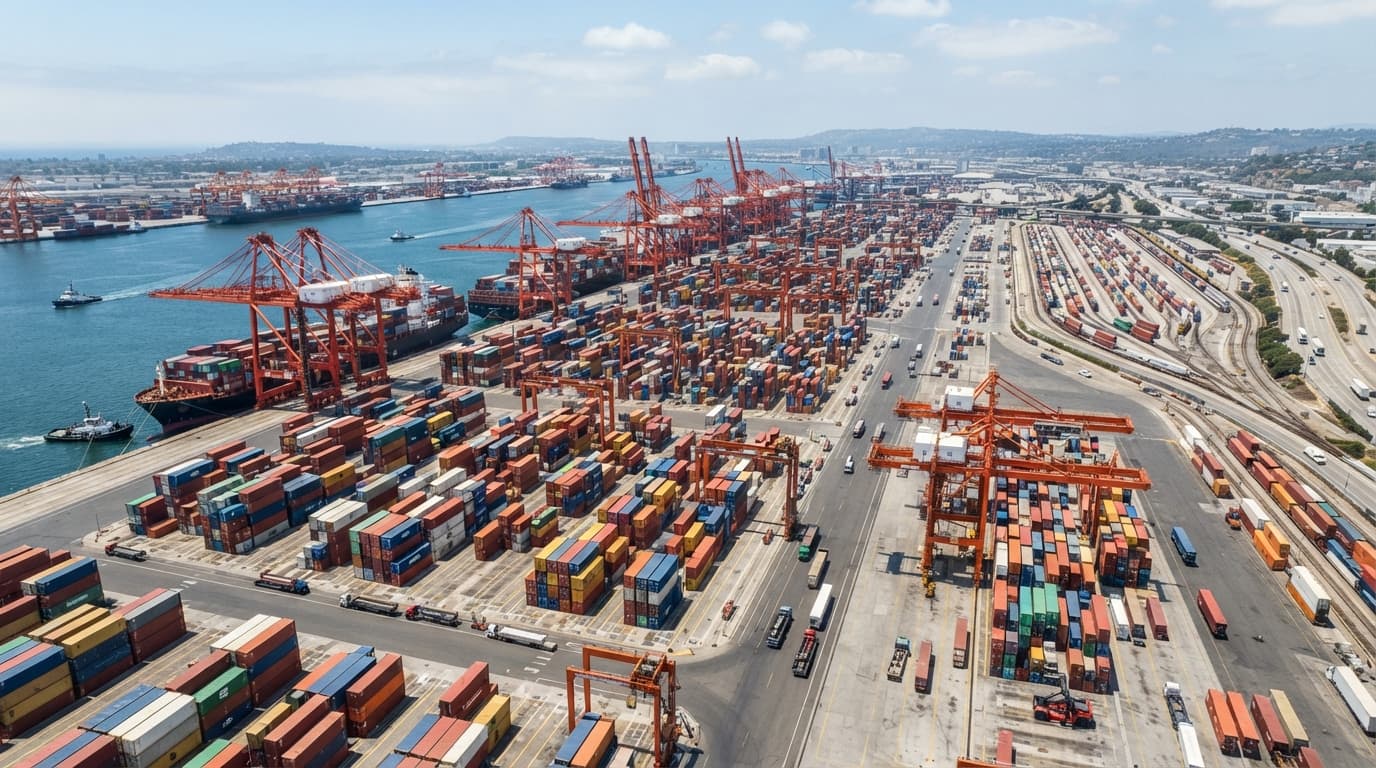
The front-loading trend has been clearly visible in port data. The Port of Los Angeles handled just over one million TEUs in June—up meaningfully from a year earlier and representing the busiest June in the port’s history, as well as one of only a handful of months to top the one-million-TEU mark.
Port leadership has observed that importers are not simply moving more cargo; they appear to be moving it differently. Many companies have stepped away from traditional seasonal shipping patterns, choosing instead to advance cargo whenever favorable conditions present themselves rather than waiting for a predictable shipping window.
The Rate Impact
The rush to pull cargo forward has driven significant rate increases across major lanes. Spot rates from Asia to the U.S. West Coast climbed sharply in the weeks following early May, while rates on the Asia-East Coast lane rose by a comparable magnitude over a similar window.
Industry freight analysts have generally attributed this front-loading primarily to anticipated tariff changes, while also noting the contribution of fuel price increases stemming from broader disruptions affecting key maritime chokepoints.
The Post-July Correction
This front-loading surge is widely expected to be followed by a meaningful correction. Industry port tracking forecasts project a notable year-over-year decline in import volumes for August, followed by further declines in September, October, and November—consistent with the broader pattern of front-loading effectively borrowing volume from later months rather than reflecting genuine demand growth.
4 · Ocean Freight: An Early Peak, Tight Capacity, and Elevated Rates
An Early Peak with a Possible Early Unwind
The ocean freight market has been experiencing an early peak season that began well before the traditional summer-to-fall window typically associated with peak shipping activity. Some industry analysts have noted that an early peak can also imply an early unwind of that peak sometime in the following months.
Record Capacity Deployment Alongside Rising Rates
Despite record capacity deployment on the transpacific trade, rates have continued climbing through much of the period. Industry analysts have pointed to the combination of record capacity deployment alongside further rate increases as a signal that underlying demand remains strong and that carriers are working to keep pace with it.
Rolling average container volumes moving from the transpacific to the U.S. West Coast have approached levels last seen during a prior tariff pause period, underscoring the intensity of the current front-loading cycle.
Carrier Adjustments
In response to elevated frontloading activity, ocean carriers have made service adjustments, including reinstating previously suspended services to accommodate shipper demand during this period of concentrated volume.
Structural Vulnerability in the Network
Industry commentary has also highlighted a structural vulnerability underlying current capacity dynamics. Continued vessel diversions around alternative routing—driven by security concerns along traditional shipping lanes—have lengthened transit times and effectively reduced usable vessel capacity by keeping ships at sea longer than under normal routing conditions.
The combination of high vessel utilization and reduced network flexibility means that even relatively modest increases in demand can trigger disproportionately large freight rate movements, a dynamic that appears to have played out repeatedly through mid-2026.
Continued Upward Pressure Expected
Some ocean freight analysts expect rates to continue increasing over the near term, with at least one major carrier announcing a substantial peak season surcharge effective in mid-July.
5 · Air Freight: Technology-Driven Demand and Capacity Constraints
A Strong but Constrained Market
The air freight market has experienced strong demand alongside significant capacity constraints, particularly out of Asia Pacific origins.
Industry freight reporting has indicated that global air freight spot rates reached notably elevated levels by mid-2026, representing a substantial increase compared with the same period the previous year. Broader demand figures suggest continued year-over-year growth into the spring months, with Asia accounting for roughly half of total global volumes and growing at an even faster pace than the global average.
The Technology Sector Factor
Asia Pacific air freight capacity has generally remained tight as the broader peak season builds, with technology-related cargo—including AI infrastructure components—continuing to drive strong demand out of Taiwan and other regional technology manufacturing hubs.
Operational Challenges
Terminal congestion at several major Asian airports has added further operational pressure to an already tight capacity environment. Industry air freight reporting has attributed recent spot rate increases to a combination of volatility, capacity uncertainty, elevated jet fuel prices, and various risk-related surcharges.
A Revised Rate Outlook
At least one major freight rate analytics firm has substantially revised its 2026 outlook over the course of the year. Having initially forecast a modest decline in long-term air freight rates, the firm has instead moved toward projecting a meaningful increase, citing the broader supply shock associated with escalating regional conflict affecting energy and shipping markets.
6 · The Intermodal Dimension: A Beneficiary of Peak Pressure
Modal Shift Acceleration
Peak season pressure on truckload capacity appears to be accelerating the broader shift toward intermodal transportation described elsewhere in current market analysis. As truckload capacity tightens and rates rise, shippers increasingly appear to be turning to rail as a cost-effective alternative for appropriate lanes.
Capacity Implications
Intermodal volumes have consistently tracked above the five-year average in recent months, with several key markets experiencing notable increases in demand. As this trend continues, rail carriers have in some cases begun prioritizing container reservations for their most committed customers, adding a capacity consideration to what might otherwise be viewed purely as a cost-saving modal shift.
7 · Strategic Considerations for Shippers
Rethinking the Peak Season Mindset
Perhaps the most fundamental implication of 2026 peak season dynamics is that traditional peak season planning frameworks may no longer fully apply. Industry voices have suggested that the assumption of a return to a stable, predictable shipping rhythm no longer reflects current reality, and that businesses increasingly need to operate in a more continuous state of adjustment, where flexibility and real-time insight are essential to staying ahead of demand shifts and disruptions.
From Fixed Cycles Toward Continuous Adaptation
The broader focus among shippers appears to be shifting away from planning around fixed seasonal cycles and toward continuously adapting to changing market signals throughout the year. This generally involves securing capacity earlier and on a more ongoing basis rather than only around a single anticipated peak, optimizing container and shipment utilization to maximize value per movement, diversifying transport options to build redundancy across modes and carriers, and strengthening real-time visibility across the broader supply chain.
The Tariff Planning Imperative
Given the central role trade policy has played in driving recent demand patterns, shippers increasingly benefit from integrating policy monitoring directly into supply chain planning processes. Industry trade analysts have noted that tariff changes have become a recurring feature of the operating environment, and that shippers have become accustomed to pulling cargo forward where doing so makes practical sense.
Planning for the Post-Peak Period
With imports expected to decline meaningfully after July, shippers may benefit from planning for a potential volume correction extending from August through November. An early peak, in other words, may reasonably be followed by an early unwind—a pattern worth incorporating into planning assumptions rather than treating as a surprise.
Balancing Cost and Service
In an environment of elevated rates and tight capacity, shippers generally need to balance cost optimization against service reliability more carefully than in calmer market conditions. The lowest-cost option available at any given moment is not necessarily the lowest-risk choice once service reliability and capacity assurance are factored in.
8 · Looking Beyond 2026: A Broader Transformation
A Potential New Normal
The dynamics shaping the 2026 peak season do not appear to be a one-year anomaly confined to current tariff and geopolitical conditions. They may instead represent a more lasting transformation in how global trade flows are organized and managed. As some industry commentary has framed it, the assumption that supply chains will return to a stable, predictable rhythm no longer appears to reflect current reality.
Implications for Supply Chain Design
Supply chains increasingly appear to need designing for volatility rather than stability as a baseline assumption. This generally involves prioritizing resilience over pure efficiency, accepting somewhat higher baseline costs in exchange for reduced vulnerability to disruption; building in continuous monitoring capabilities that support real-time visibility and faster decision-making; maintaining flexible capacity arrangements that can scale up or down in response to shifting demand signals; and treating tariff and trade policy developments as permanent planning inputs rather than occasional disruptions.
The Role of Technology
Consistent with broader industry analysis of supply chain technology trends, intelligence and end-to-end visibility appear to be becoming essential competitive capabilities rather than optional enhancements. Organizations able to see and understand their supply chains in near real time—and act promptly on that intelligence—appear increasingly likely to outperform those operating with more limited visibility into shifting demand and capacity conditions.
9 · Conclusion: A Peak Season That Behaves Differently
A Meaningful Transformation
The 2026 peak season appears meaningfully different from prior years—not simply because it is busier, though available data suggests it generally is, but because the underlying concept of a “peak season” itself appears to be shifting. Survey data points to a clear majority expecting a more active season than the year before. Port data points to record monthly throughput at major gateways. Rate data points to substantial increases across major transpacific lanes within a relatively short window.
A Deeper, More Structural Story
Beneath these individual data points lies a more structural narrative. Rather than simply describing a peak that arrived early, current industry analysis increasingly points toward the gradual erosion of the predictable seasonal cycle that supply chains have historically planned around. Multiple overlapping demand waves—driven by tariff policy, disruptions, and evolving retail promotional cycles—appear to be replacing the single, predictable surge that once defined peak season planning.
The Strategic Takeaway
For supply chain leaders, the broader signal emerging from 2026 seems reasonably clear: the era of straightforwardly predictable seasonality may be giving way to something more continuous and variable. Success increasingly appears to depend less on mastering a single annual peak season cycle, and more on building organizations capable of adapting continuously to changing market signals—securing capacity earlier, diversifying transport options, and maintaining real-time visibility across increasingly complex and less predictable supply chains.
The 2026 peak season, in this sense, may be less a discrete season and more a signal of a broader, ongoing transformation in how global trade moves.
This analysis reflects 2026 peak season conditions based on available industry survey data, market commentary, and port and freight rate reporting as of mid-2026. Market conditions evolve continuously and specific circumstances vary by shipper, product, and trade lane. Organizations managing peak season planning should consult with logistics providers and supply chain professionals for guidance tailored to their specific requirements and circumstances.