Executive Summary On September 29, 2026, UPS’s Happy Returns announced that it is now integrated directly into TikTok Shop—the first time Happy Returns has been integrated into a platform itself rather than through individual retailer websites. The integration gives TikTok Shop its only box-free, label-free return option, with consumers initiating returns inside the app and dropping items at nearly 10,000 Return Bar locations across the U.S. The integration comes ahead of the holiday returns season. In the most recent NRF and Happy Returns report (October 2025), retailers expected 17% of holiday sales to be returned, against an annual return rate estimated at 15.8% of sales for 2025 (19.3% for online sales). For sellers whose goods cross borders, returns carry additional customs, duty, and freight considerations that a domestic drop-off network does not itself resolve. The Happy Returns–TikTok Shop integration can be read as being about more than convenience: it standardizes the front end of the return, while the seller still has to decide where returns are inspected, dispositioned, and either resold or exported. This analysis examines what the integration does and does not address, why returns matter for peak-season capacity, and the disposition decisions that determine whether a return is a loss or a recovery.
Returns as a Peak Problem: What the TikTok Shop–Happy Returns Integration Actually Signals
1 · The News: A Returns Network Inside the Platform
What Was Announced
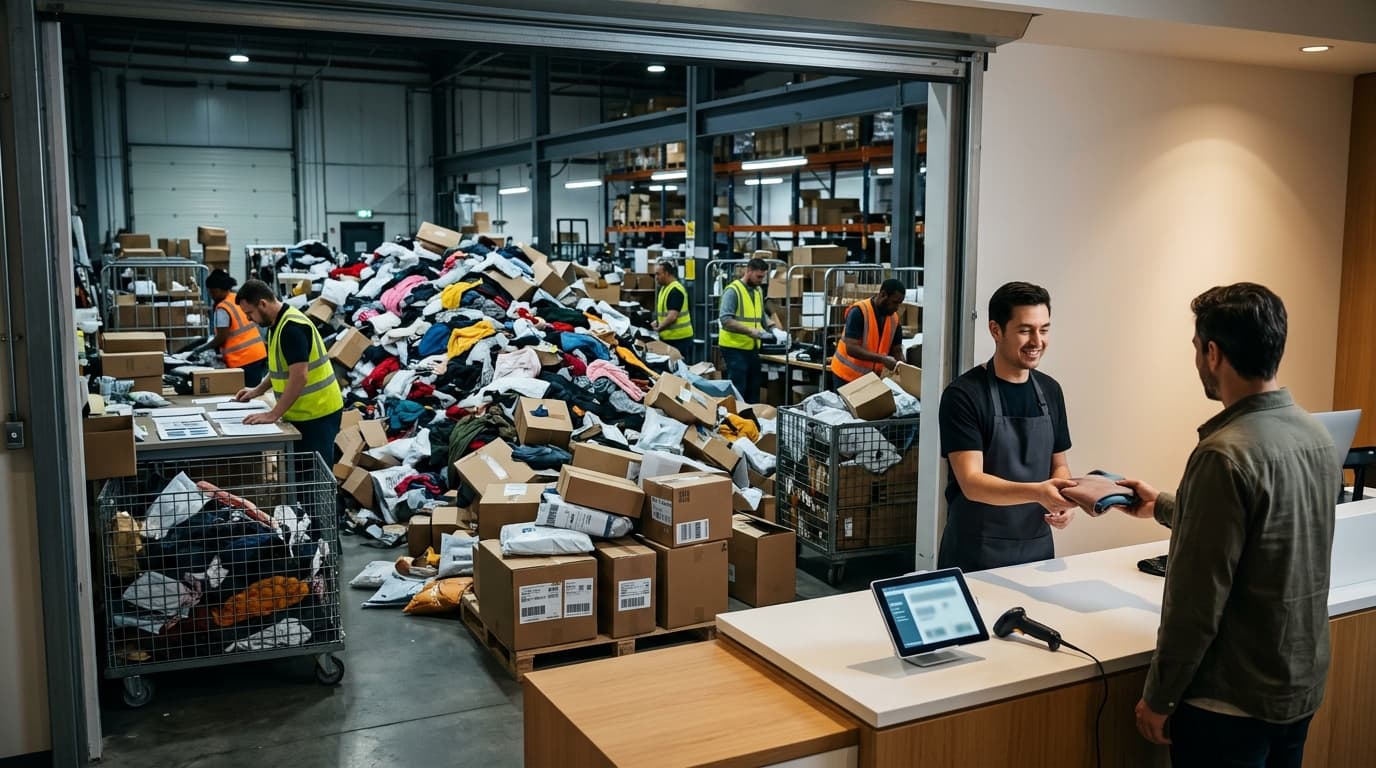
Happy Returns, the reverse logistics and software company acquired by UPS from PayPal in late 2023, announced on September 29, 2026 that it is now integrated into TikTok Shop in the United States. The mechanics are straightforward from the consumer’s side:
| Element | Detail |
|---|---|
| Initiation | Consumer starts the return inside TikTok Shop and selects Happy Returns as the method |
| Drop-off | Nearly 10,000 Return Bar locations—including The UPS Store, Ulta Beauty, and Staples |
| Label and box | None required—the item is handed over at the counter |
| Verification and consolidation | Items are scanned and verified at the Return Bar, then consolidated and shipped to processing facilities and onward to the seller |
| Refund | Instant refunds at the point of drop-off |
Sources: Happy Returns announcement of September 29, 2026; Supply Chain Dive; Retail Dive; WWD/Yahoo Finance
Why This Integration Is Different
This is not the first returns partnership. What makes it notable is the architecture:
“The collaboration marks the first time Happy Returns has been directly integrated into a platform like TikTok Shop, instead of through individual retailers’ websites.”
That distinction matters. When returns are integrated at the platform level, the returns experience becomes closer to a platform feature than a merchant-by-merchant configuration. The option is available to participating retailers whether they fulfill orders themselves or use TikTok’s fulfillment. Setup differs by model: according to Retail Dive’s coverage, orders fulfilled by TikTok require no setup, while for seller-fulfilled orders Happy Returns described the service as best suited to merchants handling roughly 10,000 or more returns a year, primarily in apparel, footwear, and accessories.
The announcement describes U.S. drop-off and consolidation. It does not describe how returns of cross-border sellers’ goods would be routed to an origin country or how customs treatment would be handled; those questions are taken up below as considerations for sellers, not as features of the integration.
The Fraud Dimension
Happy Returns frames drop-off verification as a fraud-control mechanism, not just a convenience feature. Research published by Happy Returns (with Wyllo) reports that mail-in returns see a six-times higher fraud rate than in-person, box-free drop-offs, and that in-person drop-off with item verification can cut fraud by at least 85%, based on the company’s internal data. The same research reports that for orders over $500, 1 in 64 orders involves return fraud, and 1 in 27 is marked by return policy abuse such as wardrobing. These are vendor-published figures from a company that sells the service, and should be read with that in mind.
The underlying point is that the returns channel is also a risk channel, and moving returns to a controlled physical touchpoint may change both the cost and the fraud profile.
⚠️ Critical Takeaway: The integration standardizes the returns event at the platform level. The seller’s downstream disposition questions remain, and may become more visible as returns are consolidated.
2 · The Scale: Why Holiday Returns Matter for Capacity
The NRF Data
The most recent NRF and Happy Returns report, the 2025 Retail Returns Landscape (October 2025), found that retailers expected 17% of holiday sales to be returned, a figure the report described as consistent with previous years. The same report estimated 2025 total retail returns at $849.9 billion, or 15.8% of annual sales (down from $890 billion, or 16.9%, in 2024), and estimated that 19.3% of online sales would be returned. NRF has said it will release new holiday returns insights in mid-December 2026; the 2025 figures are therefore the most recent published benchmarks and may differ from 2026 outcomes.
What 17% Means Operationally
A return rate can be read as a volume forecast. In the same NRF survey, 82% of shoppers said they would return an unwanted holiday gift within a month of receiving it, and online purchases are returned at higher rates than purchases overall. To plan for peak returns, retailers surveyed said they would rely more on third-party logistics partners (49%), hire seasonal staff to handle returns (43%), and extend return windows (37%).
For illustration, for a seller with $10 million in holiday sales, a 17% return rate would mean about $1.7 million in returned merchandise arriving over a compressed period. That volume has to go somewhere. It requires:
| Requirement | Why It Matters |
|---|---|
| Receiving capacity | Someone has to accept, scan, and log each return |
| Inspection | Condition must be verified before a refund or restock decision |
| Disposition workflow | Each unit must be routed to restock, refurbish, liquidate, or dispose |
| Documentation | For cross-border goods, customs and duty treatment must be resolved |
The Timing of Returns
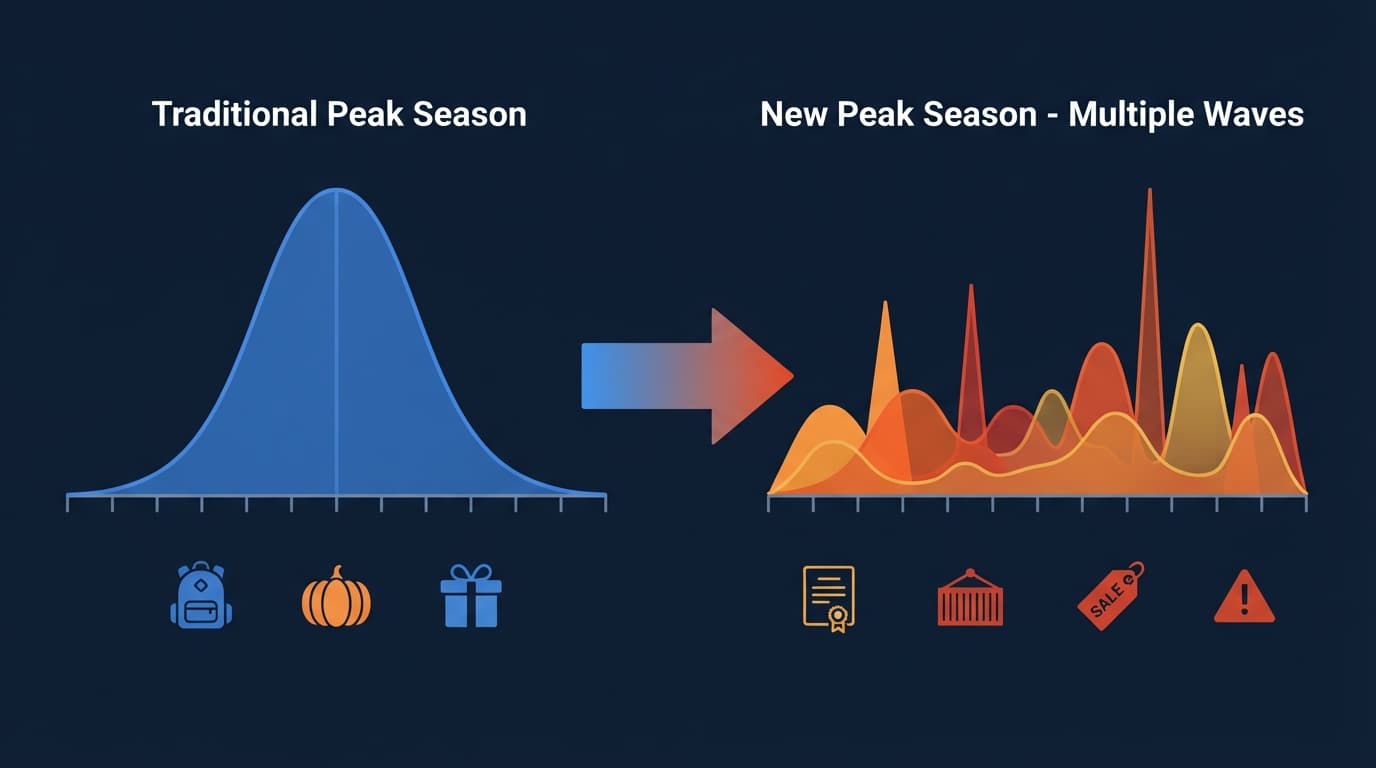
One feature of peak-season returns is when they land. Extended holiday return windows can push returns into January—after the sale has been counted and revenue recognized, and potentially after the next season’s inventory plan has been set.
The operational consequence can be a capacity squeeze in January, when warehouse space is being reallocated to new-season inventory and staffing may be reduced after peak. Whether this occurs depends on each seller’s return windows and operations.
⚠️ Critical Takeaway: A 17% holiday return rate translates into a compressed volume event that can arrive after revenue is booked and before the next season’s inventory is in place. Where returns will go and how they will be handled are planning questions as much as customer-service ones.
3 · The Cross-Border Layer: Additional Steps and Costs
Why Cross-Border Returns Are Structurally Harder
For domestic returns, the workflow is relatively contained: receive, inspect, restock or liquidate. For cross-border returns, the same return can carry three additional layers:
| Layer | What It Adds |
|---|---|
| Customs formalities | Re-import documentation, classification changes, proof-of-origin verification |
| Financial reconciliation | Duties and taxes reclamation, refund validation, currency conversion |
| Additional transport legs | Extra freight legs, modal handoffs, higher damage risk across longer handling chains |
These layers describe general industry considerations rather than measured benchmarks. Published estimates of how much more cross-border returns cost or how much longer they take vary widely by lane and vendor, and no single authoritative figure is cited here.
The Strategic Consequence
For a cross-border seller, the return decision is not only “should I accept the return?” It is also “where should the return land, and what should happen to it there?” The options are structurally different:
| Option | What It Requires | What It Costs |
|---|---|---|
| Return to origin country | Reverse freight, re-import clearance, duty treatment | Highest freight cost; slowest |
| Dispose locally | Local disposal or liquidation | Low logistics cost; total loss of goods |
| Inspect and restock locally | Local receiving, inspection, restock capability | Moderate cost; preserves resale value |
| Refurbish and resell locally | Repair capability, secondary channel access | Higher handling cost; recovers partial value |
| Re-export to a third market | Export documentation, destination compliance | Complex; U.S. duty already paid may be recoverable through drawback in some cases |
⚠️ Critical Takeaway: For cross-border sellers, returns are not only a shipping question. They are also a disposition question. A seller without local receiving and inspection capability has fewer options, and may be left choosing between paying to ship goods back and writing them off.
4 · The Disposition Decision: Where Value Is Won or Lost
The Four Dispositions
Reverse logistics practice commonly distinguishes four post-inspection dispositions:
| Disposition | What Happens | When It Makes Sense |
|---|---|---|
| Restock | Returned to inventory for resale (requires condition certification) | Like-new condition; demand still exists |
| Refurbish | Repaired and resold through secondary channels | Functional but cosmetically imperfect; repair cost below resale value |
| Liquidate | Sold in bulk to reduce holding costs | Slow-moving; bulk recovery better than storage cost |
| Recycle/Dispose | Sustainable end-of-life handling | Non-resalable; hazardous or expired |
General industry framework; not a regulatory classification.
The Timing Trap in Disposition
The disposition decision can be delayed because inspection is delayed. A returned item may sit in a receiving area waiting for someone to open it, verify condition, and route it. Each day of delay can:
- Increase storage cost
- Reduce resale value (seasonal goods tend to lose value fastest)
- Consume space that is needed for new inventory
For this reason, inspection capacity can be a binding constraint in peak-season returns, alongside transportation.
The Cross-Border Wrinkle: Duty Treatment
For cross-border goods, disposition can carry a customs consequence that domestic returns do not. The treatment depends on the direction of the movement and the goods’ origin. U.S.-origin goods that were exported and are returned may qualify for duty-free treatment under HTSUS Chapter 98 (for example, heading 9801), subject to documentation and condition requirements. For foreign-origin goods on which U.S. duty was paid at import and that are later exported, duty drawback under 19 U.S.C. 1313 may allow recovery of duties in some circumstances, subject to conditions such as time limits, documentation, and the goods’ condition. Whether either route applies depends on the specific facts, and sellers typically confirm treatment with a customs broker.
⚠️ Critical Takeaway: The disposition decision is a financial decision as well as an operational one. Recovering value from returns depends on inspecting and deciding quickly and on executing the chosen disposition without incurring avoidable customs costs.
5 · What the Integration Signals About the Returns Landscape
The Platform Is Becoming the Returns Layer
The Happy Returns–TikTok Shop integration is one indication that platforms are taking a larger role in the returns experience. When returns are integrated at the platform level:
- The consumer experience becomes consistent across sellers
- The fraud control becomes standardized at the drop-off point
- Returns data may be more visible to the platform, not just the seller
- The seller’s differentiation may shift from “easy returns” toward “what happens after the return”
The Seller’s Remaining Problem
The platform can standardize the front end of the return—initiation, label-free drop-off, instant refund. It cannot standardize the back end: what happens when the consolidated returns arrive at the seller’s facility. That is still the seller’s problem, and for cross-border sellers, it is a problem with customs, duty, and disposition complexity that the platform does not absorb.
The “Returns Are Part of Peak” Framing
Industry commentary increasingly treats returns as part of the holiday season itself rather than a post-holiday cleanup task. That framing moves returns from an exception-handling function toward a capacity-planning function.
⚠️ Critical Takeaway: The integration does not by itself resolve the seller’s back-end returns questions. It standardizes the front end, which leaves the back end—inspection, disposition, and customs treatment—as a place where sellers’ operations can differ.
6 · Questions Sellers Commonly Consider About Returns Handling
The Six Questions
Sellers planning for holiday returns often work through six questions:
| Question | Why It Matters |
|---|---|
| Where will the return physically land? | A U.S. address, a third-country hub, or the origin country? |
| Who inspects it, and how fast? | Inspection speed determines resale value |
| What are the disposition rules by category? | Restock, refurbish, liquidate, or dispose—decided in advance |
| What is the duty treatment of a returned cross-border item? | Re-import, re-export, or duty-free relief? |
| What is the storage cost of delay? | Per-pallet, per-day cost of holding a returned unit |
| What is the resale channel for each disposition? | Where does a refurbished unit actually sell? |
Planning Where Returns Land
One approach is to decide where returns will go before the first return is initiated. That decision shapes:
- Whether the return can be inspected locally or must travel internationally
- Whether the item can be restocked or must be liquidated
- Whether the duty event can be avoided, deferred, or recovered
- Whether peak return volume is handled as a planned workflow or as an exception
⚠️ Critical Takeaway: Returns handling is shaped by decisions made well before returns arrive—particularly where returns land and how they are dispositioned.
7 · Conclusion: The Front End Is Standardizing. The Back End Is Still Yours.
The Happy Returns–TikTok Shop integration is a notable development: according to trade press coverage, it is the first time Happy Returns has been integrated directly into a platform rather than through individual retailers’ websites. It is intended to make returns easier for consumers, more consistent for sellers, and more resistant to fraud, though the companies have not published evidence on its effect on conversion or repeat purchases.
Key Takeaways
| Factor | Detail |
|---|---|
| Integration Date | September 29, 2026 |
| Drop-off Network | Nearly 10,000 Return Bar locations (U.S.) |
| Consumer Experience | Box-free, label-free, instant refund |
| Holiday Return Rate (NRF/Happy Returns, 2025 report) | 17% of holiday sales |
| Annual Return Rate (2025 estimate) | 15.8% of sales (19.3% of online sales); 2024: 16.9% |
| Cross-Border Considerations | Customs, duty treatment, and freight legs; no single benchmark cited |
| Fraud Reduction at Drop-off | At least 85% (Happy Returns internal data; vendor-published) |
| Next NRF Update | Holiday returns insights expected mid-December 2026 |
The Bottom Line
For sellers, particularly those whose goods cross borders, the front end of returns is becoming a platform feature, while the back end remains the seller’s responsibility. Where a return lands, who inspects it, and what happens next determine how much value is recovered.
The message is clear: returns are part of peak-season capacity planning, and the platform-level integration standardizes the front end while leaving inspection, disposition, and customs treatment to the seller.
This analysis reflects the Happy Returns–TikTok Shop integration announced September 29, 2026, the NRF and Happy Returns 2025 Retail Returns Landscape report (October 2025), research published by Happy Returns and Wyllo on return fraud, and general industry practice on returns disposition. Fraud figures are vendor-published; return-rate figures are 2025 survey estimates, and NRF has indicated it will release new holiday returns insights in mid-December 2026. Specific return rates, costs, and disposition requirements are subject to individual seller operations and applicable customs regulations. Sellers should consult with their logistics partners and customs advisors for guidance tailored to their product categories and return profiles.