
Executive Summary
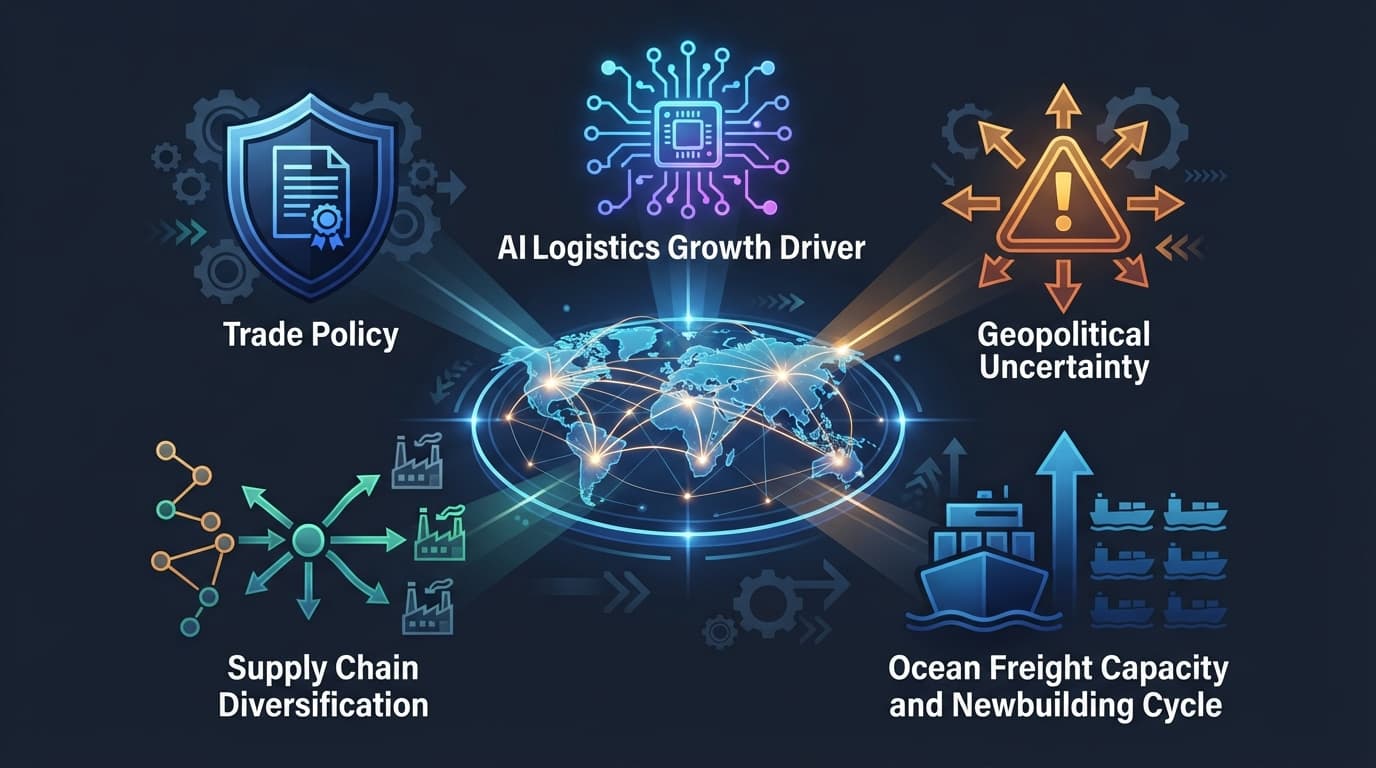
The 37th Annual Council of Supply Chain Management Professionals (CSCMP) State of Logistics Report, titled “Forged in Disruption,” concludes that supply chain volatility has shifted from a temporary condition to a lasting feature of the operating environment. U.S. business logistics costs totaled $2.4 trillion in 2025, or 7.8% of GDP, down from $2.6 trillion and 8.7% of GDP the previous year. While total expenditures declined due to softening ocean rates and flat rail revenues, operational complexity has reached an all-time high. The report, authored by Kearney and presented by Penske Logistics, identifies five structural forces reshaping the macro environment: asymmetrical global growth, tightening financial conditions, geoeconomic realignment, labor and productivity constraints, and energy price volatility. Artificial intelligence has moved from evaluation to measurable commercial returns in targeted applications, though adoption across the industry remains uneven. This analysis examines the report’s key findings, sector-specific insights, and strategic implications for supply chain leaders navigating an era of ongoing disruption.
2026 State of Logistics Report: Understanding an Industry ‘Forged in Disruption’
(2026年物流状况报告:在动荡中锻造的行业解读)
1 · The Report at a Glance: Nearly Four Decades of Industry Intelligence
A Legacy of Insight
The CSCMP State of Logistics Report, now in its 37th year, has long served as one of the industry’s most closely watched annual analyses of supply chain and economic trends. Produced for CSCMP by global consulting firm Kearney and presented by Penske Logistics, the report offers a comprehensive view of the American economy through the lens of the logistics sector and its role in broader supply chain performance.
This year’s edition, titled “Forged in Disruption,” arrives at a moment when the forces reshaping global supply chains appear less like temporary disruptions and more like enduring features of the operating environment. Korhan Acar, Kearney partner and lead author of the report, has framed the shift directly: the changes now underway are not temporary. Tariff complexity, geopolitical uncertainty, changing trade flows, AI adoption, and new network designs are becoming permanent features of the logistics landscape, and companies are increasingly redesigning how they operate rather than waiting for prior conditions to return.
The Central Thesis
The report’s central argument is that the era of predictable cyclicality in logistics has effectively ended. Persistent disruptions—spanning conflicts, energy markets, and labor shortages—are combining to form a new paradigm defined by ongoing, rather than episodic, disruption. Traditional performance drivers such as demand recovery and network scale are becoming less reliable indicators of success. Instead, performance increasingly depends on building resilience into operations, maintaining pricing discipline, and accelerating investment in digital tools and automation.
2 · U.S. Business Logistics Costs: A Deceptive Normalization
The Numbers
U.S. business logistics costs (USBLC) came in at $2.4 trillion in 2025, representing 7.8% of national GDP. This compares to $2.6 trillion and 8.7% of GDP in 2024—a meaningful percentage-point reduction in logistics costs as a share of the broader economy.
The $2.4 trillion figure spans transportation modes and logistics functions broadly. Motor carrier expenditures, the largest single category within total logistics costs, grew 1.7% in 2025 as carrier exits tightened truckload capacity and supported a supply-driven rate recovery even amid mixed underlying freight demand.
What the Decline Really Means
While total expenditures declined, the underlying data suggests a somewhat deceptive normalization. According to Acar, the drop in costs is attributable primarily to a decrease in ocean freight expenditures, which fell 36% as rates stabilized and persistent overcapacity weighed on pricing, combined with generally soft freight demand.
A critical distinction emphasized in the report: although aggregate costs are down, operational complexity remains elevated. The apparent cost reduction masks an environment of unprecedented complexity beneath the surface. Supply chains are not becoming simpler or easier to manage; total spending is simply lower in aggregate due to specific market conditions within ocean freight.
Historical Context
Prior to the pandemic, USBLC had generally hovered between 7.4% and 8.1% of nominal GDP. Following the elevated readings recorded during 2023 and 2024, some observers speculated that logistics costs were settling at a permanently higher post-pandemic baseline. This year’s figures appear to challenge that view, suggesting a partial return toward historical norms—though the complexity underlying those costs has changed in fundamental ways that the headline percentage does not fully capture.
3 · The Five Structural Forces Reshaping the Operating Environment
The report identifies five persistent structural forces continuing to reshape the macro environment, none of which show clear signs of resolution in the near term.
1 · Asymmetrical Global Growth
Regional economic growth remains highly uneven across the globe. The United States is projected to grow between 2.2% and 2.4% in 2026, while India and Southeast Asia are expected to lead global expansion. Europe lags at roughly 1% growth, and Gulf Cooperation Council (GCC) economies have turned negative, contracting by approximately 1.2% as conflict in the Middle East continues to disrupt energy flows.
This asymmetrical growth pattern creates divergent demand signals across different trade lanes and regions, complicating capacity planning and network design for logistics providers serving multiple international markets simultaneously.
2 · Tightening Financial Conditions
Persistent inflation and rising public debt levels are tightening financial conditions globally. This constrains investment capacity for both shippers and logistics providers, making capital allocation decisions more consequential and more difficult across the board.
For carriers specifically, tightening financial conditions have accelerated the capacity exit that has driven the supply-side recovery already underway in truckload markets. Smaller operators, unable to access affordable capital to replace aging equipment or absorb rising operating costs, have increasingly been forced out of the market entirely.
3 · Geoeconomic Realignment
Accelerating shifts in trade flows and broader geoeconomic realignment continue to reshape global trade patterns. The report highlights the Strait of Hormuz as a defining chokepoint in this realignment, carrying roughly 20 million barrels of oil per day along with approximately 20% of global liquefied natural gas trade.
Tariff policy has been a particularly significant factor, changing on average every 1.5 weeks in 2025—a pace the report describes as creating a “paralysis effect” on network reconfiguration decisions. This rapid-fire policy environment has made long-term network planning considerably more difficult and has encouraged many companies to react to developments as they emerge rather than execute a consistent long-term strategy.
4 · Labor and Productivity Constraints
Labor market and productivity constraints continue to pressure the logistics industry broadly. The report notes that companies are increasingly responding to these constraints with accelerated automation and expanded digital investment in AI-driven tools.
The trucking industry has been particularly affected, with regulatory actions such as the FMCSA’s non-domiciled CDL rule removing a substantial number of drivers from the labor pool. Warehousing and distribution operations face parallel challenges in finding and retaining qualified workers amid similarly tight labor conditions.
5 · Energy Price Volatility
Energy price volatility has emerged as a persistent structural force in its own right. The report’s findings on energy volatility align closely with the dramatic diesel price swings experienced throughout 2026—from roughly $3.52 per gallon in January to over $5.60 in May—alongside ongoing uncertainty surrounding Middle Eastern energy flows more broadly.
4 · Artificial Intelligence: From Evaluation to Measurable Returns
A Genuine Turning Point
One of the report’s most significant findings is that artificial intelligence has crossed from a period of evaluation into genuine commercial application within targeted areas. AI is no longer treated primarily as an experimental technology; in specific, well-defined applications, it is now delivering measurable commercial returns.
As Acar put it, the industry has reached a genuine turning point in the autonomous era, with AI, robotics, and autonomous trucking moving rapidly from limited pilots toward scaled deployment.
The Four Capabilities of AI in Supply Chains
The report frames AI’s value creation across four core capabilities:
- Interpret: Making sense of complex network signals and data streams
- Predict: Anticipating disruptions and demand patterns before they fully materialize
- Recommend: Suggesting optimal actions and responses based on available data
- Execute: Automating workflows and implementing decisions with reduced manual intervention
Interpret and predict remain the most mature of these capabilities, built on years of prior investment in visibility platforms and telematics infrastructure. Physical AI—covering warehouse robotics and autonomous vehicles—is now producing some of the industry’s most visible commercial milestones to date.
The Adoption Gap
Adoption remains uneven across the industry, however, widening the gap between organizations that have embedded AI into core operational workflows and those still confined to isolated point solutions. As the report notes, a considerable gap persists between companies that have integrated AI into core workflows and those still limited to narrow, siloed applications—with a meaningful share of organizations having implemented essentially none of it at all.
This adoption gap is increasingly becoming a competitive differentiator. Companies that successfully integrate AI into core operations are gaining meaningful advantages in efficiency, responsiveness, and cost management, while those that lag face growing pressure to close the gap before it widens further.
5 · Network Drift: The Emerging Risk of Constant Adaptation
A New Challenge
The report identifies an emerging and somewhat counterintuitive challenge it terms “network drift.” This concept addresses the cumulative risk that arises when companies make a series of individually reasonable network changes that ultimately produce a supply chain that no longer functions efficiently as a coherent whole.
Network Debt Versus Network Drift
The report distinguishes network drift from the more familiar concept of “network debt,” which refers to inefficiencies that accumulate when companies delay redesigning their supply chains over time. In today’s environment, the report argues, the greater risk may actually be the opposite problem: constant, incremental adjustments made in response to short-term events, each reasonable in isolation but collectively destabilizing over time.
Rather than treating tariffs, trade rules, and geopolitical developments as occasional disruptions warranting temporary responses, the report argues companies increasingly need to treat them as permanent operating conditions. This shift is pushing organizations toward more continuous supply chain monitoring and faster, more disciplined decision-making frameworks.
The Warning for Supply Chain Leaders
The report’s broader conclusion is that volatility is no longer a temporary challenge to be managed through until conditions normalize. It has become a lasting feature of the supply chain landscape. For supply chain leaders, the implicit warning is clear: adapting to change remains essential, but reacting too frequently without a coherent strategic framework can create new problems of its own. Left unchecked, this pattern can produce a supply chain network that slowly drifts away from its original design and becomes progressively harder to manage.
6 · Sector-by-Sector Insights
Truckload: A Supply-Driven Recovery
The U.S. truckload market is exiting one of its longest downturns in recent memory via a supply-driven reset rather than a demand-led rebound. Regulatory pressures and rising fuel costs are accelerating carrier exits, tightening capacity sufficiently to firm pricing even as aggregate freight demand remains mixed at best.
The market increasingly behaves less like a single national market and more like a collection of distinct lane-level markets, with pricing, capacity, and service reliability varying sharply by corridor. As a result, major shippers are shifting away from traditional annual bid cycles toward more continuous, dynamic procurement and more strategic, adaptive network architecture.
The report offers a dual caution: carriers should avoid mistaking a supply-side reset for a genuine demand boom, while shippers should avoid assuming that soft national freight indicators automatically guarantee easy access to capacity at the lane level.
Motor carrier expenditures grew 1.7% in 2025 as carrier exits tightened capacity and supported this broader supply-driven recovery.
Ocean Freight: Overcapacity and Fragmentation
Ocean freight expenditures dropped 36% as rates stabilized and structural overcapacity persisted across major trade lanes. The report projects industry-wide EBIT falling from approximately $32 billion in 2025 to roughly $1 billion in 2026, as new vessel capacity continues to outpace demand growth. This dramatic compression in profitability reflects the structural overcapacity that has characterized the container shipping industry for an extended period.
Air Freight: Record Volumes with Corridor Divergence
Air freight posted record cargo volumes in 2025, with global demand up 3.4% year-over-year—though corridor-level results told a more nuanced story. Asia-Europe volumes surged 10.3% as shippers rerouted around various disruptions, while Asia-North America volumes slipped 0.8% over the same period. Early 2026 data showed further acceleration, though rising fuel costs and sustainable aviation fuel requirements continue to pressure margins across the sector.
The Fragmentation Trend
External geopolitical shocks and trade policy changes are increasingly having a larger impact on logistics market conditions than traditional considerations such as aggregate demand or capacity alone. These forces are driving market fragmentation, with rates and capacity diverging meaningfully by lane or corridor, forcing many supply chains to reconsider how they are structured and how they operate day to day.
The companies best positioned to succeed in this environment are those that build resilience, adaptability, and faster, more disciplined decision-making directly into their operations.
7 · Strategic Implications for Supply Chain Leaders
The report translates its findings into several practical strategic considerations relevant to the current environment.
Design for Resilience, Not Just Efficiency
The traditional emphasis on cost minimization and pure efficiency optimization is no longer sufficient on its own. Supply chains increasingly need to be designed with resilience as a primary objective, with organizations accepting that somewhat higher baseline costs may be justified by meaningfully reduced vulnerability to disruption.
Prioritize Asset Productivity Over Footprint Expansion
Rather than defaulting to physical footprint expansion, companies are increasingly focused on extracting more value from existing assets. This means optimizing utilization of warehouses, transportation equipment, and other capital investments before committing to new capacity.
Intelligence and End-to-End Visibility
The competitive capabilities associated with genuine end-to-end visibility are becoming increasingly essential rather than optional. Companies able to see and understand their supply chains in near real time—and act decisively on that intelligence—are increasingly outperforming those operating with more limited visibility.
Accelerate Digital and Automation ROI
The report emphasizes the importance of accelerating measurable returns from digital and automation investment. Companies are increasingly prioritizing investments that deliver returns in the near term while simultaneously building capabilities that support longer-term transformation.
Reassess Capital Structure and Investment Pacing
Given tightening financial conditions and persistent uncertainty, many companies are reassessing their capital structure and investment pacing. This often translates into more conservative leverage, more selective investment criteria, and greater emphasis on financial flexibility overall.
From Annual Bids to Continuous Procurement
As the truckload market fragments into distinct lane-level dynamics, major shippers are increasingly moving away from annual bid cycles toward continuous, dynamic procurement approaches. This shift reflects growing recognition that static, once-a-year procurement strategies are no longer well matched to a rapidly changing operating environment.
8 · The Human Element: Relationships in a Volatile Environment
Amid the report’s extensive data on costs, structural forces, and technology adoption, associated panel discussions surfaced a critical human element often missing from purely quantitative analysis. Doug Cantriel, head of North American transportation and modernization at Ford, offered a candid observation: in an industry where network bids can potentially put trucking companies out of business, shippers need to remain very cognizant of the broader impact of their sourcing decisions.
A notable market shift: Cantriel observed that during the last bid cycle, conditions strongly favored shippers—a dynamic that is now shifting back toward carriers. He emphasized that navigating this shift successfully depends on genuine relationships, particularly the willingness to work together through the inevitable ebbs and flows of the market cycle.
Cantriel’s broader point—that building strong relationships matters, and that the environment should not be approached as inherently adversarial—underscores a recurring theme throughout the report. In an era defined by persistent disruption, purely transactional relationships appear increasingly insufficient. Long-term partnerships built on trust, transparency, and mutual benefit are increasingly essential for navigating sustained volatility.
9 · Conclusion: An Industry Forged in Disruption
A Fundamental Shift
The 37th Annual CSCMP State of Logistics Report delivers a clear and, in some respects, sobering message: the era of predictable cyclicality in logistics appears to be over. Persistent disruptions—spanning conflicts, energy volatility, labor shortages, and rapid-fire policy changes—are combining to form a supply chain paradigm defined by ongoing rather than episodic disruption.
The New Reality
U.S. business logistics costs may have declined to $2.4 trillion, or 7.8% of GDP, but this apparent reduction masks an environment of genuinely unprecedented operational complexity. The five structural forces identified in the report—asymmetrical growth, tightening financial conditions, geoeconomic realignment, labor constraints, and energy volatility—show few signs of resolving in the near term.
The Path Forward
Artificial intelligence has crossed meaningfully from evaluation into measurable commercial returns, though adoption across the industry remains uneven. The emerging concept of “network drift” warns against reactive decision-making absent a clear strategic framework. And the ongoing fragmentation of transportation markets calls for more sophisticated, lane-level strategies rather than broad national assumptions about capacity and pricing.
Strategic Themes
As Korhan Acar concluded, profitable growth has become the defining priority against this backdrop. The organizations best positioned to lead going forward are those combining resilience, intelligent use of logistics data, and disciplined execution to protect margins while outperforming peers in an increasingly volatile operating environment.
For supply chain leaders, the underlying message is clear: waiting for conditions to return to a prior sense of “normal” no longer appears to be a viable strategy. Persistent disruption has, in effect, become the new normal. Success increasingly depends on building organizations that are genuinely resilient, adaptable, and capable of making faster, better-informed decisions within an environment of ongoing volatility.
This analysis reflects the 37th Annual CSCMP State of Logistics Report, “Forged in Disruption,” authored by Kearney and presented by Penske Logistics. The report provides a comprehensive snapshot of the U.S. logistics industry and its role within the broader economy. Organizations navigating the current logistics environment should consult with supply chain professionals and logistics advisors for guidance tailored to their specific circumstances.