Executive Summary
Artificial intelligence in supply chain appears to be crossing a meaningful threshold in 2026. Rather than remaining confined to dashboards and isolated pilot projects, AI is increasingly delivering measurable commercial returns in specific, well-defined applications across logistics and supply chain operations. Industry technology forecasts point to a set of leading trends for 2026, with agentic AI and physical AI positioned as the most consequential, organized loosely around themes of autonomy, specialization, and governance. Yet adoption across the industry remains notably uneven—while a large majority of supply chain leaders expect funding increases with AI as a top investment priority, a much smaller share of warehousing and transportation AI initiatives are reported to fully achieve their intended goals. This analysis examines the technology trends, early return-on-investment indicators, adoption barriers, and strategic considerations for supply chain leaders navigating the gap between AI ambition and AI implementation.
Supply Chain AI Enters the Implementation Phase: Understanding 2026’s Technology Shift
(供应链人工智能进入实施阶段:理解2026年的技术转变)
1 · A Threshold Year: From Evaluation Toward Execution
A Notable Turning Point
Recent industry analysis of the logistics sector has offered a fairly definitive assessment of artificial intelligence’s trajectory: AI appears to have made the crossover from a technology organizations merely experiment with to one that delivers measurable commercial returns in specific, well-defined applications.
Industry researchers describe this as something close to a genuine turning point in the broader move toward automation, with AI, robotics, and autonomous trucking moving relatively quickly from limited pilots toward more scaled deployment. This assessment is echoed elsewhere in the industry. Supply chain technology forecasts for 2026 increasingly frame AI as a foundation for more autonomous, intelligent, and adaptive supply chains, with some analysts describing the current set of trends as more than incremental improvements—functioning instead as catalysts for broader supply chain transformation.
Beyond the Dashboard
For much of the past decade, supply chain technology conversations centered heavily on visibility—better data, better dashboards, and greater situational awareness across increasingly complex operations. By 2026, visibility alone appears insufficient to many industry observers.
Recent technology roundtable discussions among logistics executives suggest the focus is shifting from insight toward execution: how quickly and effectively organizations can act on available information to improve decisions, manage disruption, and drive tangible operational outcomes.
Industry commentary reinforces this shift is already underway in environments where decisions are high-frequency and data-rich—inventory positioning, warehouse slotting, transportation planning, and supplier performance management among them. When AI models are embedded directly into these workflows rather than layered on top as a separate reporting tool, companies increasingly report tangible outcomes: lower inventory carrying costs, improved service levels, reduced transportation spending, and better distribution center labor productivity.
2 · Leading Technology Trends: Eight Areas Shaping 2026
Industry technology forecasts for 2026 have identified eight prominent supply chain technology trends, generally organized around three broader themes: autonomy and agency, specialization and intelligence, and trust and governance.
Autonomy and Agency
Polyfunctional Robots: Continued advances in AI, machine learning, and robotics engineering are enabling robots to take on multiple tasks beyond their original single-purpose design. These more flexible systems offer an alternative workforce model, particularly valuable in environments facing persistent labor shortages.
Physical AI: This trend refers to bringing AI capabilities directly into physical operations, combining AI models with IoT sensors, robotics, and automation systems to enable real-time sensing, analysis, and execution across supply chain environments. The intent is to enhance operational efficiency, safety, and adaptability across manufacturing, warehousing, and transportation—with equipment increasingly able to sense conditions, make decisions, and act on them in something close to real time.
Agentic AI: A newer class of AI systems is emerging that introduces something akin to a virtual workforce of software agents, moving beyond simple insight generation toward actual execution—capable of planning, acting, and adapting to achieve defined goals within complex operational environments. As adoption of these systems expands, organizations are generally expected to establish appropriate guardrails to ensure explainability, accountability, and responsible use.
Collaborative Multiagent Systems: Building on individual AI agents, these systems allow multiple agents to work together across workflows and environments, with each agent specializing in a specific task or domain. Coordinating agents in this way allows organizations to automate more complex, multistep processes while improving scalability and adaptability over time.
Specialization and Intelligence
Intelligent Simulation: More advanced, AI-powered simulation capabilities are enabling more accurate modeling of supply chain scenarios, supporting better decision-making under conditions of persistent uncertainty.
Domain-Specific Language Models: Specialized AI language models trained specifically on supply chain data are enabling more accurate and context-aware interpretation of supply chain information than general-purpose models typically provide.
Trust and Governance
Product Provenance: Technologies enabling more complete end-to-end traceability and verification of product origin are becoming increasingly important, particularly as forced labor compliance and broader sustainability requirements continue to expand.
Decision Governance: Frameworks and tools designed to ensure that AI-driven decisions remain explainable, accountable, and aligned with organizational policies and regulatory requirements round out the trend list, reflecting growing attention to governance as AI takes on a larger operational role.
3 · Agentic AI: From Decision Support Toward Autonomous Execution
A Meaningful Shift in Model
Perhaps the most significant development highlighted for 2026 is the emergence of agentic AI as something closer to a production-grade technology rather than a purely experimental one. Unlike traditional rule-based automation, agentic AI systems are designed to continuously observe, decide, and act—shifting logistics operations from largely reactive problem-solving toward more proactive, semi-autonomous operations.
Industry analysis has characterized this less as simply “better AI” and more as a genuinely different operating model for how AI functions inside logistics systems—shifting AI’s role from a decision-support layer toward something closer to an autonomous execution layer in at least some operational contexts.
Early Indicators of Return
Early deployments of agentic AI have reportedly shown measurable, though still emerging, returns in various pilot and early-scale implementations, including meaningful reductions in manual workload, substantial reductions in scheduling effort, modest but real savings in expedite-related logistics spend, reductions in overall logistics costs in some cases, improvements in forecast accuracy, and general operational savings attributed to AI-powered execution.
Market Trajectory
Estimates of the agentic AI market specific to supply chain and logistics suggest meaningful expected growth over the coming years, with some forecasts projecting the market could roughly double in size by 2030. Separately, some industry forecasts suggest that by 2030, a substantial share of cross-functional supply chain solutions could incorporate intelligent agents in some form—up considerably from a relatively small base in 2025.
4 · Physical AI: The Convergence of Digital and Physical Operations
Real-Time Sensing and Execution
Physical AI represents the convergence of artificial intelligence with physical operational environments. By combining AI models with IoT sensors, robotics, and automation systems, physical AI aims to enable real-time sensing, analysis, and execution across supply chain settings.
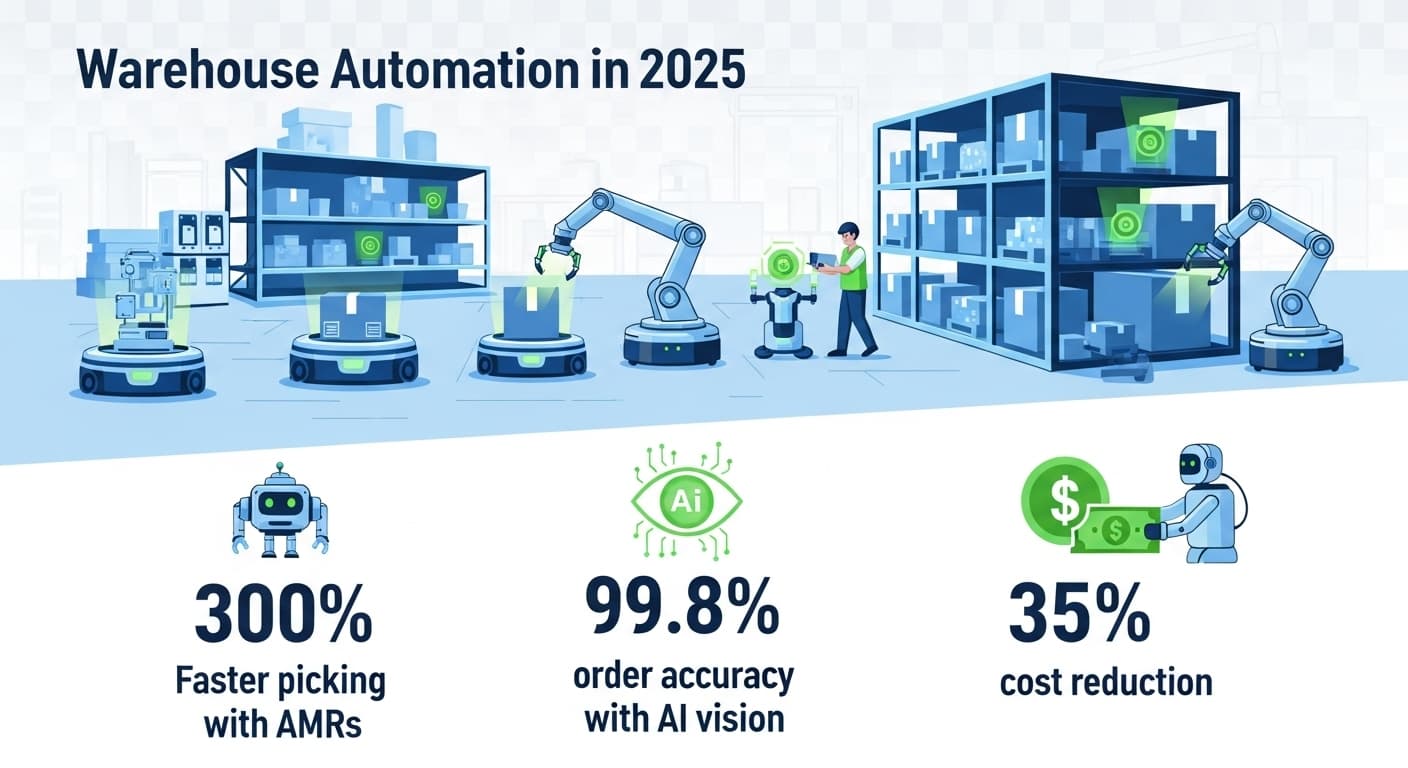
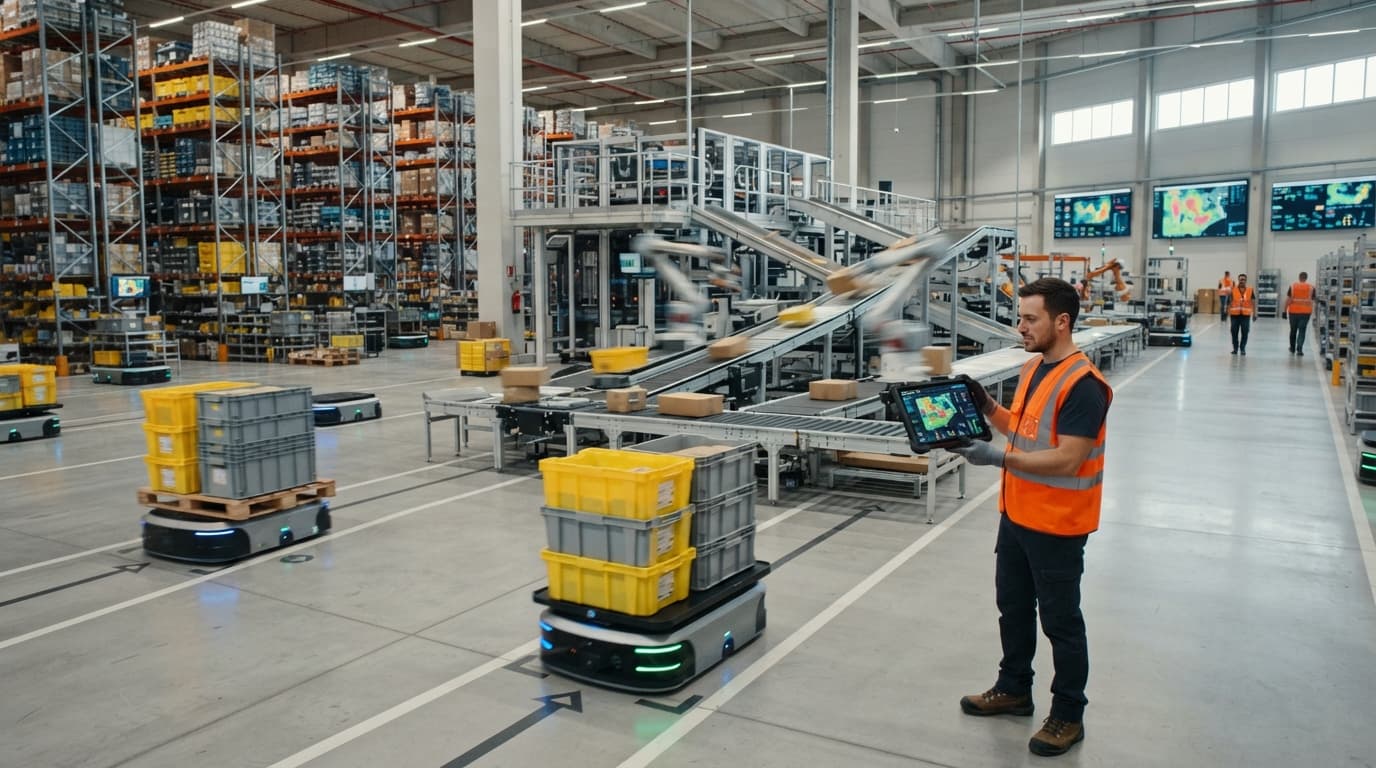
In warehouses, physical AI increasingly powers autonomous mobile robots, automated picking systems, and dynamic slotting optimization. In transportation, related applications include autonomous vehicles, predictive maintenance, and real-time route optimization. In manufacturing, similar capabilities support predictive quality control and more adaptive production scheduling.
Early Commercial Milestones
Recent industry reporting suggests that physical automation in warehouses and transportation is producing some of the sector’s earliest visible commercial milestones. A number of major logistics providers have been integrating AI-driven optimization platforms across their warehouse networks and last-mile delivery operations, with some large logistics arms of major e-commerce companies announcing plans to build sizable networks of robotic warehouses—effectively redesigning logistics operations to use AI and automation to reshape how goods are stored, moved, and delivered.
Workforce Implications
Physical AI is generally framed within the industry as augmenting rather than simply replacing human workers. Some industry research suggests that only a small share of recent layoffs have been directly attributed to AI-driven productivity gains, with most workforce reductions linked instead to broader economic and cost pressures.
That said, the workforce implications appear meaningful over the medium term. Industry surveys suggest that roughly half of logistics service providers anticipate some degree of workforce transformation ahead, with significant reskilling likely required. As some analysts have noted, people continue to define the underlying semantic layer, governance rules, and operating assumptions that make these systems function appropriately—suggesting a continued, if evolving, role for human oversight.
5 · The AI Implementation Gap: Adoption Remains Uneven
The Data on Adoption
Despite a clear industry trajectory toward AI-driven supply chains, adoption remains notably uneven across organizations. Recent industry reporting describes a considerable gap between companies that have embedded AI into core operational workflows and those still largely restricted to isolated point solutions—with a meaningful share of organizations having implemented little to none of it at all.
Some available data suggests this gap is stark: while a large majority of supply chain leaders reportedly expect funding increases with AI as a top investment priority, a much smaller share—often cited as somewhere around one in five—of warehousing and transportation AI initiatives are reported to fully achieve their intended goals.
Common Barriers to Success
Industry surveys of logistics leaders have identified several recurring barriers to more effective AI adoption, including uncertain or difficult-to-quantify ROI, a general lack of internal AI capabilities and talent, ongoing data quality issues (often cited as the leading barrier to scaling AI more broadly), and high integration costs, which a meaningful share of respondents cite as their top point of frustration.
A recurring theme across this analysis is that data quality considerations generally need to precede meaningful AI deployment—alongside a discipline of solving genuine business problems rather than pursuing technology demonstrations, and measuring business outcomes rather than simple adoption metrics.
Understanding the Success Gap
The finding that only a modest share of warehousing and transportation AI initiatives fully achieve their goals points to a broader, systemic challenge. Many AI projects appear to fall short not because the underlying technology fails to function, but because they are deployed without adequate data foundations, sufficiently clear business objectives, or broader organizational readiness.
Some industry analysts have suggested that supply chain leaders may need to redesign their operating models rather than simply deploying AI on top of existing processes, since human-centric processes, fragmented data, and outdated decision models can meaningfully limit the value AI is able to deliver.
6 · Where AI Appears to Deliver Value Today
High-Frequency Operational Decision Loops
Recent industry roundtable discussions suggest that the most measurable near-term ROI tends to come from AI applied to high-frequency operational decision loops rather than broader strategic applications.
Warehouse Slotting Optimization: Slotting optimization models that continuously adapt to changing order patterns have reportedly reduced travel time within warehouses meaningfully in some implementations.
Inventory Positioning: Predictive demand models are increasingly helping companies right-size safety stock levels without meaningfully sacrificing fill rates.
Transportation Planning: AI-driven routing and carrier selection tools appear to be improving load consolidation and reducing empty miles in various deployments.
Supplier Performance Management: AI is enabling more sophisticated supplier risk assessment and ongoing performance monitoring than manual processes typically support.
The Embedded Decision Intelligence Approach
A recurring theme in successful AI implementations is embedding AI directly into existing workflows rather than treating it as a standalone analytics layer. As some industry commentators have framed it, AI tends to deliver value when it enhances decision-making inside an already well-run operation—rather than being expected to compensate for more fundamental operational shortcomings.
A Focus-Over-Breadth Pattern
Organizations reporting the strongest returns from AI investment do not appear to be the ones running the widest array of available platforms. Some case examples describing particularly strong returns over an 18-month period point instead to organizations running a small, carefully selected number of tools—suggesting that focus and deep integration, rather than sheer breadth of deployment, tend to drive the strongest returns.
7 · Strategic Considerations for Supply Chain Leaders
Moving from Isolated Projects to Principled Investment
Some technology analysts have suggested that supply chain leaders may benefit from moving away from siloed, project-by-project AI investments toward a more deliberate, “principled bets” style strategy that balances near-term efficiency gains against longer-term transformation goals.
In practical terms, this often means shifting away from open-ended experimentation and toward clearer guidance for employees on how AI tools should be used within their specific workflows.
Building an AI-Ready Data Foundation
Given that data quality issues remain among the most commonly cited barriers to scaling AI, organizations are increasingly focused on moving from BI-oriented data foundations toward more genuinely AI-ready data—data that is well-connected, properly contextualized, and continuously updated. Investment in data quality, integration, and governance generally needs to precede any meaningful scaling of AI capabilities.
A Bimodal Approach to Roadmapping
Some analysts recommend a bimodal roadmap that balances near-term efficiency wins with a longer-term, more AI-native transformation ambition—working incrementally toward an operation that amplifies human decision-making through self-improving, adaptable technology capable of making decisions, taking action, and creating new value over time.
Rethinking the Operating Model
A recurring recommendation across industry commentary is that supply chain leaders should focus on redesigning the broader operating model rather than simply layering AI onto existing processes. As AI’s role evolves across traditional analytics, generative AI, and agentic capabilities, the latter in particular appears to hold considerable potential to shift supply chains from largely human-supported decisions toward more machine-supported execution over time.
8 · The Path Forward: 2026 and Beyond
A Longer-Term Horizon
Some longer-range industry forecasts suggest that by the early 2030s, a majority of supply chain disruptions could be resolved with limited or no direct human intervention, as AI enables increasingly autonomous supply chain operations. Continued advances in AI and agentic AI specifically are widely expected to remain among the most influential drivers of supply chain performance over the next several years.
A Growing Competitive Consideration
Industry surveys suggest that companies able to scale AI effectively across their operations are likely to gain a meaningful competitive advantage in the years ahead. Broader market reactions, including how capital markets respond to company announcements, increasingly appear to treat visible AI progress as a signal of future competitiveness.
A Widening Gap
The gap between early, more advanced adopters and organizations still in earlier stages of AI adoption appears to be widening rather than narrowing. Organizations that successfully integrate AI into core workflows are generally reporting meaningful advantages in efficiency, responsiveness, and cost management, while those still lagging face increasing pressure to close the gap.
As broader industry analysis has framed it, profitable growth has become something of a defining priority against this backdrop, with the organizations best positioned to lead likely to be those combining operational resilience, intelligent use of logistics data, and disciplined execution to protect margins while outperforming peers in an increasingly volatile environment.
9 · Conclusion: An Implementation Era Underway
A Defining Period
2026 appears to represent something of a defining period for artificial intelligence within supply chain operations. The technology has, by most industry accounts, moved meaningfully from a stage of evaluation toward measurable commercial returns in specific applications. Agentic AI and physical AI in particular are moving from limited pilots toward more scaled deployment, and the eight technology trends outlined by industry forecasters offer a useful reference point for understanding the transformation currently underway.
The Gap and the Opportunity
Even so, the implementation gap between ambition and execution remains real and, by most measures, still widening. A large majority of supply chain leaders report AI as a top investment priority with expected funding increases, yet only a modest share of initiatives are reported to fully achieve their intended goals. Organizations that address this gap—by building genuinely AI-ready data foundations, embedding AI directly into core workflows, and thoughtfully redesigning operating models rather than simply layering technology on top of existing processes—appear likely to gain a meaningful competitive edge.
A Strategic Consideration for Leaders
For supply chain leaders, the broader signal from current industry analysis is fairly consistent: the earlier phase of open-ended AI experimentation increasingly appears to be giving way to a more disciplined implementation phase. Success in this next phase seems to depend less on whether an organization adopts AI at all, and more on how effectively it can be operationalized—moving from dashboards toward decision intelligence, from insight toward execution, and from isolated pilots toward carefully scaled deployment.
This analysis reflects supply chain AI developments as of July 2026 based on available industry technology trend reports, logistics industry roundtable discussions, and related research. Technology adoption patterns and reported return-on-investment metrics continue to evolve. Organizations evaluating AI investments should consult with technology specialists and supply chain professionals for guidance tailored to their specific circumstances.