Executive Summary
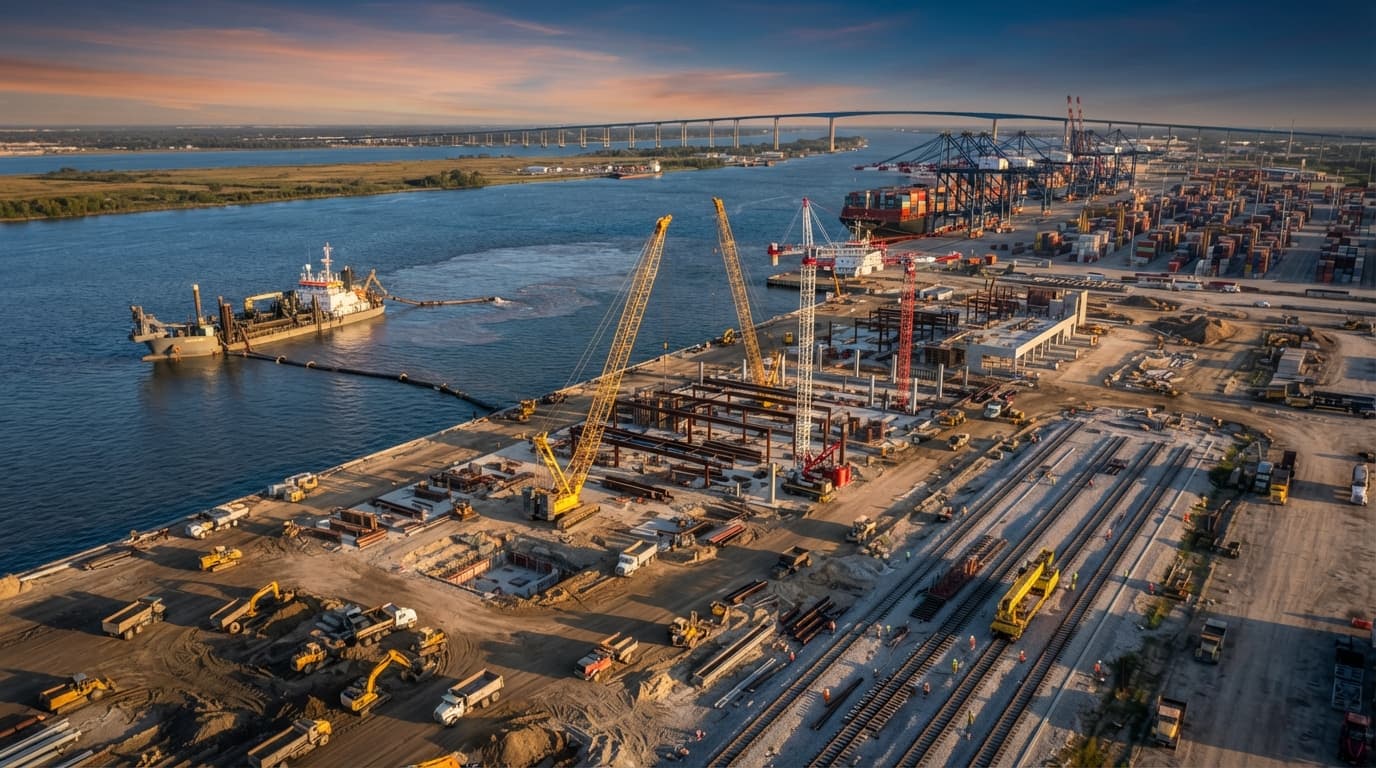
U.S. ports are in the middle of one of the largest capital investment cycles in decades, and the money is flowing disproportionately toward the East and Gulf Coasts. The Port of Savannah is executing a $4.5 billion, ten-year, self-financed program to roughly double capacity from 5.5 million to 9 million TEUs by 2035. The Port of Virginia completed dredging of a 55-foot channel in February 2026, making it the deepest commercial harbor on the U.S. East Coast. The Port of Long Beach is building a $1.5+ billion on-dock rail facility that will cut cargo processing time from four days to one. Charleston has deepened to 52 feet and is building a $422 million new terminal. This is not a story of decline for West Coast gateways so much as one of a genuinely more competitive, more distributed national port system than existed a decade ago—with real implications for where logistics providers should be building relationships and capacity. This analysis maps the major investments underway and what they mean for shippers and logistics providers choosing where to route cargo.
America’s Ports Are Racing to Rebuild: What Billions in New Infrastructure Mean for Shippers
(美国港口基础设施建设热潮:对货主意味着什么)
1 · The Bigger Picture: A More Distributed Port System
The Shift Behind the Investment
For decades, the Port of Los Angeles and the Port of Long Beach dominated U.S. containerized trade almost by default—their combined share of national container volume approached 40% at various points. That share has been eroding steadily as East and Gulf Coast ports close a historic infrastructure gap that once made West Coast routing the only realistic option for many shippers moving cargo from Asia. In the first half of 2026, Los Angeles and Long Beach each saw year-over-year volume declines of roughly 1.5%, even as Houston and other Gulf and East Coast gateways continued to grow.
Why This Matters: this is not primarily a story about West Coast decline—Long Beach itself posted a record August in 2026, as we examined in an earlier analysis. It is a story about a genuinely more competitive and geographically distributed national port system, in which shippers and the logistics providers serving them have meaningfully more viable routing options than they did even five years ago.
2 · Savannah: Self-Financed Growth at Scale
The $4.5 Billion Program
The Port of Savannah is executing what may be the single most ambitious capacity expansion program among U.S. ports: a $4.5 billion, ten-year capital program, entirely self-financed from port revenue, designed to push capacity from the current 5.5 million TEUs to 9 million TEUs by 2035. Savannah handled 5.67 million TEUs in fiscal year 2026, and closed June 2026 with 18% year-over-year monthly growth—outpacing most major U.S. ports that month.
Rail Capacity Is the Centerpiece
The Mason Mega Rail Terminal—the largest port terminal rail yard in North America, spanning 85 acres with 18 working tracks—moved 541,405 containers by rail in fiscal year 2026, the third consecutive year above half a million, giving rail a 17% modal share of Savannah’s total container traffic. That share still trails the Port of Virginia’s roughly 40% rail share, suggesting continued room for Savannah’s rail volumes to grow within existing terminal capacity.
What Else Is in the Pipeline
Savannah’s broader infrastructure program includes a new $29 million truck exit ramp providing a traffic-light-free route from Ocean Terminal directly to the highway toward Atlanta; heightening of the Talmadge Memorial Bridge over the Savannah River to allow larger container ships to call; and a future Savannah Container Terminal on Hutchison Island that will add three new big-ship berths. Combined with the Garden City Terminal berth project completed in 2023, these investments will deliver a total of 12 big-ship berths—a 100% increase in big-ship berth capacity over six years.
3 · Virginia: Depth as a Competitive Weapon
The Deepest Harbor on the East Coast
The Port of Virginia completed dredging of its 55-foot channel in February 2026, making it the deepest commercial harbor on the U.S. East Coast—three feet deeper than Charleston’s 52-foot channel, the next-deepest East Coast competitor. Virginia also benefits from zero air draft restrictions, since no bridges span the channel, allowing the largest container ships to call without waiting for favorable tidal windows that constrain vessel size at other East Coast ports.
Why Depth Matters Commercially
Why This Matters: channel depth is not a marginal technical detail—industry analysis suggests each additional foot of depth enables a port to accommodate vessels at higher loaded capacity, reducing per-TEU costs by roughly $20 to $30 depending on vessel type. For carriers deploying the largest post-Panamax and mega-ships on Asia–East Coast routes, Virginia’s depth advantage translates directly into which ports those vessels can call at full capacity, and which ports can only accept them partially loaded or during limited tidal windows.
Rail Leadership
Virginia’s roughly 40% rail modal share—well above Savannah’s 17%—reflects sustained investment in on-dock and near-dock rail capacity, supporting 2 million TEUs of annual rail capacity. Combined with a voluntary transition to 100% clean electricity completed in January 2024, Virginia has positioned itself as a port offering both physical capacity and increasingly important sustainability credentials for shippers with their own emissions targets.
4 · Long Beach: Turning Four Days Into One
The Pier B Investment
As we examined in an earlier analysis of Long Beach’s record August 2026 volumes, the port is investing more than $1.5 billion in its Pier B On-Dock Rail Support Facility—the centerpiece of its rail capital improvement program. Port CEO Dr. Noel Hacegaba has been direct about the payoff: “Pier B reduces processing time from four days to one.” Construction began in 2024, with completion anticipated in 2032.
Why West Coast Rail Investment Still Matters
Why This Matters: even as East and Gulf Coast ports gain share, Long Beach’s rail investment reflects a clear strategic bet: as sourcing diversifies toward Southeast Asian origins requiring longer ocean transit times than traditional China-direct routings, efficient on-dock rail becomes the mechanism by which West Coast ports can offset that added transit time and remain competitive on total delivery speed. Vietnam has become Long Beach’s second-largest trading partner behind China, underscoring why this rail investment is arriving now rather than in a prior decade.
5 · Charleston and Houston: Deepening and Widening
Charleston’s Depth and New Capacity
The South Carolina Ports Authority completed the Charleston Harbor Deepening project, bringing the harbor to 52 feet—at the time of completion, the deepest harbor on the U.S. East Coast, a distinction subsequently surpassed by Virginia’s 55-foot channel. Charleston is now executing the Leatherman Terminal development, budgeted at approximately $422 million, adding new container berths and on-dock rail infrastructure.
Houston’s Channel Widening
Port Houston has advanced Project 11, widening the Houston Ship Channel’s upstream segments to 46.5 feet and widening the Galveston Bay reach, with port-led segments completed in September 2025. Houston’s continued growth through the first half of 2026 reflects, in part, the benefit of this improved ship canal capacity.
New York and New Jersey: A Different Kind of Investment
The Port Authority of New York and New Jersey approved a record $45 billion capital plan for 2026–2035 in December 2025—though it is worth being precise about scope here: this figure covers the Port Authority’s entire regional infrastructure portfolio, including major airport transformations at JFK, Newark Liberty, and LaGuardia, the Midtown Bus Terminal rebuild, PATH transit service increases, and bridge and tunnel rehabilitation, not exclusively seaport terminal investment. Within that broader plan, the Port Authority’s prior 2017–2025 program delivered specific maritime infrastructure including the completed ExpressRail system (a $600 million investment enabling rapid ship-to-rail cargo transfer across the seaport) and the $1.7 billion Bayonne Bridge raising, which enabled larger, higher-capacity cargo ships to reach the port’s terminals.
6 · What This Means for Logistics Providers
The Routing Calculus Has Genuinely Changed
For much of the past decade, choosing West Coast routing for Asia-origin cargo was less a strategic decision than a default, given the infrastructure gap between coasts. That gap has substantially closed. Logistics providers should treat East and Gulf Coast routing as a genuine strategic option for an increasing share of freight, not merely a contingency for West Coast congestion events.
Depth and Rail Capacity Are the Two Metrics That Matter Most
Across every port profiled here, the two investment priorities are consistent: channel depth, which determines vessel size and per-TEU cost efficiency, and rail modal share, which determines how efficiently cargo moves inland once it clears the terminal. Logistics providers evaluating new port relationships or facility investments should weigh both metrics specifically, rather than relying on headline TEU volume alone.
Self-Financed Growth Signals Durability
Savannah’s decision to self-finance its $4.5 billion expansion from port revenue, rather than relying primarily on federal grants, is worth noting as a signal of confidence in sustained demand. Logistics providers can reasonably treat self-financed capacity expansions as a stronger signal of durable growth than federally-grant-dependent projects, which remain subject to the federal funding cycles and competitive grant processes that constrain smaller ports.
Inland Corridor Opportunities Are Expanding
Ports investing most aggressively in rail—Virginia, Savannah, Long Beach, and Charleston—are increasingly capturing discretionary cargo bound for inland markets, pulling industrial development into corridors anchored by cities such as Atlanta, Kansas City, Memphis, and Columbus. Logistics providers with inland warehousing or drayage capacity in these corridors should evaluate whether current port relationships align with where rail investment is concentrating freight flows.
7 · What Logistics Providers Should Do Now
1. Reassess Routing Defaults
Providers and shippers that have defaulted to West Coast routing for Asia-origin cargo should model total landed cost and transit time against East and Gulf Coast alternatives now that the infrastructure gap has substantially closed, rather than treating West Coast routing as the automatic choice.
2. Build Multi-Port Relationships
Given the genuine capacity growth underway at Savannah, Virginia, Charleston, and Houston, providers should consider building broker, drayage, and warehousing relationships across multiple East and Gulf Coast gateways rather than concentrating exclusively in one region, preserving flexibility as capacity and rates shift between ports.
3. Track Rail Modal Share, Not Just TEU Volume
When evaluating a port’s suitability for inland-bound freight, prioritize rail modal share and on-dock rail capacity over headline container volume figures, since rail share more directly predicts inland delivery speed and reliability.
4. Evaluate Inland Corridor Positioning
Providers with warehousing or drayage capacity in rail-connected inland markets—particularly those served by the ports investing most heavily in rail, such as Atlanta (Savannah), the Midwest (Virginia and Long Beach), and the Mid-South (Savannah’s Appalachian Regional Port)—should assess whether current capacity aligns with where rail-driven freight growth is concentrating.
5. Monitor Vessel Deployment Patterns
As channel depth investments at Virginia and elsewhere enable larger vessel calls, logistics providers should monitor how carriers redeploy their largest vessels across East Coast ports, since depth-driven vessel routing decisions can shift port-level volumes independent of underlying demand trends.
8 · Conclusion: A Genuinely More Competitive Port System
The Investment Case Is Broad-Based
Billions of dollars in channel deepening, rail expansion, and terminal construction are underway simultaneously across Savannah, Virginia, Charleston, Houston, and Long Beach. This is not a single port’s story—it is a structural realignment of U.S. port capacity that has meaningfully closed the historic gap between West Coast and East/Gulf Coast infrastructure.
The Strategic Takeaway
For logistics providers, the practical implication is straightforward: the routing decisions that made sense a decade ago deserve fresh scrutiny today. Ports that were once infrastructure-constrained alternatives to the West Coast are now, in several cases, offering superior depth, comparable or superior rail connectivity, and genuine capacity headroom for growth through the 2030s. Providers that build relationships and capabilities across this more distributed port system—rather than defaulting to legacy routing patterns—will be better positioned to offer clients real flexibility as the next decade of port investment continues to unfold.
If your organization is evaluating port routing strategy or building multi-gateway logistics capabilities, our team is available to help you assess which of these investments align with your specific freight profile and inland markets.
This analysis reflects publicly reported port capital investment data through September 2026, including announcements from the Georgia Ports Authority, the Virginia Port Authority, the South Carolina Ports Authority, Port Houston, the Port of Long Beach, and the Port Authority of New York and New Jersey. Specific investment figures, capacity targets, and completion timelines are subject to change. Logistics providers should consult directly with port authorities and their own trade compliance and logistics advisors for guidance tailored to their specific routing and capacity needs.