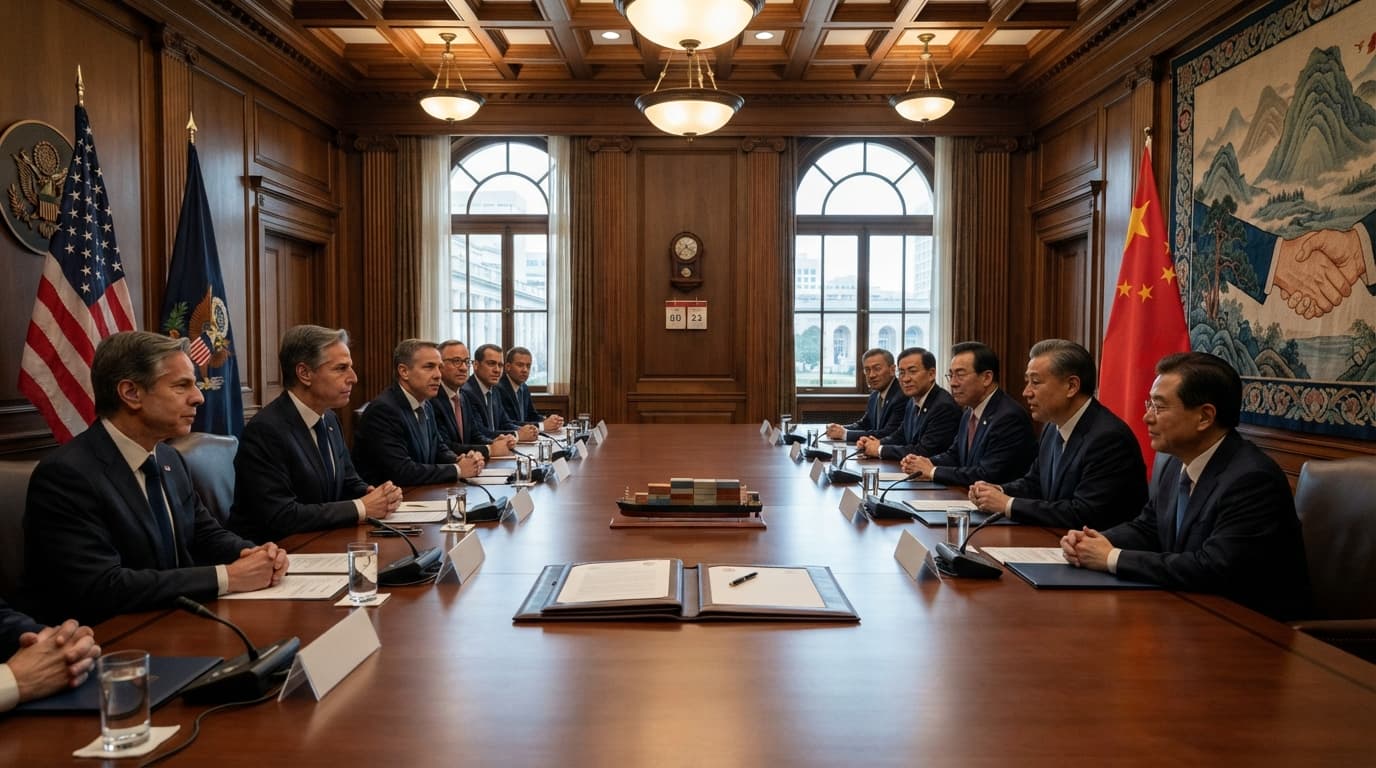
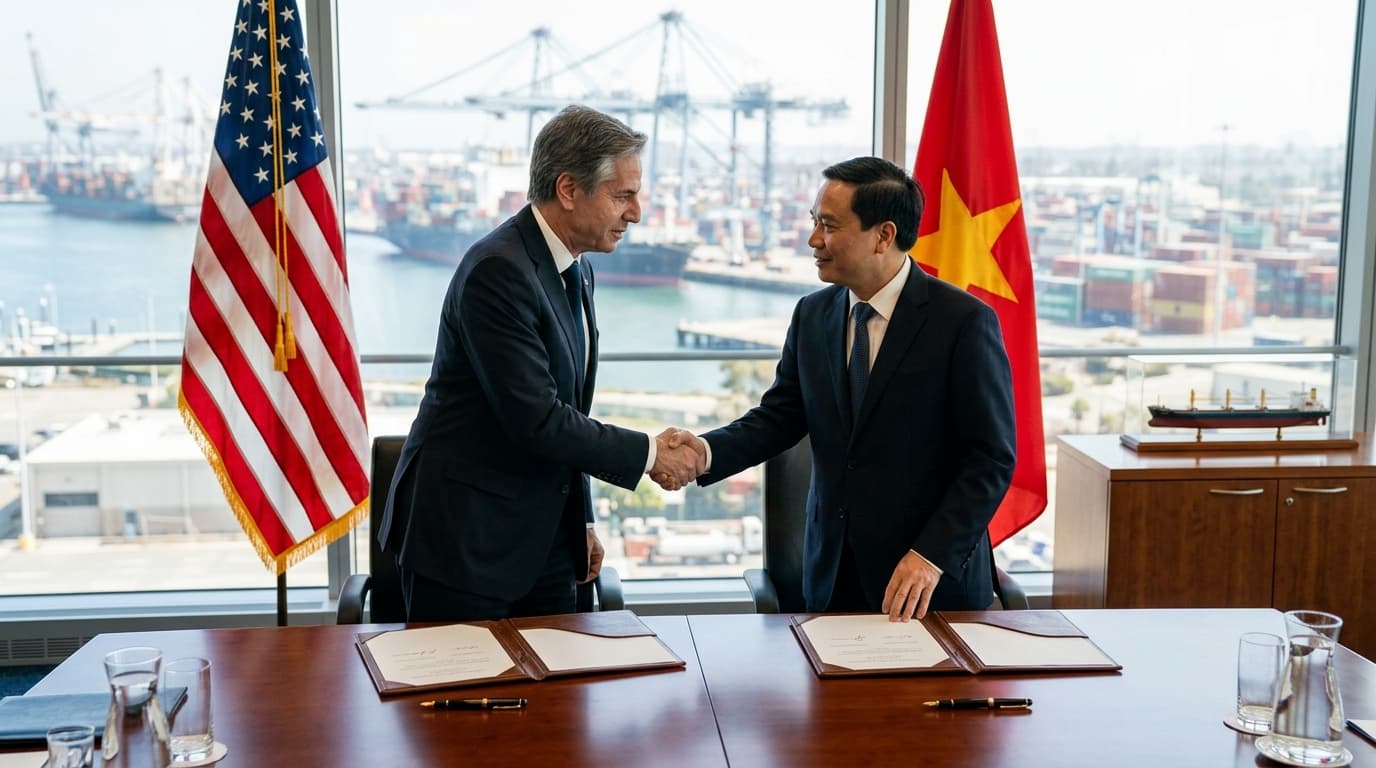
Executive Summary Vietnam and the United States say they are in the final stages of negotiating a reciprocal trade agreement—but no signing date has been announced. On October 1, 2026, Vietnam’s Foreign Ministry spokeswoman Pham Thu Hang said the two sides “have made positive progress” toward an early conclusion of a “fair and balanced reciprocal trade agreement,” without giving a timetable or a tariff level. At a September 21 meeting in New York, Party General Secretary and President To Lam met USTR Jamieson Greer, who said the negotiating teams were “very close to a final outcome.” Critical questions remain unanswered: Will the 12.5% Section 301 forced-labor tariff on Vietnamese goods survive the agreement, or will a forced-labor commitment move Vietnam into the 10% tier? What will the agreement require on transshipment? And how will the deal affect the “China+1” strategy that has driven Vietnam’s export boom? This analysis examines what we know, what we don’t know, and what logistics providers should do now.
Vietnam-U.S. Trade Agreement: What Logistics Providers Must Prepare For
(越美贸易协定:物流企业必须做好的准备)
1 · The Negotiation Status: “Very Close to a Final Outcome”
The September 21 Meeting
On September 21, 2026, on the sidelines of the UN General Assembly in New York, Party General Secretary and President To Lam met with USTR Jamieson Greer. According to the Vietnamese Foreign Ministry, Greer said the two negotiating teams had made significant progress and were “very close to a final outcome,” adding that once the agreement is signed and implemented it would open new opportunities for cooperation. The most recent formal negotiating round had been held in mid-July 2026, and the two countries first signed a framework for a trade agreement in October 2025.
In a Bloomberg TV interview during the same trip, To Lam said a deal was “very close,” pledged to increase Vietnamese purchases of U.S. products such as aircraft to narrow the trade imbalance, and addressed the issue Washington cares about most: “We do not tolerate the transshipment of goods. Trade must be genuine.” He also urged Washington to take a comprehensive approach to outstanding trade issues, including the Section 301 investigations.
The October 1 Confirmation
At Vietnam’s regular Foreign Ministry press briefing on October 1, spokeswoman Pham Thu Hang provided the official confirmation:
“Vietnam and the U.S. have made positive progress in negotiations toward an early conclusion of a fair and balanced reciprocal trade agreement so as to create a stable and long-term framework for bilateral economic, trade, and investment relations.”
She added that Vietnamese authorities will “provide full and specific information” once the two sides reach agreement. Notably, she gave no timetable for concluding the talks and no tariff level—so, while both sides sound optimistic, the public record does not support a specific signing date.
The European Union Dimension
In a related development, international media have reported that the European Union is expected to remove Vietnam from its list of non-cooperative jurisdictions for tax purposes in its October update, eight months after adding it in February. Asked about the reports, the spokeswoman did not confirm them; she said only that Vietnam has maintained close and responsible exchanges with the European Council and EU member states. Importers should treat the EU delisting as a possibility, not a fact.
⚠️ Critical Takeaway: The agreement is not yet signed, and neither government has announced when it will be. Both sides are signaling that talks are in their final stage, which is a reason to prepare—not a reason to assume a signing date.
2 · What We Know About the Agreement
The Framework: “Fair and Balanced Reciprocal Trade”
The agreement is consistently described as “fair and balanced reciprocal trade”—language that suggests concessions on both sides. The text has not been released, so the following reflects public statements and press reporting rather than the draft agreement itself. Vietnam has said it wants:
- A stable, long-term framework for bilateral economic, trade, and investment relations
- A comprehensive resolution of outstanding issues, including the pending Section 301 investigations
The U.S. side has pointed to:
- A more balanced trade relationship (Greer credited Vietnam’s efforts to rebalance trade; Vietnam has pledged purchases such as aircraft)
- Transshipment, which press reporting identifies as a main area of dispute
- Market access for American companies, the other commonly cited sticking point
The Tariff Question: Will 12.5% Survive?
The most critical question for logistics providers and importers is: What tariff rate will ultimately apply to Vietnamese goods?
The current situation:
| Tariff Layer | Rate | Status |
|---|---|---|
| MFN Base Rate | Varies by product | In effect |
| Section 301 Forced Labor Tariff | 12.5% | Effective July 24, 2026 |
| Section 232 (steel/aluminum) | 50% (if applicable) | In effect |
| AD/CVD (product-specific) | Varies | In effect |
Source: USTR, Vietnam Ministry of Industry and Trade
Vietnam was placed in the 12.5% tier under the Section 301 forced-labor action—the higher of the policy’s two rates—alongside China, Brazil, and Russia, among 38 economies paying the flat 12.5%. The 10% tier applies to economies that ban imports of forced-labor goods, that committed to such a ban in an Agreement on Reciprocal Trade, or that operate a partial regime. (We examined Vietnam’s position in more detail in our earlier analysis of the Vietnam sourcing shift.)
Why the Forced-Labor Rules Matter Here: Vietnam issued Decree 292/2026/ND-CP on July 22, 2026, prohibiting imports of goods made wholly or partly with forced labor; it took effect on September 5, 2026. Because the Section 301 tiers turn on exactly this kind of import ban—and on commitments made in reciprocal trade agreements—a forced-labor commitment in the agreement is a plausible route to the 10% tier. That is our inference, however: USTR has not announced any re-tiering, and no tariff level has been disclosed by either government.
⚠️ Critical Takeaway: Do not assume the 12.5% tariff will disappear. The agreement could lower it, leave it in place, or restructure it, and nothing has been announced.
3 · The Stakes for Vietnam: A $137 Billion Eight Months
The Scale of the Relationship
According to Vietnamese customs data, two-way trade with the U.S. reached $137.42 billion in the first eight months of 2026, up 23.4% year-over-year—a pace consistent with roughly $200 billion for the full year. Vietnam has become one of the clearest beneficiaries of the “China+1” strategy: in July 2026, the U.S. goods deficit with Vietnam ($23.3 billion) was larger than its deficit with China ($15.2 billion).
The “China+1” Paradox
Vietnam’s rise as a manufacturing hub has been remarkable—but it has also created vulnerabilities:
The Opportunity:
- Multinationals shifted capacity from China to Vietnam to hedge geopolitical and tariff risk
- Vietnam’s exports to the U.S. nearly tripled between 2017 and 2024
The Risk:
- The U.S. is stepping up scrutiny of Chinese goods transshipped through Vietnam to circumvent tariffs and rules of origin
- Vietnam faces pressure to move up the value chain—away from low-cost assembly toward higher-value production
The Competitive Pressure
Trading partners in the 10% tier face a lower additional duty than Vietnam’s 12.5%—a gap of 2.5 percentage points. USTR has published the full text of ten Agreements on Reciprocal Trade, including with ASEAN neighbors Malaysia, Cambodia, and Indonesia; Vietnam is not yet on that list. For low-margin products such as textiles and garments, where ordinary duties are already heavy, even a small gap can influence sourcing decisions.
⚠️ Critical Takeaway: Vietnam’s competitiveness as a “China+1” destination partly depends on how its final tariff compares with those of regional competitors. Whether the agreement delivers parity is one of the key open questions.
4 · What the Agreement Must Address
Non-Tariff Barriers
Vietnam’s Foreign Ministry has said the agreement should take into account the development conditions of both countries, and U.S. officials have emphasized balance and transshipment. The issues most often cited in public reporting and U.S. policy statements—not confirmed contents of the agreement—include:
| Barrier Type | U.S. Concern |
|---|---|
| Transshipment | Chinese goods routed through Vietnam to evade U.S. tariffs |
| Origin Fraud | False claims of Vietnamese origin |
| Labor Standards | Forced labor in supply chains |
| Intellectual Property | IP protection and enforcement |
| Sanitary/Phytosanitary | Food safety and agricultural standards |
The Traceability Requirement
Whatever the final text says, U.S. importers are already prioritizing:
- Flexible delivery capabilities
- Transparency in the supply chain
- Compliance with sustainable development certifications
- Food safety and hygiene standards (SPS)
The “Substantial Transformation” Test
The core issue for transshipment enforcement is substantial transformation. Goods that undergo only minor processing—repackaging, simple assembly, labeling—in Vietnam do not qualify for Vietnamese origin. They remain Chinese-origin for tariff purposes, subject to China-specific tariffs and AD/CVD orders.
Vietnam has taken steps to address this:
- Decree 292/2026/ND-CP (issued July 22, effective September 5) prohibits imports of goods produced with forced labor
- Public commitments at the top level: To Lam has said Vietnam does “not tolerate the transshipment of goods” and has rejected allegations that Vietnam facilitates the rerouting of Chinese goods
5 · What This Means for Logistics Providers
5.1 The “Wait-and-See” Trap
The most dangerous response to the pending agreement is inaction. Logistics providers that wait for the final text before preparing could be caught flat-footed if the agreement is signed quickly and tariff changes take effect soon after.
Recommended actions:
- Model multiple tariff scenarios: 12.5% (status quo), 10% (the lower Section 301 tier), 5% (partial relief), 0% (full relief)
- Plan for in-transit shipments: Rate changes could apply to goods already on the water, depending on the effective-date rules, which have not been announced
- Build flexibility into contracts: Include tariff adjustment clauses that allow cost pass-through if rates change
5.2 The Transshipment Enforcement Risk
Regardless of the tariff outcome, transshipment enforcement will intensify. The U.S. has made clear that it views Vietnam as a transshipment risk—and that this must be addressed in any agreement.
What logistics providers should do:
- Screen supply chains for transshipment indicators: Chinese-origin raw materials, components, or semi-finished goods that undergo only minor processing in Vietnam
- Verify substantial transformation: Ensure that Vietnamese origin claims meet the legal standard
- Document everything: Maintain records of manufacturing processes, input sourcing, and value-added calculations
5.3 The Capacity Planning Challenge
If the agreement reduces tariffs, Vietnam’s export volumes to the U.S. could increase significantly—placing pressure on:
- Ocean freight capacity: Vietnam-U.S. routes may see higher demand
- Port infrastructure: Vietnamese ports (Cat Lai, Cai Mep, Hai Phong) may face congestion
- Inland logistics: Trucking and warehousing capacity in Vietnam’s manufacturing hubs
Logistics providers should begin capacity planning now—not after the agreement is signed.
5.4 The Compliance Investment Imperative
The agreement will almost certainly include enhanced compliance requirements—on labor, environment, IP, and origin. Logistics providers that invest in compliance infrastructure now will be best positioned to serve clients under the new framework.
| Compliance Area | Investment Needed |
|---|---|
| Origin Verification | Systems to document and verify substantial transformation |
| Labor Standards | Supply chain audits for forced labor |
| Traceability | End-to-end visibility from raw material to finished product |
| Customs Documentation | Enhanced record-keeping for U.S. entry |
6 · What Logistics Providers Must Do Now
1. Monitor the Negotiation Closely
Both governments say talks are close to conclusion, so an announcement could come with little notice. Logistics providers should:
- Monitor Vietnamese Foreign Ministry briefings (held regularly)
- Track USTR announcements and Federal Register notices
- Subscribe to industry alerts from trade associations
2. Model Tariff Scenarios
Develop landed cost models for multiple tariff outcomes:
| Scenario (illustrative) | Additional Section 301 Duty | Change vs. Today (as % of customs value) |
|---|---|---|
| Status Quo | 12.5% | Baseline |
| Lower Tier | 10% | -2.5 points |
| Partial Relief | 5% | -7.5 points |
| Full Relief | 0% | -12.5 points |
These scenarios are for planning only; no rate has been announced.
3. Audit Supply Chains for Transshipment Risk
For clients sourcing from or through Vietnam:
- Map the full supply chain: Where do raw materials and components originate?
- Assess transformation: What processes occur in Vietnam?
- Document origin: Can you prove substantial transformation?
4. Prepare for Capacity Shifts
If tariffs are reduced, Vietnam-U.S. volumes could surge. Logistics providers should:
- Secure ocean freight capacity on Vietnam-U.S. routes
- Evaluate warehousing options in Vietnam and the U.S.
- Develop contingency plans for port congestion
5. Communicate with Clients
Proactive communication is essential:
- Advise clients on the negotiation status —what’s known and what’s not
- Help clients model cost impacts under different scenarios
- Prepare clients for compliance requirements that may accompany the agreement
7 · Conclusion: A Defining Moment for Vietnam-U.S. Trade
The Vietnam-U.S. reciprocal trade agreement represents a defining moment for one of the world’s fastest-growing trade relationships. If concluded successfully, it could:
- Stabilize tariff treatment for Vietnamese exports
- Resolve transshipment concerns that have created friction
- Create a stable framework for bilateral trade and investment
But the agreement is not yet signed—and critical questions remain unanswered.
Key Takeaways
| Factor | Detail |
|---|---|
| Negotiation Status | “Very close to a final outcome” (USTR Greer, Sept. 21); no signing date announced |
| Current Vietnam Tariff | 12.5% Section 301 forced labor tariff |
| Two-Way Trade | $137.4 billion in Jan–Aug 2026 (+23.4% YoY) |
| Key U.S. Concerns | Transshipment, origin fraud, labor standards |
| EU Tax List | Removal in October update reported by media; not confirmed by Hanoi |
| Tariff Outcome | Unknown—could be reduced, maintained, or restructured |
| Timeline | Not announced—both sides say talks are close to conclusion |
The Bottom Line
For logistics providers, the message is clear: prepare for the agreement now, before it is signed. The companies that model multiple scenarios, audit supply chains for transshipment risk, and invest in compliance infrastructure will be best positioned to serve clients—and capture market share—when the new framework takes effect.
The message is clear: Both governments say a deal is close, but the timing and the tariff level are still unknown. Prepare for several outcomes—not for a single assumed one.
This analysis reflects Vietnam-U.S. trade negotiations as of October 7, 2026, including statements from Vietnam’s Foreign Ministry (October 1, 2026), the To Lam-USTR Greer meeting (September 21, 2026), and related developments. No agreement text has been published. Specific tariff rates, agreement terms, and implementation timelines are subject to final negotiations and official announcements. Logistics providers should monitor Vietnamese and U.S. government announcements and consult with trade counsel for guidance tailored to their specific operations and client needs.