
Executive Summary
On August 13, 2026, the White House released a report titled “The Great Transshipment Scam,” alleging that a network spanning more than 40 countries helps China-origin goods evade U.S. tariffs. Citing five separate estimates, it puts annual transshipment exposure at $40 billion to $303 billion—roughly $19–$34 billion in lost tariff revenue under its central case—alongside claims of 450,000 lost U.S. jobs and up to $150 billion in annual GDP loss. The report creates no new legal requirements, but previews an AI-enabled “Detective Border” system tied to Executive Order 14411’s tightening of importer of record rules. For importers and brokers, it’s another signal that documentation and sourcing scrutiny are only intensifying. This analysis covers the report’s claims and what importers should do to prepare.
“The Great Transshipment Scam”: What the White House’s New Report Means for Importers
(白宫"转运骗局"报告:对进口商意味着什么)
1 · The Report: What It Is and Why It Was Released
Origin and Scope
“The Great Transshipment Scam” was published by the White House Office of Trade and Manufacturing Policy on Thursday, August 13, 2026. The 25-page report offers yet another signal that federal authorities are strengthening customs enforcement efforts, and that importers, customs brokers, and others should consider more proactive measures to address the challenges it raises.
Why This Matters: the report itself does not create new legal obligations or impose new tariffs. It is best understood as a policy and evidentiary document—one designed to justify and preview further enforcement action, including the specific data-driven targeting system described below, rather than a rule the trade community must comply with directly. That said, reports of this kind have historically served as reliable previews of where U.S. customs enforcement priorities are headed next.
The Core Allegation
The report’s central argument is that substantial volumes of Chinese-origin goods are entering the United States through third countries, resulting in the loss of “tens of billions of dollars” a year in import duty and tariff revenue, as well as larger trade deficits, fewer domestic jobs, and lower economic growth. It asserts the existence of a “global network of production hubs, logistics platforms, free-trade zones, bonded warehouses, processing corridors, and re-export centers” that facilitates illegal transshipment “through both production-side and logistics-side channels.”
Production-side channels may include light assembly, finishing, testing, packaging, labeling, inspection, or component integration performed before export to the U.S. Logistics-side channels may include routing, consolidation, warehousing, re-invoicing, relabeling, or the creation of new export documentation designed to obscure a shipment’s true origin.
2 · The Numbers: Five Estimates, One Wide Range
A Genuinely Wide Range of Estimates
The report draws on five separate government and private-sector analyses to place potential annual transshipment exposure between roughly $40 billion and $303 billion—a range so wide that the report itself cautions the estimates are not additive and rely on different methodologies. The individual estimates cited include:
| Source | Estimate |
|---|---|
| Goldman Sachs | Narrowest estimate, isolating the rerouting channel specifically |
| White House Council of Economic Advisers | $34.2 billion–$89.6 billion (rounded midpoint ~$60 billion) |
| Exiger | Central estimate of approximately $75 billion |
| Department of Commerce | Broader $109 billion trade-transfer benchmark; separately, ~$67 billion in 2025 illegal transshipment through Mexico, India, and Vietnam specifically |
| Altana | $303 billion (characterized as an upper-bound exposure measure, not a direct estimate of illicit trade) |
Translating Exposure into Lost Revenue
Using illustrative tariff differentials of 25%, 35%, and 45%, the report estimates a range of foregone tariff revenue depending on which underlying exposure figure is used:
- Narrow $40 billion case: roughly $10 billion–$18 billion in lost revenue
- Central $75 billion case: roughly $19 billion–$34 billion in lost revenue
- Broad $303 billion case: roughly $76 billion–$136 billion in lost revenue
The Commerce Department’s separate $67 billion transshipment estimate for Mexico, India, and Vietnam alone was tied to an estimated $28 billion in lost tariff revenue.
Broader Economic Claims
Beyond tariff revenue, the report attributes 450,000 displaced U.S. jobs and $113 billion to $150 billion in annual GDP loss (under its central case) to the practices it describes—figures that go considerably beyond the customs-specific revenue argument and into broader economic and manufacturing-policy territory.
3 · The Forty-Plus Countries: A Three-Tier Network
The report identifies more than 40 countries as participants in what it terms a “global Shadow Transshipment Network,” grouped into three tiers based on their perceived integration into China-linked production and supply networks, with the report identifying principal operating roles for each:
Tier 1: Diversified Scale Leaders
Major trading partners with diversified industrial bases, where the report suggests “illegal transshipment risk may be embedded within broad legitimate trade flows”: Canada, Mexico, the European Union, India, Israel, Japan, South Korea, and Taiwan.
Tier 2: Scale Leaders with Significant China Integration
Countries closely integrated into China-linked production and supply networks: Brazil, Indonesia, Malaysia, Thailand, Türkiye, and Vietnam.
Tier 3: Small, Opportunistic Targets
Smaller jurisdictions the report describes as offering specific “weak-link advantages”—low labor costs, limited customs enforcement capacity, or preferential access to the U.S. market: Argentina, Azerbaijan, Bangladesh, Cambodia, Chile, Colombia, Costa Rica, Dominican Republic, Georgia, Jordan, Kazakhstan, Kenya, Laos, Morocco, Myanmar, Oman, Panama, Peru, the Philippines, Singapore, Sri Lanka, Switzerland, the United Arab Emirates, and Uzbekistan.
Why This Matters: the breadth of this list is itself a signal. Companies sourcing from Tier 1 countries—major, diversified economies most importers would never have associated with transshipment risk—should not assume their supply chains are automatically outside the scope of heightened scrutiny simply because the sourcing country is a longstanding, mainstream trading partner.
4 · The Country-of-Origin Critique
The report also takes direct aim at the legal standards used to determine country of origin, complaining that “current standards for determining country of origin are complex and cumbersome” and “based on customs case law, rather than a precise statute, which can lead to inconsistent application and provide an easy mechanism for tariff evasion.” Imports conforming to these standards may meet the letter of the law, the report states, while nonetheless failing “to meet the spirit of the law.”
The report urges congressional action to amend and codify statutory standards for determining country of origin—a longer-term legislative goal that, if pursued, could eventually replace the current substantial-transformation case law framework with more prescriptive statutory rules.
5 · What the Government Is Already Doing—and the “Detective Border” System
Current Enforcement Tools
The report notes that effective enforcement “requires distinguishing legitimate manufacturing and substantial transformation from pass-through trade and origin shifting,” and points to steps already underway: new reciprocal trade agreements include provisions designed to prevent agreement benefits from accruing substantially to third countries, and CBP has built targeting systems that leverage “the enormous amounts of trade and travel data available,” systems that are already beginning to incorporate artificial intelligence.
The report also explicitly ties this effort to Executive Order 14411, describing it as directing CBP to tighten importer of record requirements, increase bonding and domestic asset requirements, require additional ownership and business affiliation disclosures, impose good standing requirements, strengthen penalties, and improve trade transparency—the same executive order behind the Form 5106 accuracy review, CTPAT-linked broker requirements for foreign importers, and the pending supply chain visibility ANPRM we have examined in earlier analyses.
The “Detective Border” System
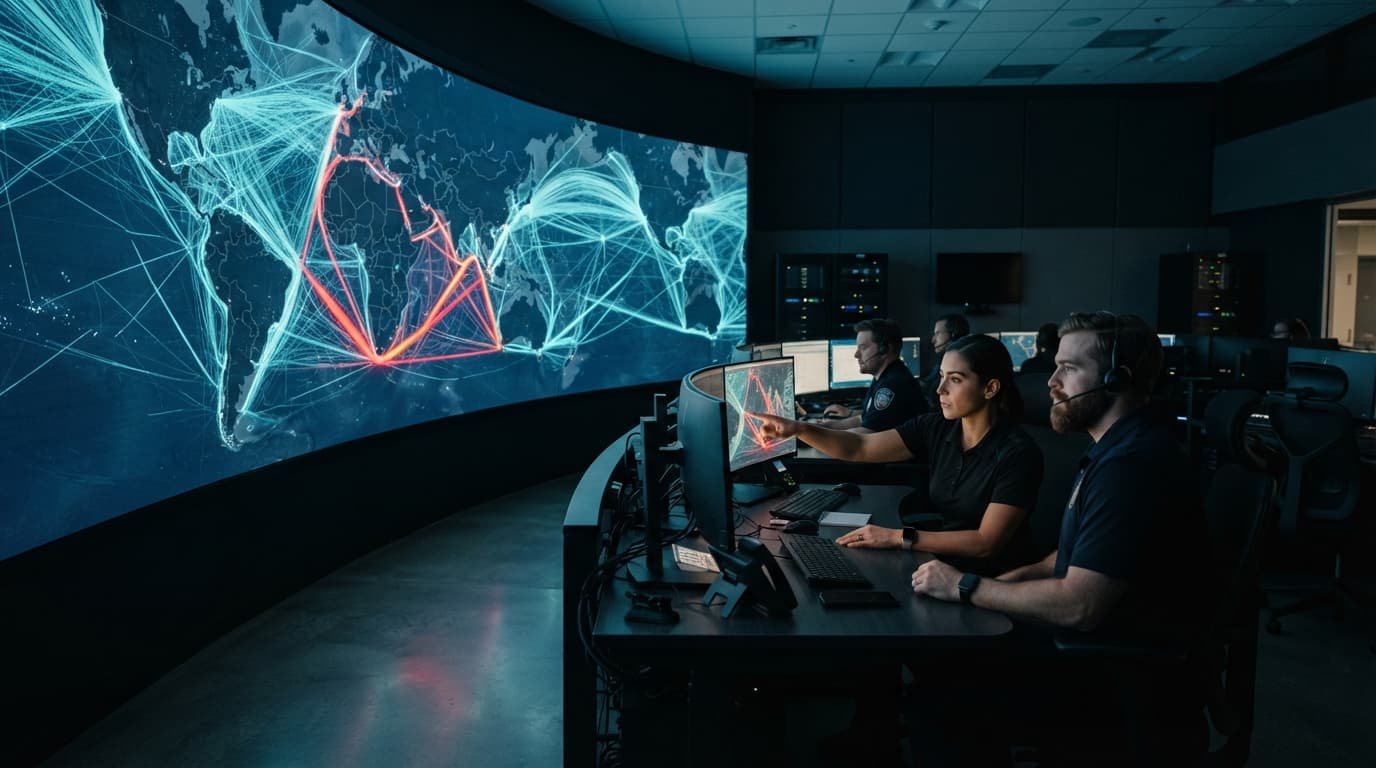
Beyond current tools, the report previews the development of an AI-enabled system the administration has nicknamed “Detective Border,” described as a system that “never sleeps, never tires, and never forgets.” This emerging system would be tasked with “ingesting and analyzing global trade data with lightning speed, identifying anomalous routing patterns, validating production capacity, and directing enforcement toward the highest-probability offenders.” The report frames Executive Order 14411 as giving CBP the “enforcement leverage” to translate Detective Border’s output into “immediate interdiction, penalty tariffs, sanctions, and potential loss of market access.” The report frames this directly: it states that the “age of untraceable illegal transshipment is over.”
Why This Matters: the report does not specify concrete new actions against China or the more than 40 named economies, and no new tariffs were announced alongside its release. But the described system—continuous, AI-driven, and explicitly designed to feed directly into CBP’s existing and expanding enforcement authorities—suggests that detection capability, not just legal authority, is the piece the administration is now actively building out.
6 · International Reaction
The report has already drawn pushback from several of the named economies. A Chinese embassy spokesperson in Washington said China “firmly opposes” what it characterized as the over-stretching of national security justifications to suppress Chinese enterprises, and warned that Beijing would take steps necessary to safeguard its own interests. The European Union and Singapore have also pushed back on their inclusion in the report’s network. Importers and logistics providers should expect this report to become a point of ongoing diplomatic friction rather than a settled, uncontroversial premise—even as CBP’s underlying enforcement infrastructure continues to build out regardless of the diplomatic response.
7 · Takeaways for Importers
In the Shorter Term
Importers should expect greater scrutiny of, and requests for, bills of materials, production records, manufacturing process documentation, labor and capacity information, supplier relationships, and country-of-origin substantiation—especially when sourcing from any of the jurisdictions named above, including the Tier 1 economies many importers would not have previously flagged as high-risk. Gathering, confirming, and maintaining this documentation now will help importers withstand this scrutiny and minimize the shipment delays and penalties that could otherwise result.
In the Longer Term
Importers should consider that sourcing models built around genuine local value addition, significant processing, local component sourcing, and factory investment will likely prove more defensible going forward than those built around minimal assembly, relabeling, packaging changes, or other limited processing steps. As importers consider such changes, they should bear in mind the need to validate production capacity, factory capabilities, input sources, ownership structures, and supply-chain traceability—not merely assert them on paper.
A Note on First Sale Valuation
Current U.S. law expressly permits first sale valuation when the legal requirements are met, and the report does not assert that first sale is illegal. However, the report clearly presents first sale as contrary to the administration’s objective of maximizing tariff revenue, and suggests that existing customs rules may not adequately support that objective.
This makes first sale transactions more likely to attract audit, documentation, and policy scrutiny going forward. Companies using first sale valuation should, at minimum, expect more CF-28 requests for information from CBP, more audits, and more validation of transaction structures and related-party arrangements. They should also remain alert to potential regulatory or statutory efforts to tighten first sale requirements—though none are specifically proposed in this report, and previous legislative attempts in this direction have been unsuccessful.
8 · How This Fits the Broader Enforcement Picture
This report does not stand alone. It arrives alongside a documented pattern of escalating customs enforcement we have tracked across recent months: CBP’s Form 5106 accuracy review and IOR number voiding beginning September 18; the CTPAT-validated broker requirement for foreign importers of record; the pending ANPRM on heightened import disclosures for supply chain visibility; and the broader institutional buildout at DOJ, including the National Fraud Enforcement Division’s Global Trade and Commerce Enforcement Section and its joint Resource Guide to Trade Fraud Enforcement with DHS—which itself explicitly names transshipment schemes as a priority trade fraud typology.
Read together, “The Great Transshipment Scam” functions less as a standalone policy paper than as the analytical and rhetorical foundation for enforcement actions the administration has already begun taking, and likely intends to continue taking, under Executive Order 14411’s broader framework.
9 · Conclusion: A Preview, Not Yet a Rule
What the Report Does and Doesn’t Do
“The Great Transshipment Scam” does not itself create new legal requirements, and it does not announce specific new enforcement actions against any of the more than 40 named countries. What it does is lay out, in considerable detail, the administration’s justification for the enforcement buildout already underway—and preview a data-driven detection system explicitly designed to make future enforcement faster, broader, and more automated.
The Strategic Takeaway
For importers, customs brokers, and logistics providers, the report reinforces a message this publication has repeated across several recent analyses: proactive documentation, genuine supply chain transparency, and defensible sourcing structures are no longer optional best practices—they are the baseline expectation of an enforcement environment that is actively building the tools to verify compliance at scale. Companies sourcing from any of the jurisdictions named in this report, including mainstream trading partners in Tier 1, should treat the coming months as a window to strengthen documentation before “Detective Border” and its companion enforcement authorities are fully operational.
If your organization would benefit from a review of your country-of-origin documentation, first sale valuation practices, or broader transshipment risk exposure in light of this report, our trade compliance team is available to help you prepare.
This analysis reflects “The Great Transshipment Scam,” published by the White House Office of Trade and Manufacturing Policy on August 13, 2026, and related public reporting and reactions through late August 2026. The report does not itself impose new legal requirements. Importers should consult with customs brokers and trade compliance professionals for guidance tailored to their specific sourcing and supply chain circumstances.